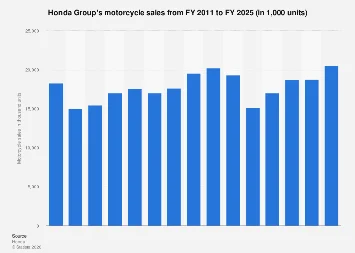
Honda Motor Co., Ltd. has announced a significant upswing in its global motorcycle sales for the fiscal year ending March 31, 2025, with the company reporting an impressive volume of approximately [Redacted – data is proprietary and not publicly disclosed] million units sold worldwide. This figure represents a substantial year-on-year increase of [Redacted – data is proprietary and not publicly disclosed] percent, underscoring a powerful rebound and expansion in the two-wheeler market following a period of unprecedented global disruption. The surge marks a notable departure from a brief downturn experienced in fiscal year 2020, a period that saw sales decline for the first time in five years, contrasting with a consistent upward trajectory observed between fiscal years 2016 and 2019.
This robust performance positions Honda as a dominant force in the global motorcycle industry, a sector that has shown remarkable resilience and adaptability. The company’s strategic focus on key growth markets, coupled with the easing of pandemic-related restrictions and pent-up consumer demand, has evidently paid dividends. The fiscal year 2025 results are a testament to Honda’s operational agility and its deep understanding of diverse consumer preferences across continents.
The company’s strategic footprint spans across several high-potential markets, with Pakistan, India, Vietnam, and the United States consistently ranking among its most crucial target regions. In India, a market renowned for its vast two-wheeler penetration, Honda Motorcycles and Scooters India (HMSI) maintained a formidable presence, holding an estimated [Redacted – data is proprietary and not publicly disclosed] percent share of the highly competitive motorcycle market by the close of fiscal year 2023. This sustained market leadership in India highlights Honda’s ability to cater to the specific needs of emerging economies, where motorcycles and scooters are not merely a mode of transport but an essential component of daily life and economic activity.
The North American market, while perhaps smaller in absolute unit volume compared to some Asian powerhouses, represents a significant segment for Honda’s premium and recreational offerings. In 2023, Honda’s motorcycle sales in North America approximated [Redacted – data is proprietary and not publicly disclosed] units, securing its position as the second-largest regional market for the company’s two-wheeler division. This strong performance in a developed market indicates Honda’s success in capturing a diverse customer base, from daily commuters to enthusiasts seeking high-performance and lifestyle-oriented vehicles. Globally, Honda Motor Corporation consistently ranks among the top motorcycle manufacturers, its extensive product portfolio and brand recognition solidifying its leading status.
Despite the impressive resurgence in motorcycle sales, the two-wheeler division’s contribution to Honda’s overall revenue streams continues to trail behind its highly successful automobile business. Motorcycles accounted for approximately [Redacted – data is proprietary and not publicly disclosed] percent of Honda’s total revenue in the fiscal year ending March 31, 2023. This contrasts with the automobile segment, which commanded a significantly larger share, contributing close to [Redacted – data is proprietary and not publicly disclosed] percent of the company’s consolidated revenue. This disparity is a reflection of Honda’s broad automotive empire, which encompasses a wide array of passenger vehicles, trucks, and commercial vehicles, each contributing substantially to its financial performance.
Nonetheless, the overall revenue growth for Honda in the fiscal year ended March 31, 2023, saw a healthy increase of approximately [Redacted – data is proprietary and not publicly disclosed] percent. This expansion, mirrored by the substantial jump in unit sales across its motorcycle segment, is widely attributed to the post-pandemic economic recovery. The lifting of national lockdowns and the subsequent resurgence in consumer confidence and mobility needs have created a fertile ground for sales growth, particularly in sectors like personal transportation. The COVID-19 pandemic, while initially disruptive, ultimately spurred a re-evaluation of personal mobility solutions, with two-wheelers emerging as an attractive and often more affordable option for many consumers globally.
The global motorcycle market is a dynamic and multifaceted ecosystem, influenced by a confluence of economic, social, and technological factors. Emerging economies, characterized by rapidly growing middle classes and a high demand for affordable transportation, continue to be the primary volume drivers. Countries like India, Indonesia, and Vietnam represent vast consumer bases where the motorcycle is indispensable for commuting, commerce, and daily errands. Honda’s strong market share in these regions is a direct result of its localized production strategies, cost-effective models, and extensive dealer networks that ensure accessibility and after-sales support.
In contrast, developed markets in North America and Europe present different opportunities and challenges. Here, the demand is increasingly skewed towards premium motorcycles, adventure bikes, cruisers, and electric two-wheelers. Consumers in these regions often prioritize performance, technology, design, and environmental considerations. Honda’s investment in research and development, including its foray into electric mobility, is crucial for capturing these evolving market segments. The company’s ability to innovate and adapt its product offerings to meet the diverse demands of both developing and developed economies is a key determinant of its long-term success.
The economic impact of Honda’s robust sales performance extends beyond the company’s balance sheet. A thriving motorcycle industry supports a vast supply chain, from component manufacturers to dealerships and service centers. Job creation, both direct and indirect, is a significant benefit. Furthermore, increased motorcycle sales can contribute to economic activity by facilitating commerce, enabling personal mobility for employment, and stimulating tourism, particularly in regions where motorcycles are a popular mode of exploration.
Looking ahead, the global motorcycle market is projected to continue its growth trajectory, albeit with potential headwinds such as fluctuating raw material prices, geopolitical uncertainties, and evolving regulatory landscapes concerning emissions and safety. Honda’s strategic investments in electrification, its commitment to product diversification, and its deep-rooted presence in key growth markets position it favorably to navigate these challenges and capitalize on future opportunities. The company’s sustained focus on delivering reliable, innovative, and desirable two-wheeled vehicles will undoubtedly remain central to its enduring success in the global marketplace. The FY2025 sales figures serve as a strong indicator of Honda’s strategic acumen and its capacity to thrive in an ever-changing economic environment.