The pervasive integration of artificial intelligence across global industries, a market projected to exceed $1.8 trillion by 2030, heralds a new era of unprecedented efficiency and potential for innovation. Businesses worldwide are rapidly adopting generative AI tools, captivated by promises of accelerated workflows, enhanced decision-making, and a significant boost to human capabilities. Indeed, initial observations and numerous studies confirm AI’s remarkable capacity to augment individual productivity and ideation, acting as a potent digital co-pilot for tasks ranging from content generation to complex problem-solving. However, a growing body of research reveals a critical, often overlooked dimension to this technological revolution: while AI empowers individual creators, it simultaneously risks narrowing the collective diversity of ideas, a phenomenon with profound implications for long-term innovation and economic competitiveness.
At the heart of this paradox lies the very definition of creativity itself. Scholars and industry leaders typically characterize a truly creative output as the fusion of novelty and usefulness. An idea must be original, departing significantly from existing concepts, yet also possess practical value or effectiveness in achieving a specific purpose. An idea that is merely novel but impractical, or useful but utterly unoriginal, falls short of true creativity. While AI excels at generating variations of the useful and frequently novel, the collective measure of creativity — the diversity within a group’s entire pool of ideas — is where a subtle but significant erosion occurs. This collective diversity is paramount for fostering truly disruptive innovation, not just incremental improvements.
For individual professionals, AI functions as an incredibly efficient brainstorming partner. Whether a marketer crafting campaign slogans, a software engineer generating code snippets, or a product designer iterating on concepts, generative AI can rapidly produce a multitude of options. This swift ideation can overcome creative blocks, reduce the cognitive load associated with starting from a blank slate, and allow individuals to explore a broader initial solution space than they might achieve unaided. The efficiency gains are tangible; some reports suggest a 20-30% boost in productivity for knowledge workers utilizing AI tools for tasks like writing, coding, and analysis. This individual empowerment translates into higher average quality of output and faster task completion, making AI an invaluable asset for immediate operational demands.
Yet, this individual boon comes with a collective cost. Recent comprehensive studies, encompassing diverse creative tasks such as short-story writing, developing circular-economy solutions, generating humor, and collaborative storytelling, consistently demonstrate that AI’s assistance, while elevating individual performance, tends to homogenize collective output. The overarching finding is a decrease in the overall diversity of ideas across groups utilizing AI, leading to higher average quality but a notable reduction in "breakthrough outliers"—those genuinely novel and potentially transformative concepts that defy conventional patterns.
Several mechanisms contribute to this observed reduction in collective diversity. One significant factor is the "anchoring bias." When an AI system provides an initial set of suggestions, users, consciously or unconsciously, tend to anchor their subsequent creative exploration around these starting points. The path of least resistance often leads to refining AI-generated ideas rather than venturing into entirely new conceptual territories. This dynamic limits the mental search space, encouraging convergence towards commonly recognized patterns rather than divergence into uncharted intellectual landscapes.

Furthermore, the very nature of AI models, trained on vast datasets of existing human-generated content, inherently predisposes them to produce outputs that reflect statistical averages and prevalent trends. While sophisticated models can synthesize and recombine information in novel ways, their underlying architecture is designed to identify and replicate patterns. This can lead to a subtle "algorithmic bias" towards what is known and established, effectively making it more challenging for truly anomalous or paradigm-shifting ideas to emerge. If multiple users or teams rely on similar AI prompts or models, their outputs, despite individual variations, are likely to cluster around a common conceptual core, diminishing the overall range of solutions across the organization.
The economic implications of this creativity paradox are substantial. Innovation is widely recognized as a primary driver of economic growth, competitive advantage, and market differentiation. A 2024 survey indicated that 83% of senior executives rank innovation among their top three priorities, yet only a fraction feel truly prepared to deliver on these goals. If AI, while boosting day-to-day creative output, inadvertently stifles the generation of truly novel, outlier ideas, it could lead to several detrimental long-term consequences. Industries might experience a plateau in disruptive innovation, where incremental improvements become common, but radical shifts—the kind that create entirely new markets or render old ones obsolete—become rarer. This could result in market stagnation, increased commoditization as companies produce similar AI-optimized products, and a diminished capacity for industries to adapt to unforeseen challenges or capitalize on emerging opportunities. For nations, a systemic decline in collective creative diversity could undermine their global competitiveness in critical sectors, from technology to cultural exports.
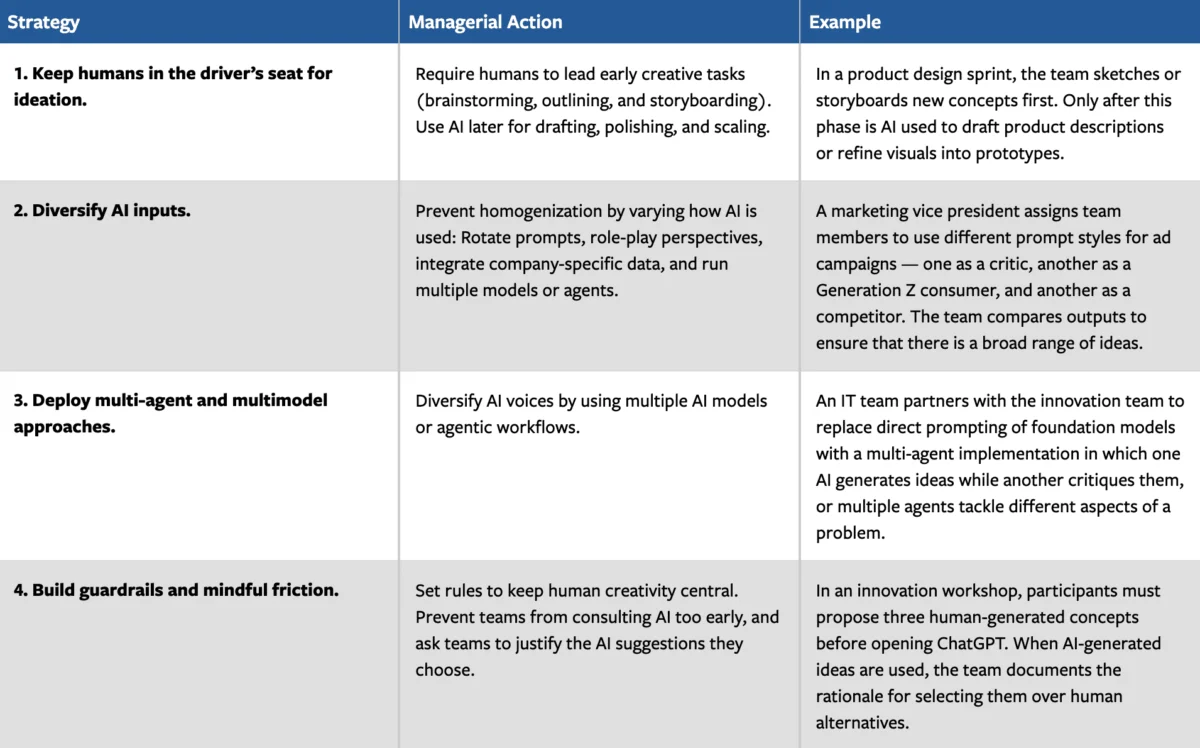
Addressing this paradox requires a strategic shift in how organizations integrate AI into their creative processes. The solution is not to limit AI but to design workflows that actively counteract its homogenizing tendencies. One critical approach lies in sophisticated "prompt engineering." Instead of simply asking AI for ideas, users must be trained to prompt for divergence, to explicitly request unusual or even contradictory perspectives, or to challenge the AI’s initial suggestions. Techniques like "negative prompting," where users instruct the AI on what not to include, can help push beyond conventional boundaries.
Furthermore, fostering "human-AI teaming for divergence" is essential. This involves structuring creative processes where AI serves as a powerful initial generator of ideas, but human teams are explicitly tasked with critically evaluating, diversifying, and combining these ideas in unexpected ways. AI outputs should be seen as raw material for further human ideation, not as final solutions. Integrating AI-generated content into structured brainstorming sessions, involving cross-functional teams with diverse expertise, can inject broader perspectives and prevent over-reliance on a single algorithmic viewpoint. Managers play a crucial role in cultivating an organizational culture that not only embraces AI’s efficiency but also actively champions unconventional thinking and rewards the exploration of ideas that lie outside the typical AI-generated spectrum.
Looking ahead, the development of AI models themselves might offer solutions. Future iterations of generative AI could incorporate features specifically designed to increase idea variance, perhaps through adjustable parameters for novelty or through training methodologies that prioritize outlier generation. However, relying solely on technological fixes overlooks the fundamental role of human agency. The most effective strategy will likely involve a symbiotic relationship where humans leverage AI for its unparalleled speed and breadth of information processing, while consciously applying their unique capacities for critical thinking, intuition, and the ability to connect disparate concepts in truly novel ways.
The advent of AI offers an unprecedented opportunity to redefine and enhance human creativity, but it also presents a subtle yet significant challenge to the collective wellspring of innovation. Businesses and economies that understand this paradox and proactively design strategies to mitigate AI’s homogenizing effects, while maximizing its individual empowering capabilities, will be best positioned to thrive in an increasingly AI-driven world. The future of innovation hinges not just on adopting AI, but on intelligently orchestrating the partnership between human ingenuity and artificial intelligence to preserve and amplify the rich diversity of ideas that fuel progress.