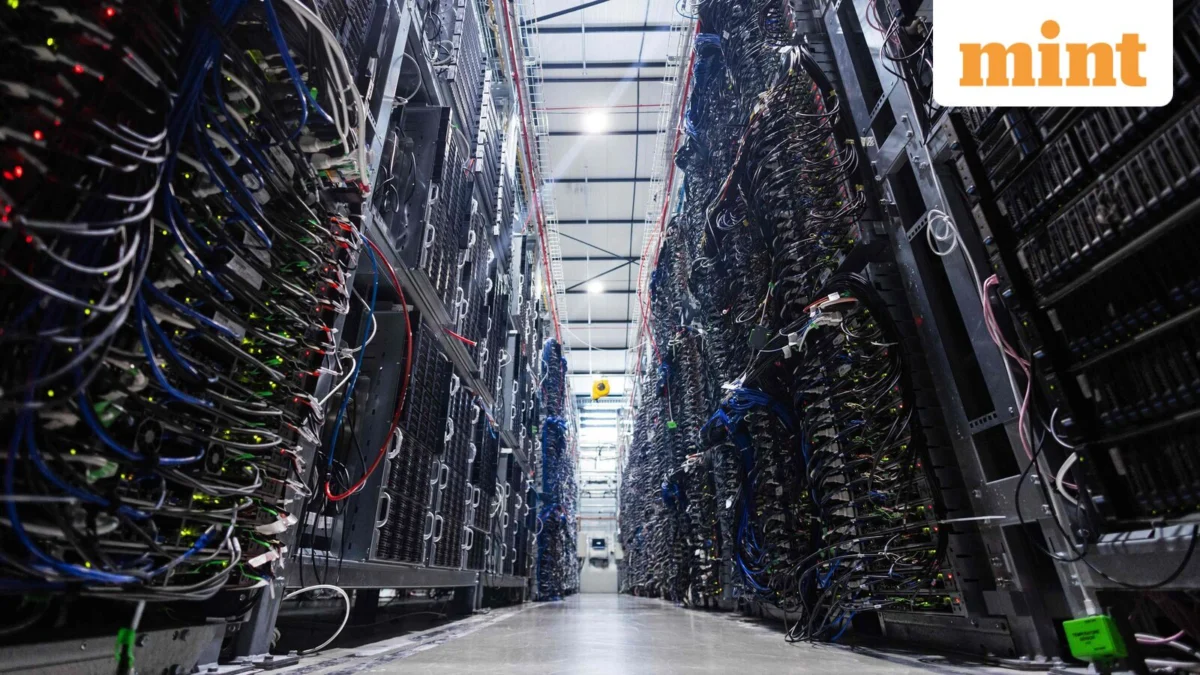
Leading Indian IT services firms are embarking on a significant strategic pivot, channeling substantial capital into the asset-heavy data centre business. This decisive shift, spearheaded by industry stalwarts like Tata Consultancy Services (TCS) and HCL Technologies, signifies a profound recalibration of their business models in response to the escalating demands of artificial intelligence (AI) and the growing imperative for data localization. No longer content with merely providing software services or managing client infrastructure, these companies envision themselves as full-stack digital enablers, underpinning the AI revolution with robust, proprietary compute infrastructure.
The scale of this strategic commitment is formidable. TCS, through its dedicated AI-focused venture, HyperVault, has announced plans to invest an estimated $6-7 billion over the next decade to establish 1GW of data centre capacity. This ambitious undertaking underscores a long-term vision to build a foundational infrastructure layer for advanced AI applications. Similarly, HCL Technologies is dedicating approximately ₹3,500 crore (roughly $360 million) towards developing up to 50MW of data centre capacity, complementing its $150 million investment in Sarvam AI, an Indian sovereign AI platform. These investments mark a departure from the traditional asset-light model that has defined the Indian IT services sector for decades, signaling a proactive move to secure a pivotal role in the evolving digital economy.
At the heart of this transformation lies the disruptive power of Generative AI. This technology is fundamentally reshaping the landscape of software development and maintenance, threatening to automate significant portions of traditional coding and IT operations. As AI agents increasingly take over tasks previously performed by human employees—with TCS, for instance, projecting a future where AI agents could equal human headcount within three years—the industry’s growth levers are shifting. The ability to innovate and deliver cutting-edge AI solutions will hinge not just on algorithms and talent, but crucially, on access to immense computational power and specialized hardware, including advanced graphics processing units (GPUs) and AI accelerators. By owning and operating their data centres, IT service providers aim to capture a larger share of the burgeoning enterprise AI spending, moving beyond mere service contracts to offering integrated AI platforms and infrastructure.
The demand for localized, high-performance data centre infrastructure is further intensified by India’s rapid digital expansion and evolving regulatory environment. Despite generating approximately 20% of the world’s data, India currently possesses less than 3% of global data centre capacity, with around 150 facilities compared to a global count exceeding 11,000. This significant disparity highlights a critical infrastructure gap. Projections from leading economic analyses and industry reports indicate a massive surge in India’s data centre capacity, expected to grow from about 1.4GW in Q2 2025 to an impressive 8GW by 2030. This exponential growth is driven by several factors: the phenomenal adoption of digital payment systems like UPI, the aggressive digitization of banking, financial services, and insurance (BFSI) sectors, and AI-led transformations across various industries.

Moreover, the regulatory landscape, particularly the Digital Personal Data Protection Act (DPDP Act), plays a pivotal role. This legislation, alongside other data residency requirements, mandates that certain types of data be stored and processed within India’s geographical boundaries. Such sovereign data requirements create a distinct advantage for domestic operators, as enterprises seek to ensure compliance, reduce latency, and enhance data security by keeping their digital assets within national borders. This confluence of technological imperative and regulatory mandate strengthens the case for building robust, low-latency, and sovereign AI infrastructure within India.
The foray into the data centre business, however, pits these Indian IT giants against formidable global hyperscalers such as Amazon Web Services (AWS), Google Cloud, and Microsoft Azure. These multinational behemoths possess unmatched scale, colossal R&D budgets, proprietary hardware stacks, and a global footprint that is difficult for any single domestic player to replicate. Their continuous heavy investments in India further intensify this competitive landscape. Yet, Indian IT firms are strategically positioning themselves to carve out valuable niches. Their focus lies in leveraging sovereign data requirements, offering integrated solutions that bundle infrastructure with specialized AI services, and potentially providing better price-performance ratios or lower overall costs for domestic enterprises. By aligning with government priorities for digital sovereignty and focusing on highly regulated industries like BFSI and public sector, they can act as strategic partners in India’s broader digital transformation and AI adoption journey.
The operational complexities and risks associated with this asset-heavy model are substantial. Data centres are incredibly power-intensive, demanding vast amounts of electricity and sophisticated cooling systems. Land acquisition in prime metropolitan areas is both expensive and fraught with regulatory hurdles, which can vary significantly across states. The capital outlay required is immense, and unlike the relatively quick returns seen in traditional software services, data centre investments typically yield slower, long-term returns. Furthermore, the environmental impact of these energy-hungry facilities, particularly their carbon footprint and water consumption, is becoming an increasingly critical consideration, driving a push towards green data centres powered by renewable energy.
Despite these challenges, the strategic importance of AI infrastructure is likely to compel more large Indian IT companies to explore similar investments. The "early mover" advantage could allow TCS and HCLTech to build a competitive moat, securing critical compute capacity and expertise. Success in this new paradigm will depend on a delicate balance: managing the capital intensity effectively while developing highly differentiated offerings that resonate with specific market needs. Missteps, however, could leave companies burdened with underutilized assets in a market where hyperscalers continue to innovate and dominate. The long-term implications for the Indian IT sector are profound. This strategic pivot not only diversifies revenue streams but also elevates India’s standing in the global digital infrastructure landscape, fostering a more resilient and self-reliant digital economy capable of driving the next wave of technological innovation.