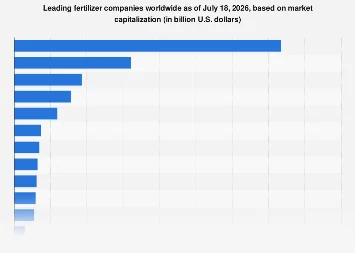
As of the mid-point of 2026, the global fertilizer industry is characterized by a concentrated group of dominant players, with market capitalization serving as a key metric for assessing their financial heft and influence. Leading the pack, one Australian conglomerate has established itself as the largest fertilizer company by market capitalization, commanding an impressive valuation of approximately $30 billion USD. This entity, a diversified business powerhouse with significant interests extending beyond agriculture into retail and chemicals, underscores the strategic integration of fertilizer production within broader industrial frameworks. Following closely in second place is a North American giant, valued at around $25 billion USD, whose operations are intrinsically linked to agricultural inputs and services.
The landscape of global fertilizer production and distribution is largely shaped by a handful of entities that have achieved considerable scale and market penetration. Among these, Wesfarmers and Nutrien stand out as particularly influential forces. Wesfarmers, with a legacy stretching back to its origins as a rural cooperative in 1914, has evolved into a multifaceted Australian enterprise. While its origins lie in serving the Western Australian agricultural community, its contemporary operations span a wide array of sectors, including retail, chemicals, and industrial and safety products. This diversification provides a robust financial foundation and allows for strategic synergies, with its fertilizer division playing a crucial role in its chemical segment and its retail arm potentially influencing distribution channels. Wesfarmers’ substantial presence in both Australia and New Zealand positions it as a critical supplier to these key agricultural markets.
Nutrien, a more recent entrant in its current form, was born from the significant 2018 merger of PotashCorp and Agrium. This union created a behemoth in the global potash market, boasting a production capacity exceeding 12 million metric tons of potassium chloride. Potash, a vital nutrient for plant growth, is essential for global food security, and Nutrien’s significant stake in its production places it at the forefront of this critical segment. Beyond potash, Nutrien also ranks as the third-largest global producer of nitrogen fertilizer, trailing only industry titans CF Industries and Yara. The company’s financial performance in recent years has reflected a positive trajectory, with its 2022 revenue reaching approximately $32 billion USD, indicating a sustained period of growth and market demand. This revenue figure highlights the immense scale of Nutrien’s operations and its significant contribution to the global agricultural value chain.
Another pivotal player in the nitrogen fertilizer segment is the U.S.-based CF Industries Holdings, Inc. Headquartered in Chicago, CF Industries is widely recognized as the world’s largest producer of ammonia, a foundational component in the manufacturing of nitrogen fertilizers. Its extensive plant capacity for ammonia, both within the United States and on a global scale, underscores its strategic importance. While the company’s revenue streams have experienced some volatility over the past decade, 2022 marked a significant upswing, with sales reaching a ten-year high of approximately $10 billion USD. This resurgence in revenue signals a strong recovery and robust demand for its nitrogen-based products, driven by factors such as global agricultural output and the essential role of nitrogen in crop yields.
The global fertilizer market is not merely about production capacity; it is also deeply influenced by macroeconomic trends, geopolitical stability, and the relentless demand for increased agricultural productivity to feed a growing world population. The companies at the apex of this industry operate within a complex ecosystem where factors such as natural gas prices (a key feedstock for nitrogen fertilizers), global commodity prices for agricultural products, and government policies related to food security and environmental sustainability all play a crucial role. The sheer scale of these enterprises means their strategic decisions, investment in research and development, and operational efficiencies have far-reaching implications for farmers worldwide, impacting everything from crop yields to food affordability.
The dominance of these few large companies also raises questions about market concentration and its potential impact on competition and pricing. While scale can drive efficiencies and lower costs, a highly concentrated market can also present challenges for smaller producers and potentially limit innovation or responsiveness to specific regional needs. Regulatory bodies and industry analysts closely monitor these dynamics to ensure a healthy and competitive market that ultimately benefits the agricultural sector and global consumers.
Furthermore, the fertilizer industry is increasingly navigating the imperative of sustainability. Companies are investing in technologies to reduce greenhouse gas emissions associated with fertilizer production, develop more efficient nutrient delivery systems that minimize environmental runoff, and explore alternative, bio-based fertilizer solutions. The ability of these market leaders to innovate and adapt to these evolving environmental and regulatory landscapes will be critical to their long-term success and their contribution to a more sustainable global food system. The financial valuations and market capitalizations observed in mid-2026 are a testament to their current strength, but their future standing will undoubtedly be shaped by their commitment to innovation and environmental stewardship. The ongoing demand for fertilizers, however, remains a powerful underlying force, driven by the fundamental need to enhance agricultural output in a world with a constantly expanding population. The strategic positioning and operational scale of companies like Wesfarmers, Nutrien, and CF Industries will continue to define the contours of this essential global industry for the foreseeable future.