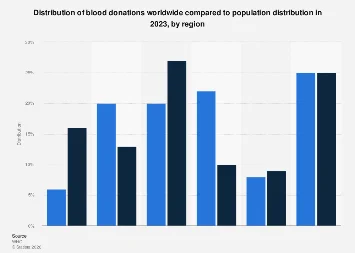
In 2023, a stark contrast emerged between where the world’s population resides and where vital blood donations are collected, highlighting significant disparities in healthcare resource allocation and public health engagement across different global regions. Data compiled from 171 countries reveals a complex landscape where demographic weight does not always correlate with blood donation contributions, raising critical questions about equity, accessibility, and the effectiveness of national blood transfusion services.
Europe, for instance, stands out as a disproportionately large contributor to the global blood supply. While representing approximately 9.6% of the world’s population, the continent accounted for a substantial, though precise figures are behind paywalls, percentage of worldwide blood donations. This overrepresentation suggests robust public awareness campaigns, well-established donation infrastructures, and a strong culture of voluntary, unpaid donation within many European nations. Countries like the United Kingdom, Germany, and France have long prioritized national blood services, often supported by government funding and comprehensive public health strategies aimed at ensuring a consistent and safe blood supply. The emphasis on voluntary, non-remunerated donation, a cornerstone of ethical blood collection practices championed by the World Health Organization (WHO), likely plays a significant role in maintaining high donation rates in these regions.
Conversely, Africa, a continent with a rapidly growing population that constitutes roughly 17% of the global total, presented a significantly lower share of total blood donations. This disparity underscores the immense challenges faced by many African nations in establishing and sustaining adequate blood transfusion services. Factors contributing to this deficit are multifaceted, including limited healthcare infrastructure, insufficient funding for blood banks, a scarcity of trained personnel, and often, a greater reliance on replacement or paid donations, which can carry higher risks of transfusion-transmitted infections. The WHO’s goal of achieving 100% voluntary non-remunerated blood donation by 2020 remains a distant aspiration for many countries on the continent. The logistical hurdles of collecting, testing, storing, and distributing blood in vast, often rural, and resource-constrained settings exacerbate the problem.
This geographical imbalance in blood donation is not merely a statistical anomaly; it carries profound implications for global health equity. Regions with lower donation rates often face critical shortages, particularly during times of increased demand such as during emergencies, natural disasters, or for routine medical procedures like surgery and childbirth. This can lead to compromised patient care, increased morbidity and mortality, and a widening gap in health outcomes between more developed and less developed regions. The reliance on emergency appeals or international aid for blood products can be unsustainable and does not address the root causes of persistent shortages.
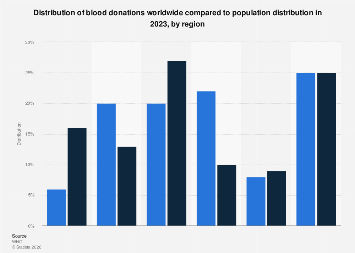
Examining other regions further illuminates this global pattern. North America, encompassing the United States and Canada, typically boasts a well-developed blood donation system with high rates of voluntary, unpaid donations, contributing significantly to the global pool. The established infrastructure, coupled with effective public campaigns by organizations like the American Red Cross and Canadian Blood Services, ensures a relatively stable supply. Asia, with its vast population, presents a mixed picture. While some East Asian countries like Japan and South Korea have strong donation systems, many South and Southeast Asian nations grapple with similar challenges to Africa, including infrastructure deficits and a mixed donor base. Latin America also exhibits regional variations, with some countries demonstrating robust donation programs while others face persistent shortages.
The supplementary notes accompanying the data indicate that the collections included all types of blood donors: voluntary non-remunerated, family or replacement, and paid. This inclusivity, while capturing a broader spectrum of donations, also implicitly highlights areas where voluntary, unpaid donations may be less prevalent. The global health community, including the WHO, consistently advocates for voluntary non-remunerated blood donation as the safest and most sustainable model. Paid donations, while sometimes filling immediate gaps, can create incentives for individuals to donate more frequently than is safe or to conceal health conditions, increasing the risk of infectious disease transmission.
The economic ramifications of these disparities are substantial. Maintaining a safe and sufficient blood supply requires significant investment in infrastructure, technology, personnel training, and public awareness. For nations struggling with limited financial resources, prioritizing blood services can be a difficult choice amidst competing public health needs. However, the economic cost of untreated conditions and preventable deaths due to blood shortages can far outweigh the investment required to strengthen national blood transfusion systems. Furthermore, the interconnectedness of the global economy means that health crises in one region can have ripple effects elsewhere, impacting trade, tourism, and international cooperation.
Addressing this global disconnect requires a multi-pronged approach. International cooperation, including financial and technical assistance from developed nations and global health organizations, is crucial for supporting capacity building in underserved regions. Investing in public education campaigns to promote voluntary blood donation, dispelling myths and fears surrounding the process, and fostering a culture of altruism are paramount. Technological advancements, such as improved blood storage solutions and mobile donation units, can help overcome logistical challenges in remote areas. Furthermore, strengthening regulatory frameworks and ensuring rigorous screening of all donated blood are essential for patient safety.
The data for 2023 serves as a critical reminder that the availability of life-saving blood is not uniformly distributed across the globe. As populations continue to grow and shift, particularly in developing regions, the need for blood transfusions will only increase. Bridging the gap between where people live and where blood is donated is not just a matter of statistical balance; it is a fundamental imperative for achieving global health equity and ensuring that every individual, regardless of their geographical location, has access to essential medical care. The challenge ahead lies in translating this awareness into concrete actions that build resilient and equitable blood transfusion systems worldwide.