Cork, a material harvested from the bark of the cork oak tree (Quercus suber), stands as a testament to nature’s ingenuity and a vital component of a sustainable global economy. With a history stretching back millennia, this unique, renewable resource is increasingly recognized not just for its traditional applications, particularly in the wine industry, but also for its remarkable performance in a diverse and expanding range of high-tech sectors. As the world grapples with the urgent need for environmentally responsible materials, cork offers a compelling blend of ecological benefits and functional excellence, demonstrating how nature-based solutions can drive economic value and reduce environmental impact across multiple industries.
The inextricable link between cork and wine production is a story etched in time, a relationship that has evolved into a profound symbiosis. For centuries, the natural cork stopper has served as the guardian of wine, a living product in its own right, protecting, preserving, and even enhancing its quality. While the use of cork for stoppers can be traced back to ancient civilizations, the modern era solidified its role with the influence of figures like Dom Pérignon in the 17th century, who championed the pairing of cork with glass bottles, establishing an enduring standard that continues to define the wine experience for many.
At the forefront of this vital industry is Corticeira Amorim, a Portuguese company that has ascended to become the world’s leading producer and exporter of cork products. With a legacy rooted in a deep commitment to renewable, bio-based materials and a steadfast dedication to life cycle-based sustainability assessments, Corticeira Amorim embodies the modern potential of cork. Established in 1870 as a family enterprise, the company has transformed into a global powerhouse, extending its reach to over 100 countries. While its product portfolio now spans innovative solutions for flooring, automotive components, and even aerospace-grade composites, its identity remains intrinsically tied to the production of high-performance cork stoppers, an astonishing feat of over five billion units produced annually.
The enduring appeal of cork stoppers for wine bottles stems from a confluence of factors, encompassing technical efficacy, sensory contributions, and, crucially, a superior environmental profile. Extensive, peer-reviewed life cycle assessment (LCA) studies and product carbon footprint analyses consistently underscore cork’s environmental advantages. Corticeira Amorim adheres rigorously to the ISO 14067 standard for quantifying the carbon footprint of products, employing a cradle-to-gate methodology. These comprehensive studies, covering approximately 60% of the company’s product range and independently verified by APCER (Portuguese Association of Certification), provide robust, credible, and transparent data, aligning with evolving EU regulatory expectations for environmental disclosures.
The findings from these assessments are compelling: all analyzed cork stoppers exhibit a negative carbon footprint within the defined system boundaries. This highlights cork’s significant environmental value as a packaging solution for the wine industry. The carbon sequestration achieved by cork stoppers varies depending on the specific product type, ranging from -28.72 g CO2e per Spark Top II stopper, designed for sparkling wines, to -56.4 g CO2e per Naturity cork stopper, a testament to the material’s inherent carbon-negative properties.
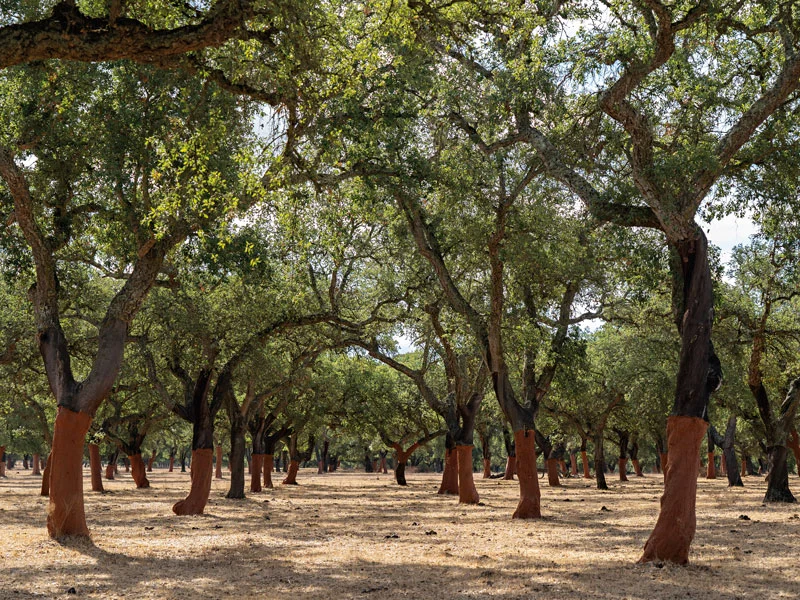
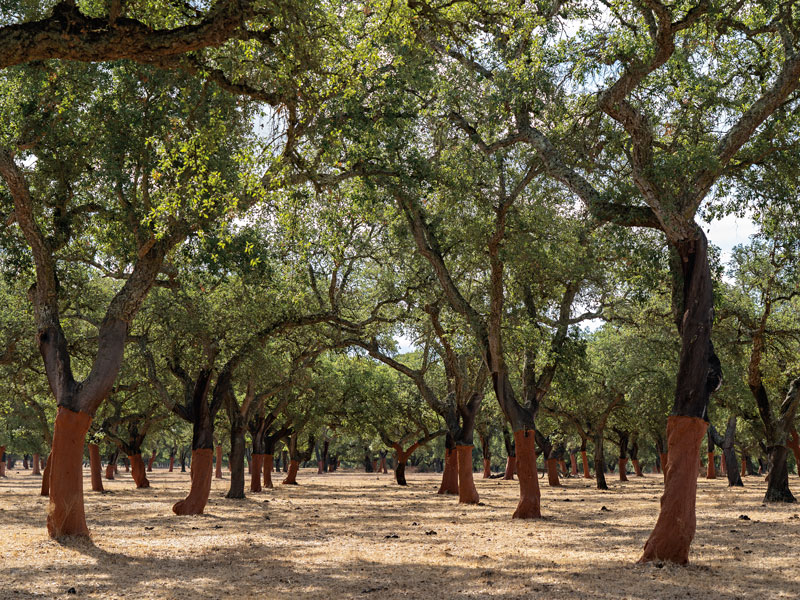
The exceptional environmental credentials of cork are intrinsically linked to the life cycle of the cork oak tree itself. Native to the Mediterranean basin and forming the cornerstone of Portugal’s distinctive Montado agroforestry landscape, the cork oak is unique in its ability to regenerate its bark after harvesting. This regenerative process allows cork oak forests to function as potent carbon sinks and long-term carbon reservoirs, with individual trees typically living for around 200 years. A study cited by APCOR (Portuguese Cork Association) indicates that cork oak forests can sequester as much as 73 tonnes of CO2 for every tonne of cork harvested. This positions cork as a powerful nature-based system with substantial long-term carbon storage potential, while simultaneously contributing to a cascade of other vital ecosystem services.
Beyond its role in cork production, the Montado ecosystem is a crucial habitat supporting a rich tapestry of biodiversity, including iconic endangered species such as the Iberian lynx and the Spanish imperial eagle. The cork oak, Quercus suber, plays an indispensable role in maintaining soil health, preventing desertification, and fostering a resilient landscape. In stark contrast to monoculture forestry plantations, the cork oak forest represents an exemplary model of land use, harmoniously integrating environmental stewardship with economic productivity. The long-term viability and health of these vital forests are directly dependent on responsible forest management practices and the maintenance of thriving, economically sustainable cork value chains. This ensures that these multifunctional landscapes are not only preserved but also actively managed for generations to come, underscoring the circular economy principles inherent in cork’s lifecycle.
The economic ripple effects of the cork industry extend far beyond the immediate harvest. The complex value chain, from forest management and bark extraction to processing, manufacturing, and global distribution, generates significant employment and economic activity, particularly in rural regions of Portugal and other Mediterranean countries where cork oak forests are prevalent. The global market for cork products is substantial, with the wine stopper segment alone representing a significant portion. However, the diversification into new applications is rapidly expanding this market. For instance, the market for cork-based flooring and wall coverings, valued at over USD 3 billion globally and projected to grow at a CAGR of approximately 5-6% in the coming years, is driven by consumer demand for sustainable and aesthetically pleasing interior design solutions.
In the high-performance materials sector, cork’s unique properties are being leveraged in innovative ways. Its lightweight, shock-absorbing, and insulating characteristics make it ideal for applications in the automotive industry, contributing to vehicle efficiency and passenger comfort. In the aerospace sector, specialized cork composites are being developed for their thermal insulation and fire-retardant properties, demonstrating the material’s adaptability to stringent technical requirements. The burgeoning market for sustainable packaging solutions also presents a significant opportunity for cork, offering a biodegradable and renewable alternative to plastics and other less environmentally friendly materials.
The economic resilience of the cork industry is further bolstered by ongoing investment in research and development. Companies like Corticeira Amorim are continuously exploring new processing techniques and innovative applications for cork, pushing the boundaries of what this ancient material can achieve. This includes the development of advanced cork composites, the extraction of valuable compounds from cork by-products, and the exploration of cork’s potential in fields such as biomedical engineering. Such innovation not only strengthens the economic base of the industry but also enhances its contribution to a circular economy, minimizing waste and maximizing resource utilization.
As global supply chains face increasing scrutiny regarding their environmental impact, the inherent sustainability of cork provides a distinct competitive advantage. Its natural regeneration cycle, coupled with its carbon sequestration capabilities and its contribution to biodiversity, positions it as a material of choice for businesses seeking to align their operations with environmental, social, and governance (ESG) principles. The growing consumer awareness of climate change and the demand for eco-friendly products further amplify the market appeal of cork-based goods.
In conclusion, cork is far more than just a traditional raw material; it is a sophisticated, nature-based solution with profound economic and ecological implications. Its millennia-old legacy is being actively reshaped by modern innovation, solidifying its role as a key material for a sustainable future. From protecting precious vintages to enabling cutting-edge technologies, cork continues to demonstrate its unparalleled value, proving that ancient wisdom and contemporary scientific advancement can indeed converge to create a more sustainable and prosperous world. The ongoing success of the cork industry serves as a powerful reminder of the economic potential embedded within natural, renewable resources when managed responsibly and harnessed with ingenuity.