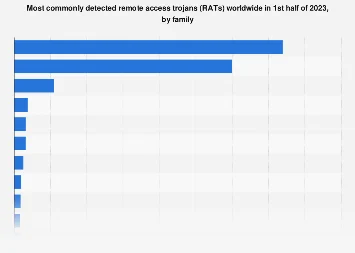
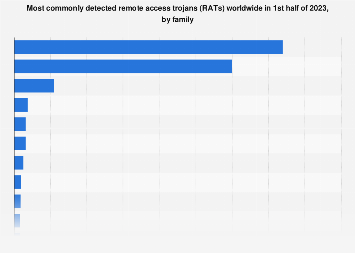
In the first half of 2023, the cybersecurity threat landscape was significantly shaped by the prevalence of Remote Access Trojans (RATs), with Agent Tesla and Emotet emerging as the most widely detected and impactful malware families. These sophisticated tools, designed to grant attackers unfettered remote control over compromised systems, posed a persistent and evolving challenge to individuals and organizations globally. Analysis of threat intelligence data reveals that Agent Tesla was the leading perpetrator, accounting for approximately 37% of detected RAT attacks during this period. Hot on its heels was Emotet, a particularly insidious and adaptable threat, responsible for a substantial 30% of identified attacks. The continued dominance of these two RATs underscores their effectiveness in achieving malicious objectives, ranging from data exfiltration and espionage to serving as a gateway for further, more damaging cyber intrusions.
Following these frontrunners, REMCOS secured the third position, demonstrating a prevalence of 5.5%. While significantly less widespread than Agent Tesla and Emotet, its continued presence highlights the diverse array of RATs actively deployed by threat actors. The remaining share of detected attacks was distributed among a multitude of other RAT families, each with its own unique capabilities and target profiles. This diverse ecosystem of malicious software necessitates a comprehensive and adaptive cybersecurity strategy, as organizations cannot afford to focus solely on the most prevalent threats. Understanding the specific characteristics and attack vectors of each RAT family is crucial for effective defense.
Remote Access Trojans, by their very nature, are designed to bypass traditional security measures and establish persistent, covert channels of communication between the attacker and the victim’s machine. Once installed, often through deceptive phishing emails, malicious attachments, or compromised websites, a RAT can provide threat actors with an alarming degree of control. This control can manifest in various ways, including the ability to steal sensitive credentials, record keystrokes, capture screenshots, access and exfiltrate files, and even manipulate system settings. The implications for businesses are profound, potentially leading to significant financial losses, reputational damage, intellectual property theft, and disruption of critical operations.
Agent Tesla’s sustained prevalence is largely attributed to its evolution as a highly configurable and stealthy information-stealing malware. Initially designed to exfiltrate credentials from a wide range of applications, including web browsers, email clients, and VPN software, it has since incorporated advanced evasion techniques to circumvent antivirus software and security protocols. Its modular nature allows attackers to customize its payload, tailoring it to specific targets and objectives. The widespread availability of Agent Tesla through underground forums and its relatively low cost of deployment contribute to its enduring popularity among cybercriminals.
Emotet, on the other hand, has a more complex and dynamic history. Originally distributed as a banking trojan, it has transformed into a highly sophisticated botnet capable of delivering a wide range of secondary malware payloads, including ransomware, other trojans, and information stealers. Its ability to spread rapidly through spam campaigns and exploit vulnerabilities in unpatched systems makes it a significant threat vector. The sheer scale of Emotet’s operations and its capacity to serve as a platform for other cybercrime activities have solidified its position as one of the most dangerous malware families in existence. The constant adaptation and reinvention of Emotet by its operators present a formidable challenge for cybersecurity professionals.
The economic impact of RATs extends far beyond the immediate costs of remediation and data recovery. For businesses, a successful RAT attack can lead to a loss of customer trust, decreased productivity due to system downtime, and substantial fines for non-compliance with data protection regulations. The global cybersecurity market is a testament to the growing threat, with significant investments being made in threat intelligence platforms, endpoint detection and response (EDR) solutions, and security awareness training. The total spending on cybersecurity globally is projected to reach hundreds of billions of dollars annually, a clear indicator of the escalating arms race between cyber defenders and malicious actors.
Comparing the prevalence of RATs across different regions reveals some nuanced patterns, though definitive global data can be challenging to aggregate due to varying reporting standards and the clandestine nature of cybercrime. However, generally speaking, developed economies with a higher concentration of digital assets and a greater reliance on interconnected systems tend to be more heavily targeted. North America and Europe consistently report high volumes of cyber threats, including RAT attacks. Emerging economies, while sometimes perceived as less attractive targets, are increasingly becoming fertile ground for cybercriminals as their digital infrastructure expands and cybersecurity awareness lags behind. The globalized nature of the internet means that no region is entirely immune.
Beyond the top contenders, other RAT families like REMCOS, AVE_MARIA, and NetWire RAT, while appearing lower in the prevalence rankings, still represent significant threats. REMCOS, for instance, has gained notoriety for its advanced features, including remote desktop control, keylogging, and file management capabilities, often distributed through sophisticated social engineering tactics. AVE_MARIA and NetWire RAT also possess robust functionalities that enable attackers to maintain persistent access and execute a range of malicious activities. Even threats with seemingly low prevalence, such as Cobalt Strike (1%), which is often used by penetration testers but also by malicious actors for its advanced command-and-control capabilities, can have a disproportionately high impact due to their sophistication.
The persistence of these threats underscores the ongoing need for robust, multi-layered cybersecurity strategies. This includes not only technical solutions such as advanced threat detection, firewalls, and intrusion prevention systems but also a strong emphasis on human factors. Regular security awareness training for employees, promoting best practices for password management, recognizing and reporting phishing attempts, and understanding the risks associated with downloading unknown files are critical components of a comprehensive defense. Furthermore, organizations must adopt a proactive approach to threat intelligence, staying informed about the latest malware trends, vulnerabilities, and attack methodologies. The landscape of remote access trojans is constantly shifting, and only through continuous vigilance and adaptation can businesses hope to stay ahead of the ever-evolving cyber threat. The data from the first half of 2023 serves as a stark reminder that the battle against sophisticated malware like Agent Tesla and Emotet is far from over, demanding sustained attention and investment from the global cybersecurity community.