The intricate system of federal financial aid in the United States plays a pivotal role in enabling access to higher education, with the academic year 2024-2025 revealing distinct average support levels across various programs. For students pursuing tertiary education, understanding the financial scaffolding available is crucial for planning and affordability. Data compiled for this academic period highlights significant variations in the average amounts disbursed through key federal initiatives, offering a snapshot of how different aid mechanisms are deployed to support students.
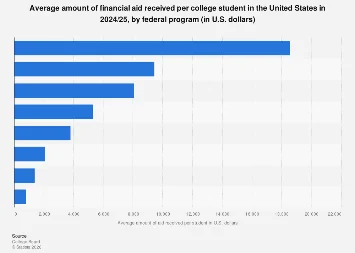
At the apex of average aid received per student stands the Post-9/11 GI Bill Veterans’ Benefits, a program designed to honor military service with substantial educational support. This benefit averaged an impressive $18,570 per eligible student, underscoring its significance as a comprehensive funding source for veterans transitioning to civilian academic pursuits. This level of support aims to cover not only tuition and fees but often extends to living expenses and other educational costs, reflecting a national commitment to the educational aspirations of those who have served. The robust funding associated with the GI Bill is a testament to its intended impact, ensuring that veterans can pursue degrees and professional development without undue financial burden.
Following closely behind, the Direct Subsidized and Unsubsidized Loans combined offered an average of $9,460 per student. This aggregate figure encompasses two distinct loan types that, while both federal and often packaged together, possess different interest accrual policies. Direct Unsubsidized Loans, available to both undergraduate and graduate students regardless of financial need, provided an average of $8,070. This reflects a widespread reliance on these loans to bridge the gap between available grants, personal savings, and the total cost of attendance. The availability of unsubsidized loans is a critical component of the federal student aid architecture, providing a crucial liquidity mechanism for a broad spectrum of students.
The Federal Pell Grant program, a cornerstone of need-based federal aid for undergraduates, provided an average of $5,320 per student. While lower than the average loan amounts, Pell Grants are a critical lifeline for low-income students, as they do not require repayment. The average amount signifies the program’s reach in making higher education accessible to a demographic that might otherwise be priced out of college. The eligibility criteria for Pell Grants are primarily based on financial need, determined by the Free Application for Federal Student Aid (FAFSA), making it a direct investment in educational equity.
Delving further into the loan landscape, Direct Subsidized Loans, which are exclusively for undergraduate students and for which interest is paid by the government while the student is in school at least half-time, averaged $3,790. This distinction highlights the preferential treatment of subsidized loans, which are designed to reduce the overall cost of borrowing for undergraduate students demonstrating financial need. The average amount here reflects a targeted approach to alleviating immediate borrowing costs for a specific student population.
The Federal Work-Study program, designed to provide part-time employment opportunities for students with financial need, averaged $2,080 per participating student. This program not only offers financial assistance but also provides valuable work experience, often related to a student’s field of study. The average amount indicates that while work-study is a supplementary form of aid, it contributes meaningfully to a student’s ability to cover educational expenses while gaining practical skills.
Lower on the average aid spectrum are the Estimated Federal Education Tax Benefits, which amounted to $1,410 per student. These benefits, which can include deductions and credits such as the American Opportunity Tax Credit and the Lifetime Learning Credit, offer a reduction in a student’s or family’s overall tax liability. While not direct cash disbursements, these tax benefits represent a significant form of governmental support that reduces the net cost of education. Eligibility for these benefits often depends on income levels and qualified educational expenses.
Finally, the Federal Supplemental Educational Opportunity Grant (FSEOG) program, another need-based grant for undergraduates, averaged $810 per student. FSEOG awards are typically smaller than Pell Grants and are distributed by individual institutions based on the availability of funds and the demonstrated financial need of eligible students. The lower average amount reflects its role as a supplementary grant, often used to provide a final boost to ensure a student’s financial viability for the academic term.
The data from the 2024-2025 academic year reveals a tiered system of federal financial support, with veterans’ benefits offering the most substantial average aid, followed by a mix of loans and grants designed to address different facets of educational financing. The distinction between undergraduate-only programs (Pell Grants, FSEOG, Direct Subsidized Loans for undergraduates) and those available to graduate students (Direct Unsubsidized Loans, Federal Work-Study, Tax Benefits) further illustrates the targeted nature of federal aid policies.
Globally, the United States’ model of extensive federal student loan programs is a notable feature. Many European countries, for instance, tend to rely more heavily on tuition-free or low-tuition public university systems, supplemented by grants and scholarships rather than large-scale federal loan portfolios. This contrast underscores the unique approach taken in the U.S., where a significant portion of higher education funding is facilitated through a combination of institutional tuition, private and federal loans, and grants. The average figures presented here are critical indicators of the financial realities faced by American students and the role the federal government plays in mitigating the substantial costs associated with higher education.
The economic implications of these aid levels are far-reaching. For students, the availability and average amounts of these programs directly influence college enrollment decisions, choice of institution, and the long-term burden of student debt. For the broader economy, the success of these federal programs in facilitating educational attainment contributes to a more skilled workforce, potentially boosting productivity and innovation. Conversely, if average aid levels are perceived as insufficient relative to rising tuition costs, it could lead to decreased enrollment, increased student debt defaults, and a widening of educational disparities.
The supplementary notes accompanying the data provide crucial context regarding eligibility. For instance, the fact that Direct Subsidized Loans were once available to graduate students but are now limited to undergraduates highlights policy shifts over time. Similarly, the exclusion of graduate students from Pell Grants and FSEOG underscores the differentiated support structures for undergraduate versus graduate studies. These nuances are vital for a complete understanding of how federal aid is distributed and its intended impact on different segments of the student population. As educational costs continue to be a significant concern for families and individuals, these figures offer a vital benchmark for assessing the effectiveness and adequacy of federal financial aid in the United States.