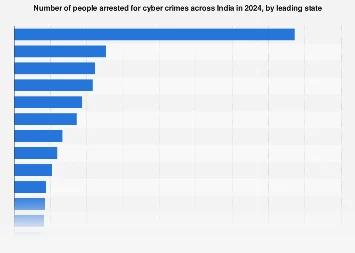
As the digital economy continues its rapid expansion across India, so too does the sophisticated and pervasive threat of cybercrime. In 2024, law enforcement agencies, particularly at the state level, have intensified their efforts to combat this growing menace, leading to a significant uptick in arrests related to various forms of online malfeasance. This heightened enforcement activity underscores a crucial shift in India’s approach to digital security, moving from reactive measures to more proactive and targeted interventions against perpetrators of cyber fraud, data breaches, and other digital offenses.
The statistics emerging from leading Indian states paint a complex picture of the nation’s battle against cybercriminals. While specific granular data on the total number of arrests is often subject to proprietary access, the general trend indicates a substantial increase in apprehended individuals. This surge is not merely a reflection of increased criminal activity, but also a testament to the evolving capabilities and strategic focus of police departments and cybercrime units across the country. States like Maharashtra, Karnataka, Telangana, and Delhi, being major economic and technological hubs, naturally witness a higher volume of both cyber incidents and subsequent enforcement actions.
The motives behind cybercrimes in India are diverse, mirroring global trends. Financial gain remains a primary driver, with phishing scams, ransomware attacks, and online fraud schemes targeting both individuals and businesses. The National Crime Records Bureau (NCRB) has previously indicated that a significant percentage of cybercrimes reported in India involve financial fraud. These range from sophisticated Business Email Compromise (BEC) scams that can cripple corporations to more common, yet equally damaging, ATM skimming and UPI (Unified Payments Interface) related frauds that affect millions of ordinary citizens. Beyond financial motives, data theft for corporate espionage or to fuel illicit markets, identity theft, and the dissemination of harmful content, including child exploitation material and hate speech, also contribute to the alarming statistics.
The types of cybercrimes being investigated and prosecuted are equally varied. While traditional cyber offenses like hacking and unauthorized access to computer systems persist, there has been a notable rise in crimes leveraging social engineering tactics and the exploitation of emerging technologies. The proliferation of mobile banking and digital payment platforms, while offering immense convenience, has also created new avenues for fraudsters. Exploitation of vulnerabilities in e-commerce platforms, the misuse of social media for spreading misinformation and orchestrating scams, and the increasing threat of sophisticated ransomware attacks on critical infrastructure are all areas receiving significant attention from cybercrime units. Furthermore, the dark web continues to be a breeding ground for cybercriminals, facilitating the trade of stolen data, malware, and the planning of larger-scale attacks.
The economic impact of cybercrime on India is profound and multifaceted. Beyond the direct financial losses incurred by victims, businesses face significant costs associated with incident response, recovery, reputational damage, and increased cybersecurity investments. For individuals, the loss of savings, compromised personal data, and the emotional distress caused by victimisation can have long-lasting consequences. The World Economic Forum has consistently highlighted cybercrime as one of the most significant threats to global economic stability, and India, as a rapidly growing digital economy, is particularly vulnerable. Estimates vary widely, but the cumulative economic damage from cyber threats in India runs into billions of dollars annually. This economic drain can hinder investment, stifle innovation, and impede the nation’s progress towards its digital transformation goals.
In response to this escalating threat, Indian states have been bolstering their cybersecurity infrastructure and enforcement mechanisms. Many states have established dedicated cybercrime police stations, equipped with specialized forensic tools and trained personnel. The Ministry of Home Affairs, through its National Cybercrime Reporting Portal, has facilitated a more streamlined process for citizens to report cybercrimes, thereby improving data collection and enabling faster response times. Furthermore, there is an increasing emphasis on public-private partnerships, with law enforcement agencies collaborating with cybersecurity firms and technology companies to share threat intelligence, develop best practices, and conduct joint operations.
However, challenges persist. The sheer volume of reported cybercrimes often overwhelms existing resources. The digital divide, while narrowing, means that a segment of the population remains less digitally literate and therefore more susceptible to sophisticated scams. Moreover, the cross-border nature of many cybercrimes necessitates enhanced international cooperation, which can be complex and time-consuming. The rapid evolution of cyber threats also means that law enforcement agencies must constantly adapt and upskill their personnel to stay ahead of evolving criminal tactics.
The increasing number of arrests, therefore, should be viewed not just as a measure of success in combating cybercrime, but also as an indicator of the scale of the problem and the continuous need for vigilance. It signals that authorities are actively pursuing offenders, which can act as a deterrent. However, the ultimate measure of success will lie in reducing the incidence of cybercrime itself, protecting citizens and businesses, and fostering a secure digital environment conducive to economic growth and innovation. As India continues its ambitious journey towards becoming a digitally empowered nation, the robust and evolving response to cyber threats will remain a critical determinant of its overall security and prosperity. The year 2024 marks a pivotal moment, where enhanced enforcement is a clear signal of the nation’s commitment to securing its digital future, even as the adversaries continue to innovate and adapt.