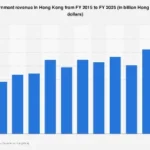
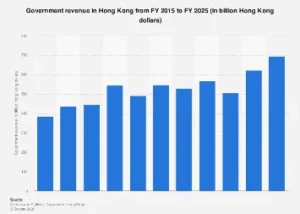


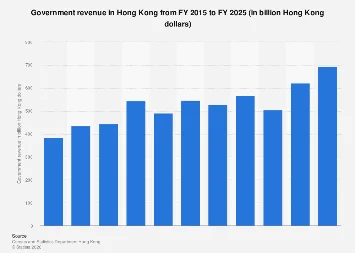
Hong Kong’s government revenue, a critical barometer of its economic health and fiscal capacity, is projected to hover around HK$742.3 billion for the financial year 2025-2026. This figure, representing a significant but nuanced picture, underscores the ongoing dynamism and inherent sensitivities of the city-state’s financial landscape. While precise figures for future years are often subject to revision based on evolving economic conditions and policy adjustments, the overall trajectory provides a vital lens through which to assess the territory’s financial planning and its capacity to fund public services, infrastructure development, and economic stimulus measures.
The financial year in Hong Kong, like in many jurisdictions, runs from April 1st to March 31st of the following year. This temporal framework is crucial for understanding budgetary cycles and the impact of economic events over a defined period. The projected revenue for FY2025-2026 is not an isolated data point but rather a culmination of trends observed over the preceding decade and a half, with projections extending to the present and immediate future. Understanding these trends requires a deeper dive into the components of government revenue and the external factors that influence them.
Hong Kong’s revenue streams are historically diverse, drawing significantly from property-related taxes, stamp duties, corporate and income taxes, and revenue generated from government land sales. The performance of the property market, therefore, has a direct and substantial impact on the city’s coffers. Similarly, the robustness of its financial services sector, a cornerstone of Hong Kong’s economy, directly influences corporate tax receipts and the volume of transactions subject to stamp duty. Global economic conditions, trade dynamics, and investor sentiment also play pivotal roles, affecting both the profitability of businesses operating in Hong Kong and the attractiveness of the city as an investment destination.
Looking back, the period from FY2015 to FY2024 has likely witnessed fluctuations in government revenue, influenced by a confluence of factors. The global economic slowdowns, geopolitical tensions, and more recently, the lingering effects of the COVID-19 pandemic, have all presented challenges. The domestic economic environment, including social unrest and shifts in international trade patterns, has also contributed to this variability. For instance, periods of significant market volatility or a downturn in property values could lead to a contraction in stamp duty revenue, a key component of the government’s income. Conversely, periods of strong economic growth and a booming property market would typically see revenue figures surge.
The projected revenue for FY2025-2026, therefore, needs to be contextualized within this historical pattern. Analysts often rely on econometric models and forecasts from institutions like the International Monetary Fund (IMF) and the Asian Development Bank (ADB) to gauge future economic performance and its implications for government finances. These forecasts typically consider factors such as projected GDP growth rates, inflation, interest rate movements, and the anticipated performance of key economic sectors. For Hong Kong, the continued integration with mainland China’s economy, while offering opportunities, also introduces a degree of interdependence and exposure to the economic policies and performance of its larger neighbor.
The significance of government revenue extends far beyond mere accounting figures. It directly dictates the government’s ability to implement its policy agenda. This includes funding for social welfare programs, healthcare services, education, public transportation, and ambitious infrastructure projects such as the Northern Metropolis development or the expansion of the MTR network. A healthy revenue stream allows for greater fiscal flexibility, enabling the government to respond to unexpected crises, invest in long-term economic diversification, and maintain Hong Kong’s competitive edge as a global financial hub.
However, reliance on certain revenue sources, particularly property-related taxes and land sales, can also create vulnerabilities. A sharp downturn in the property market, for example, could lead to a significant deficit, forcing the government to either cut spending, increase borrowing, or explore alternative revenue-generating measures. This has led to ongoing discussions and policy considerations around broadening the tax base and enhancing revenue resilience. Potential avenues include further developing the financial services sector to boost corporate tax revenues, promoting innovation and technology to foster new industries, and enhancing tourism and retail sectors.
Global comparisons offer further perspective. Many advanced economies face similar challenges in balancing fiscal sustainability with the demands for public services. Countries with diversified economies and broad tax bases often exhibit greater resilience to economic shocks. For Hong Kong, a territory with a relatively small landmass and a highly concentrated economic structure, the imperative to diversify revenue sources and foster new growth engines remains a strategic priority. The government’s commitment to innovation and technology, for instance, aims to create new high-value industries that can contribute to tax revenues and employment in the long term.
Furthermore, the prevailing global interest rate environment can also influence government finances. Higher interest rates can increase the cost of servicing any outstanding public debt, although Hong Kong has historically maintained a strong fiscal position with relatively low levels of public debt compared to many developed nations. Conversely, a stable or declining interest rate environment can reduce borrowing costs, freeing up resources for other expenditures.
The projected figures for FY2025-2026 also serve as a crucial input for economic forecasting and investment analysis. Businesses and investors closely monitor government revenue trends as an indicator of economic stability and the government’s capacity to support economic activity. Consistent and predictable revenue streams generally foster greater business confidence and encourage long-term investment. Conversely, significant revenue shortfalls or persistent fiscal deficits could signal underlying economic weaknesses and lead to increased investor caution.
The Hong Kong Special Administrative Region (HKSAR) government regularly publishes its budget, providing detailed breakdowns of revenue and expenditure projections. These documents offer valuable insights into the government’s fiscal strategy, its economic assumptions, and its spending priorities. The interplay between revenue generation and expenditure decisions is fundamental to fiscal policy, shaping the overall economic trajectory of the territory. As Hong Kong navigates the complexities of the global economic landscape, its ability to manage its public finances effectively, adapt to changing circumstances, and foster sustainable revenue growth will be paramount to its continued prosperity and its role as an international financial center. The figures for FY2025-2026, while subject to refinement, offer a critical snapshot of this ongoing fiscal journey.