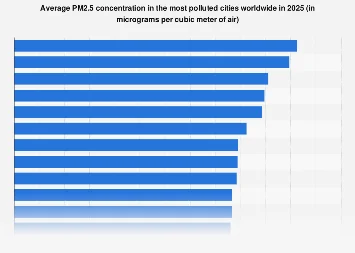
The persistent and escalating challenge of air pollution continues to cast a long shadow over urban centers worldwide, with 2025 data painting a stark picture of the most severely affected metropolitan areas. While precise, real-time rankings often depend on the specific pollutants measured and the methodologies employed by various research bodies, an emerging consensus points towards a disproportionate burden on South Asian cities, particularly within India. This ongoing environmental crisis not only poses significant threats to public health but also carries substantial economic repercussions, impacting productivity, healthcare costs, and the very livability of these sprawling urban landscapes.
The most commonly cited metrics for air quality revolve around particulate matter, specifically PM2.5 (particles with a diameter of 2.5 micrometers or less) and PM10 (particles with a diameter of 10 micrometers or less). These microscopic particles, often invisible to the naked eye, can penetrate deep into the lungs and even enter the bloodstream, leading to a cascade of respiratory and cardiovascular diseases. Other key pollutants of concern include nitrogen dioxide (NO2), sulfur dioxide (SO2), ozone (O3), and carbon monoxide (CO). Annual average concentrations of these substances serve as critical indicators for assessing the long-term health risks faced by urban populations.
While a definitive, universally agreed-upon list of the "most polluted cities" for 2025 is subject to the latest data releases from organizations like the World Health Organization (WHO), IQAir, and various national environmental agencies, trends observed in preceding years strongly suggest continued dominance of Indian cities at the lower end of air quality rankings. Cities such as Delhi, Ghaziabad, Faridabad, and Bhiwadi have frequently appeared in the top echelons of global pollution indices. This concentration of pollution in specific regions is a complex interplay of rapid industrialization, vehicular emissions, agricultural burning, construction dust, and geographical factors that can trap pollutants.
The economic implications of such pervasive air pollution are profound and multifaceted. Healthcare systems bear a significant strain as rates of asthma, bronchitis, pneumonia, heart attacks, and strokes escalate. Productivity losses occur due to increased absenteeism from work and reduced cognitive function among affected individuals. Furthermore, the long-term effects of chronic exposure can lead to reduced life expectancy, impacting the demographic and economic potential of a nation. For businesses operating in these heavily polluted cities, air quality can also present operational challenges, from increased maintenance costs for equipment to potential disruptions in supply chains and labor availability. The cost of implementing air purification systems and health monitoring for employees adds another layer of financial burden.
Globally, the fight against air pollution is an uneven one. Developed nations in North America and Europe have made considerable progress in reducing air pollution over the past few decades, largely through stringent regulatory frameworks, technological advancements in emissions control for vehicles and industries, and a shift towards cleaner energy sources. The Clean Air Act in the United States and similar legislation in the European Union have demonstrably improved air quality in many of their major cities. However, this progress has often been achieved at the cost of offshoring heavy industries to regions with less stringent environmental regulations, a practice that has contributed to the current pollution burden in developing economies.
In contrast, many rapidly developing nations are grappling with the dual challenge of economic growth and environmental protection. The sheer scale of urbanization and industrial expansion, coupled with often inadequate infrastructure and enforcement mechanisms, creates a potent cocktail for deteriorating air quality. For instance, while China has also faced severe air pollution challenges, it has also invested heavily in renewable energy and implemented aggressive measures to curb industrial emissions, leading to observable improvements in some of its major cities in recent years. This demonstrates that significant progress is achievable with concerted political will and strategic investment.
The impact of air pollution extends beyond immediate health concerns to influence broader economic strategies. Countries and cities that can demonstrably improve their air quality often become more attractive for foreign investment, tourism, and skilled labor. Conversely, persistent pollution can deter these crucial economic drivers. International organizations are increasingly recognizing the economic imperative of addressing air pollution, framing it not just as an environmental issue but as a critical factor in sustainable development and global economic stability.
Looking ahead, the challenge for 2025 and beyond will be to implement more effective and scalable solutions. This includes transitioning to cleaner transportation fleets, promoting renewable energy sources for both industrial and residential use, improving waste management practices to reduce open burning, and implementing stricter emission standards for industries. Urban planning also plays a crucial role, with strategies like increasing green spaces, promoting public transportation, and designing more pedestrian-friendly cities contributing to better air quality. The development and widespread adoption of affordable and effective air purification technologies, both at a municipal and household level, will also be vital.
The data emerging from 2025 regarding the world’s most polluted cities serves as a critical wake-up call. It underscores the urgent need for collaborative action at local, national, and international levels. Economic growth cannot sustainably come at the expense of public health and environmental integrity. The economic costs of inaction – measured in lost lives, chronic illnesses, and diminished productivity – far outweigh the investments required to create cleaner, healthier urban environments. The ongoing struggle for cleaner air in cities like those identified in the latest rankings highlights a global economic imperative: a commitment to environmental sustainability is inextricably linked to long-term economic prosperity and human well-being.