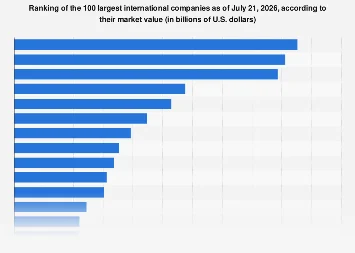
As of July 21, 2026, the global economic landscape is dominated by a select group of multinational corporations whose market valuations reach astronomical figures, reshaping industries and influencing global economic trends. Leading this pack is the American technology giant NVIDIA, which has ascended to the pinnacle of corporate value, boasting an impressive market capitalization of $4.769 trillion USD. This valuation underscores NVIDIA’s profound influence in the burgeoning fields of artificial intelligence, high-performance computing, and advanced chip manufacturing, sectors that are experiencing exponential growth and driving technological innovation worldwide.
Following closely behind, with a valuation of approximately $4.562 trillion USD, is Apple Inc. The Cupertino-based behemoth continues its reign as a consumer electronics and services powerhouse, consistently demonstrating its ability to innovate and maintain a loyal global customer base. Apple’s sustained success is a testament to its integrated ecosystem of hardware, software, and services, which continues to command premium pricing and significant market share across multiple product categories.
Alphabet (Google), the parent company of the world’s most dominant search engine, ranks third with a market value of $4.437 trillion USD. Its vast digital advertising empire, coupled with significant investments in cloud computing, artificial intelligence research, and other ventures like Waymo, solidifies its position among the top global corporations. Microsoft, another stalwart of the technology sector, is positioned at fourth place with a valuation of $2.888 trillion USD. Its strategic expansion into cloud services with Azure, coupled with its enduring presence in enterprise software and gaming, continues to drive its robust market performance.
E-commerce and cloud computing giant Amazon rounds out the top five, commanding a market capitalization of $2.646 trillion USD. Amazon’s diversified business model, encompassing online retail, cloud infrastructure (AWS), digital streaming, and artificial intelligence, continues to exhibit remarkable resilience and growth.
The semiconductor industry, critical to the functioning of the modern digital economy, features prominently in the top rankings. Taiwan Semiconductor Manufacturing Company (TSMC), a linchpin in global chip production, holds the sixth position with a valuation of $2.243 trillion USD. Its indispensable role in supplying advanced microchips to a vast array of technology companies globally underscores its strategic importance.
Emerging as a significant force is SpaceX, the pioneering aerospace manufacturer and space transportation services company founded by Elon Musk. With a valuation of $1.969 trillion USD, SpaceX’s disruptive innovations in reusable rocket technology and its ambitious Starlink satellite internet constellation project have propelled it into the upper echelons of global corporate value, signaling a new era of private enterprise in space exploration and connectivity.
Broadcom, another key player in the semiconductor and infrastructure software sectors, secures the eighth spot with a market value of $1.764 trillion USD. Its strategic acquisitions and focus on high-growth areas like networking, broadband, and mainframe software have contributed to its substantial valuation.
The energy sector, despite ongoing global transitions, still holds significant sway, exemplified by Saudi Aramco. The Saudi Arabian state-owned oil and gas giant ranks ninth with a valuation of $1.685 trillion USD. Its immense reserves and production capacity continue to make it a critical player in global energy markets, though its long-term valuation will be increasingly influenced by global energy policies and the pace of the energy transition.
Meta Platforms, formerly Facebook, closes out the top ten with a market capitalization of $1.562 trillion USD. While navigating evolving social media landscapes and regulatory scrutiny, Meta continues to invest heavily in its metaverse ambitions and artificial intelligence, seeking to define the next frontier of digital interaction.
The list reveals a clear dominance of technology companies, which occupy a disproportionate number of top positions. This trend reflects the ongoing digital transformation across all sectors of the global economy, with companies leveraging data, AI, and advanced computing to drive innovation and market value. The sheer scale of these valuations highlights the immense wealth and influence concentrated within these corporate entities, prompting ongoing discussions about market competition, regulation, and their broader societal impact.
Beyond the top ten, the list continues to feature other significant technology firms, including Tesla ($1.513 trillion USD), which has redefined the automotive industry with its electric vehicles and autonomous driving technology, and Samsung ($1.218 trillion USD), a diversified conglomerate with strengths in electronics, semiconductors, and consumer goods. Micron Technology and SK Hynix, both critical memory chip manufacturers, also feature prominently, underscoring the vital role of memory in the digital infrastructure.
The presence of financial institutions such as JPMorgan Chase ($908.94 billion USD) and Berkshire Hathaway ($1.087 trillion USD), a conglomerate led by Warren Buffett known for its diverse investments, illustrates the continued importance of the financial services sector in the global economy. Walmart ($887.64 billion USD) remains a titan of retail, demonstrating the enduring power of brick-and-mortar and e-commerce integration.
The semiconductor ecosystem is further represented by companies like Advanced Micro Devices (AMD) ($841.56 billion USD) and ASML ($673.43 billion USD), the latter being a critical supplier of photolithography equipment essential for advanced chip manufacturing. Visa ($669.79 billion USD) and Mastercard ($469.73 billion USD) represent the global payment processing industry, a sector that has seen substantial growth driven by digital transactions.
The health sector also shows its resilience and importance, with companies like Johnson & Johnson ($643.3 billion USD) and Eli Lilly ($1.101 trillion USD) achieving high valuations, reflecting sustained demand for pharmaceuticals, medical devices, and healthcare services. Energy giants like Exxon Mobil ($587.29 billion USD) and Chevron ($346.55 billion USD) still command significant market presence, albeit with the backdrop of evolving energy policies and the push towards sustainability.
Several Chinese technology and financial companies are also making their mark on the global stage. Tencent ($530.47 billion USD), a major player in social media, gaming, and digital payments, and China Construction Bank ($386.48 billion USD), along with other major Chinese banks, highlight the growing economic might of China.
The data also points to a significant shift in the nature of value creation. Companies that are at the forefront of technological innovation, particularly in areas like artificial intelligence, cloud computing, and advanced manufacturing, are accumulating wealth and influence at an unprecedented rate. This concentration of value in specific sectors and companies raises important questions about market dynamics, potential antitrust concerns, and the equitable distribution of economic benefits.
Furthermore, the global geographic distribution of these top-tier companies is heavily weighted towards North America and Asia, with a notable presence from Europe and the Middle East. This reflects the current centers of technological advancement, capital markets, and consumer demand.
The ongoing fluctuations in stock markets mean that these valuations are dynamic, subject to daily changes based on investor sentiment, economic indicators, and company performance. However, the sustained dominance of these particular entities in mid-2026 suggests a robust and well-established competitive landscape, shaped by continuous innovation, strategic expansion, and the increasing digitization of global commerce and daily life. The sheer scale of these market capitalizations underscores the profound economic impact these corporations have, influencing employment, investment, technological development, and consumer behavior on a global scale.