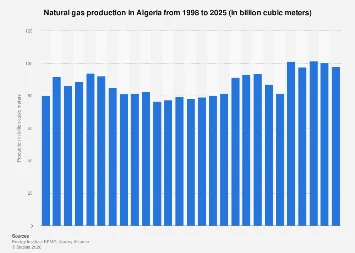
Algeria’s natural gas production is projected to reach approximately [masked value] billion cubic meters in 2025, reflecting a [masked value] percent decline compared to the preceding year. This anticipated dip marks a continuation of recent output trends, though the nation’s gas sector has experienced significant growth over the long term. Between 1998 and the projected 2025 figures, Algeria’s natural gas production has expanded by nearly [masked value] billion cubic meters. This substantial increase underscores Algeria’s enduring importance as a major energy supplier, particularly to European markets. The sector’s trajectory, however, has been marked by a peak in production observed in 2023, suggesting a potential recalibration or plateauing in output levels.
Algeria’s energy landscape is dominated by hydrocarbons, with natural gas playing a pivotal role in both its domestic economy and its international trade relationships. As the third-largest gas producer in Africa, behind Nigeria and Egypt, Algeria holds a strategic position in global energy security, especially for European countries heavily reliant on gas imports. The nation’s extensive natural gas reserves, estimated to be among the largest in the world, provide a robust foundation for its production capabilities. Sonatrach, the state-owned oil and gas company, is the primary driver of exploration, extraction, and distribution, managing vast infrastructure networks that facilitate the transport of gas through a sophisticated pipeline system, including major trans-Mediterranean routes to Italy and Spain.
The dynamics of Algeria’s natural gas production are influenced by a complex interplay of factors. Global energy demand, fluctuating international prices, and the pace of domestic consumption all contribute to output levels. Furthermore, the country’s commitment to developing its oil and gas sector, including investments in new exploration and enhanced recovery techniques, plays a crucial role. However, the sector also faces challenges, including the need for continuous infrastructure upgrades, the impact of geopolitical events on energy markets, and the increasing global pressure to transition towards cleaner energy sources. The projected decrease in production for 2025, while modest in the context of the overall historical growth, signals a need for careful strategic planning to maintain its competitive edge and meet evolving market demands.
The historical data indicates a strong upward trend in Algerian natural gas production over the past two and a half decades. This growth has been driven by a combination of factors, including increasing global demand for natural gas as a cleaner alternative to coal and oil, coupled with Algeria’s strategic location and established export infrastructure. The country has consistently been a significant supplier to Europe, leveraging its proximity to the continent. Production figures from 1998 show a baseline from which substantial expansion has occurred, culminating in a peak in 2023. This peak production year suggests a period of maximized output, potentially influenced by favorable market conditions or the successful commissioning of new extraction projects. The subsequent projected decrease for 2025 could be attributed to a variety of reasons, including the natural depletion of some older fields, increased domestic demand for energy, or strategic decisions to manage reserves more sustainably.
The economic implications of Algeria’s natural gas production are profound. Hydrocarbons account for a significant portion of the nation’s export earnings and government revenue, underpinning its fiscal stability and economic development initiatives. The natural gas sector is a major employer, directly and indirectly supporting a substantial workforce. Fluctuations in production and international prices can have a direct impact on the national budget, influencing government spending on social programs, infrastructure projects, and economic diversification efforts. Therefore, maintaining a stable and competitive natural gas production output is of paramount importance for Algeria’s economic well-being.
Globally, Algeria’s natural gas production contributes to the diversification of energy supplies for importing nations. Its role as a reliable supplier, particularly to Europe, helps to mitigate risks associated with over-reliance on single sources. The country’s production levels are closely watched by market analysts and policymakers in energy-importing regions, as changes in its output can influence regional gas prices and supply security. Comparisons with other major gas producers, such as Russia, Qatar, and the United States, highlight Algeria’s position within the global energy market. While it may not match the sheer volume of some of these larger players, its strategic importance, particularly for the European market, remains significant.
Looking ahead, Algeria’s natural gas sector faces a dynamic future. The global energy transition, with its increasing emphasis on renewable energy sources, presents both challenges and opportunities. While demand for natural gas is expected to remain robust in the medium term, particularly as a transitional fuel, the long-term outlook will be shaped by the pace of decarbonization efforts worldwide. Algeria is actively exploring ways to enhance the efficiency of its existing operations, invest in new technologies, and potentially develop its liquefied natural gas (LNG) export capacity to reach a wider range of markets. The country’s ability to adapt to these evolving global energy dynamics will be critical for sustaining its position as a key energy producer.
The projected production figures for 2025 should be viewed within this broader context of global energy trends and domestic policy objectives. The anticipated decline, while noteworthy, does not diminish Algeria’s status as a significant player in the global gas market. Instead, it may signal a strategic shift towards optimizing resource management, focusing on higher-value exports, or responding to increased domestic energy needs driven by population growth and industrial development. Continued investment in exploration and production technologies, alongside a commitment to sustainable practices, will be essential for Algeria to navigate the complexities of the international energy landscape and secure its long-term energy future. The nation’s strategic importance in supplying natural gas, especially to Europe, means its production trends will continue to be a critical indicator of regional and global energy market stability.