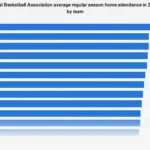



The National Basketball Association (NBA) continues to be a titan of global sports entertainment, drawing massive crowds to its arenas year after year. As the league gears up for the 2026 season, projections and analyses of team attendance figures offer a crucial lens through which to view the sport’s economic health, fan engagement, and market dynamics. Understanding these projected attendance figures is not merely an academic exercise; it provides vital insights into team valuations, sponsorship appeal, and the overall commercial viability of franchises in an increasingly competitive entertainment landscape.
While specific, officially released attendance data for the 2026 NBA season remains a forward-looking metric, industry analysts and sports business forecasters consistently track trends and extrapolate future performance based on historical data, market conditions, and evolving fan behavior. These projections are indispensable for investors, league officials, team owners, and marketers aiming to capitalize on the NBA’s immense popularity. The NBA’s consistent performance in terms of gate receipts and overall revenue places it at the forefront of professional sports leagues, with attendance figures serving as a primary driver of this financial success.
Factors influencing projected attendance are multifaceted. Broadly, they can be categorized into team performance, star power, arena experience, local market demographics, and the broader economic climate. A winning team, led by charismatic, high-profile players, invariably attracts more fans. The allure of seeing generational talents like LeBron James, Stephen Curry, or emerging superstars like Luka Dončić and Jayson Tatum in action is a significant draw, translating directly into ticket sales and premium seating revenue. The league’s commitment to enhancing the in-arena experience – from advanced audiovisual technology and diverse food and beverage options to interactive fan zones and exclusive hospitality suites – also plays a critical role in encouraging repeat visits and attracting new attendees.
Market size and demographics of the team’s home city are also pivotal. Franchises located in major metropolitan areas with larger populations and higher disposable incomes, such as Los Angeles, New York, or Chicago, generally have a built-in advantage in terms of potential fan base. However, the NBA has demonstrated remarkable success in cultivating passionate fan bases even in smaller markets, such as Milwaukee or Oklahoma City, through strong team performance and community engagement. These smaller markets often boast higher per-capita attendance rates, highlighting the deep connection between teams and their local communities.
Economically, attendance is a foundational element of an NBA team’s revenue stream. Ticket sales, including single-game tickets, season tickets, and group packages, directly contribute to a team’s bottom line. Beyond tickets, attendance figures heavily influence revenue from concessions, merchandise sales, and parking. Furthermore, a consistently high attendance record enhances a team’s attractiveness to corporate sponsors, who seek association with popular and well-attended events to reach a broad and engaged audience. The value of these sponsorship deals is often directly correlated with the visibility and reach provided by a team’s fan base, as reflected in its attendance metrics.
The global reach of the NBA also factors into long-term attendance projections. The league’s international marketing efforts, including regular-season games played abroad and the cultivation of global fan followings for its star players, contribute to an overall increase in interest. This global appeal can translate into increased demand for tickets when international fans visit the United States or even inspire the creation of new fan bases in markets where the league might eventually consider expansion or more frequent international fixtures.
When considering projected attendance for 2026, it is important to acknowledge the cyclical nature of sports. Team performance can fluctuate, and player movements can dramatically alter a team’s fortunes and, consequently, its attendance figures. However, the NBA has a proven track record of resilience. Even during periods of rebuilding or when star players move teams, the league’s established brand, its deep talent pool, and its strategic initiatives generally ensure that attendance remains robust. The introduction of the NBA’s new Collective Bargaining Agreement (CBA), which often includes provisions impacting player movement and team building, can also have subtle but significant effects on competitive balance and, by extension, fan interest and attendance across the league.
Looking ahead to 2026, several factors could influence attendance patterns. The continued growth of digital media and streaming services offers alternative ways for fans to engage with the NBA, potentially impacting in-arena attendance for some demographics. However, the NBA has also been at the forefront of leveraging these technologies, integrating them into the fan experience through mobile ticketing, in-arena apps, and enhanced broadcast offerings. The league’s ability to adapt and innovate in this digital space will be crucial in maintaining the primacy of the live game experience.
Furthermore, the economic health of the United States and global markets will inevitably play a role. Disposable income is a key determinant of discretionary spending on entertainment like professional sports. A strong economy generally supports higher attendance, while economic downturns could lead to a more price-sensitive consumer base. Projections for 2026 will likely incorporate macroeconomic forecasts to gauge the affordability of NBA tickets and associated expenditures for fans.
The NBA’s strategic focus on fan experience is a significant mitigating factor against potential declines in attendance. Investments in modernizing arenas, incorporating technology that enhances engagement, and creating unique hospitality offerings are designed to make attending an NBA game a premium experience that cannot be replicated elsewhere. This focus on the "experience economy" is particularly relevant for younger demographics who prioritize memorable events and social sharing.
While precise numbers for 2026 attendance are speculative, the underlying trends suggest continued strength for the NBA. The league’s commitment to star power, its global appeal, and its ongoing efforts to innovate in fan engagement position it favorably. The economic impact of these projected attendance figures is substantial, underpinning team valuations that consistently rank among the highest in professional sports. As the NBA continues to evolve, its ability to fill arenas will remain a cornerstone of its enduring success and economic power.