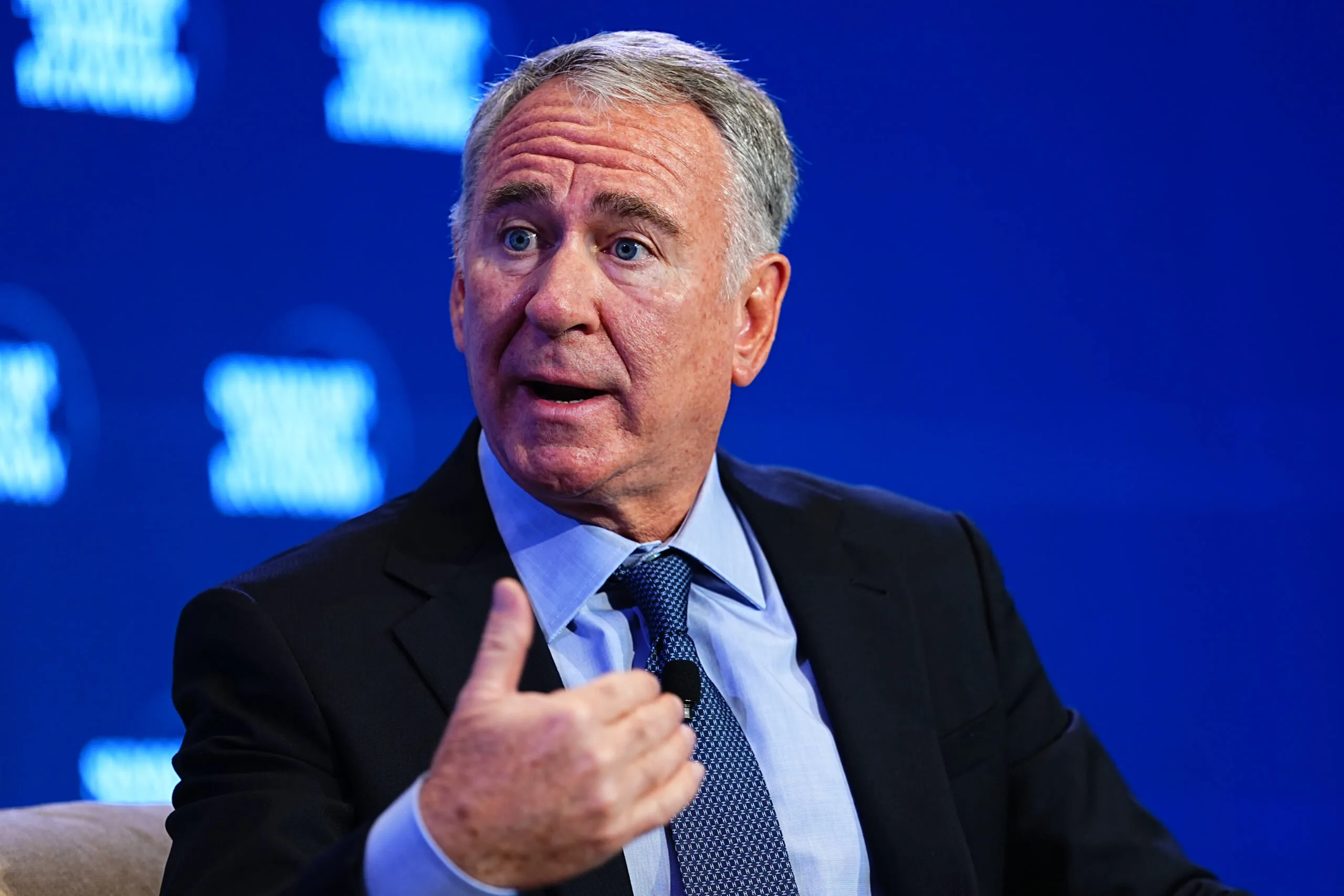
The fragile equilibrium of the global economy currently rests upon a narrow stretch of water less than 21 miles wide at its tightest point. As geopolitical tensions in the Middle East escalate into prolonged maritime disruptions, Ken Griffin, the founder and CEO of Citadel, has issued a stark warning to international markets: the continued closure of the Strait of Hormuz is a direct catalyst for a global recession. Speaking at the Semafor World Economy Summit in Washington, D.C., Griffin articulated a grim forecast, suggesting that if this vital artery for global energy remains obstructed for a period of six to twelve months, the resulting economic contraction would be unavoidable.
The Strait of Hormuz is widely regarded as the world’s most important oil transit chokepoint. Approximately one-fifth of the world’s total oil consumption—and nearly a third of all seaborne-traded oil—passes through this corridor daily. It connects the petroleum producers of the Persian Gulf with key markets in Asia, Europe, and North America. For an global economy still grappling with the aftershocks of post-pandemic inflation and shifting supply chains, the loss of this passage represents a systemic shock that transcends simple fluctuations in fuel prices.
According to Griffin, the timeline is the critical variable. While the global financial system can absorb short-term volatility and temporary spikes in energy costs, a sustained blockade would shatter the logistical frameworks that underpin international trade. “Let’s assume the strait is shut down for the next six to twelve months—the world’s going to end up in a recession,” Griffin stated during his address. “There’s no way to avoid that.” His assessment reflects a growing consensus among macroeconomists that the "energy tax" imposed by sustained triple-digit oil prices would eventually drain consumer purchasing power and drive up manufacturing costs to unsustainable levels.
The Macroeconomic Mechanics of an Energy Shock
The immediate fallout of the current conflict has already been felt in the commodities markets. Crude oil prices, which sat comfortably below $70 per barrel prior to the outbreak of hostilities between the United States and Iran, have surged to hover around the $100 mark. While this is a significant increase, it remains below the record highs seen in previous decades when adjusted for inflation. However, the danger lies not just in the current price, but in the potential for a "parabolic move" should the blockade persist.
When energy prices rise sharply and stay elevated, the economic impact is twofold. First, it acts as a regressive tax on consumers. As the cost of gasoline, heating, and electricity climbs, households are forced to divert discretionary income toward basic utilities, leading to a contraction in retail spending and services—the primary engines of growth in developed economies. Second, the industrial sector faces a massive surge in input costs. From petrochemicals and plastics to logistics and aviation, every sector of the modern economy is tethered to the price of hydrocarbons.
Furthermore, a prolonged energy crisis complicates the mandate of central banks. Over the past two years, the Federal Reserve and the European Central Bank have been engaged in a delicate balancing act, raising interest rates to cool inflation without triggering a hard landing. A supply-side shock like the closure of the Strait of Hormuz renders traditional monetary policy tools less effective. Interest rate hikes cannot produce more oil or clear a shipping lane; they can only suppress demand, which, in this context, means forcing a recession to bring prices down.
The Disconnect Between Markets and Geopolitical Risk
One of the most perplexing aspects of the current crisis is the resilience of equity markets. Despite the military exchanges that began in early 2026, major stock indices have managed to rebound to pre-conflict levels. This "optimistic sentiment," as Griffin describes it, suggests that investors are operating under the assumption that the conflict will be contained or that a diplomatic resolution is imminent.
However, many analysts argue that the market is failing to price in the "tail risk" of a catastrophic escalation. The current stability is built on the hope that the conflict will remain a localized military engagement rather than a total regional conflagration. If the Strait of Hormuz remains inaccessible, the "risk premium" currently embedded in oil prices—roughly $20 to $30 per barrel—could double. Griffin’s commentary suggests that the market’s current buoyancy is contingent on a duration that may be unrealistically short. If the blockade moves from weeks into months, the sudden repricing of risk could lead to a severe and synchronized sell-off across global exchanges.
Asia’s Precarious Position
While a global recession would spare few, the immediate economic pain would be felt most acutely in Asia. Major economies such as China, India, Japan, and South Korea are heavily dependent on Middle Eastern crude to fuel their massive industrial bases. Unlike the United States, which has achieved a high degree of energy independence through the shale revolution, Asian giants remain tethered to the Persian Gulf.
For China, the world’s largest oil importer, a $100-plus oil environment threatens its already cooling manufacturing sector. For India, where energy subsidies are a significant part of the national budget, prolonged high prices could lead to a ballooning fiscal deficit and a weakened currency. The vulnerability of these "engines of growth" means that a slowdown in Asia would rapidly transmit to the rest of the world through reduced demand for exports and disrupted high-tech supply chains.
The Great Energy Pivot: Accelerating the Transition
A recurring theme in Griffin’s analysis is the long-term structural shift that such a crisis inevitably triggers. Much like the oil shocks of the 1970s spurred the development of fuel-efficient vehicles and North Sea oil exploration, the current blockade is expected to ignite a massive, accelerated shift toward alternative energy sources.
“The world is going to see a massive shift toward alternative fuel sources, including wind, solar, and nuclear,” Griffin noted. This shift is no longer merely an environmental imperative but a core component of national security strategy. When the primary energy corridor of the world is subject to the whims of geopolitical actors, "energy sovereignty" becomes the priority.
Nuclear energy, in particular, is seeing a significant renaissance in policy circles. Long sidelined due to safety concerns and high capital costs, nuclear power offers a baseline of carbon-free energy that is immune to maritime blockades. Similarly, the volatility of fossil fuel prices makes the fixed-cost nature of renewables like solar and wind increasingly attractive to long-term institutional investors. However, Griffin cautioned that while this transition is inevitable, it cannot happen overnight. The "bridge" to a renewable future still requires the stable flow of hydrocarbons, and a 12-month gap in that flow could destroy the very capital needed to fund the green transition.
Geopolitical Strategy and the Cost of Inaction
The military dimension of the crisis also entered Griffin’s assessment. He suggested that the consequences of the current war might have been significantly more dire had the United States delayed its strategic strikes. By addressing Iran’s military capabilities before they reached a more advanced state, Griffin argues that the U.S. may have prevented an even more protracted or lethal confrontation.
This "preventative" logic, however, does little to soothe the immediate economic anxiety. The reality of 2026 is a world where the lines between military strategy and global finance have blurred entirely. The Strait of Hormuz is no longer just a geographical feature; it is a pulse point for the global standard of living.
A Period of Profound Uncertainty
As the world watches the developments in the Middle East, the economic stakes have never been higher. The difference between a "mid-cycle slowdown" and a "global recession" may come down to the persistence of a single maritime blockade. Ken Griffin’s warnings serve as a reminder that the global economy is a highly integrated, yet highly fragile, machine.
The coming months will determine whether the world can pivot toward energy resilience or if it will succumb to the inflationary pressures of a closed sea lane. For now, the $100 barrel of oil stands as a sentinel of uncertainty, marking the boundary between a managed crisis and an unavoidable economic downturn. If the gates of Hormuz remain shut, the path to a global recession appears not just possible, but a mathematical certainty in the eyes of one of the world’s most influential financial leaders.