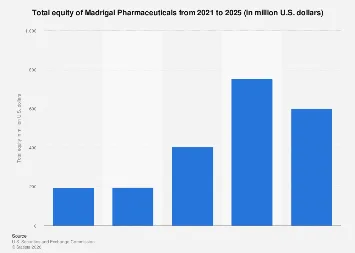
As the global pharmaceutical industry navigates an era of intense innovation, regulatory scrutiny, and evolving market demands, understanding the projected financial trajectory of key players like Madrigal Pharmaceuticals becomes paramount for investors, analysts, and industry stakeholders. While precise figures for future equity are subject to a myriad of economic variables and company-specific performance, an examination of the factors influencing such projections offers crucial insights into the company’s anticipated financial standing by 2025. This analysis delves into the potential drivers and determinants of Madrigal Pharmaceuticals’ total equity, exploring its strategic positioning, R&D pipeline, market penetration, and the broader economic climate.
The pharmaceutical sector is characterized by its high capital expenditure requirements, particularly in research and development. Companies invest billions in the discovery, testing, and approval of new drugs, a process that is both lengthy and fraught with uncertainty. Madrigal Pharmaceuticals, a biopharmaceutical company focused on developing therapies for liver and metabolic diseases, is no exception. Its equity position in 2025 will be significantly shaped by the success or setbacks of its lead candidate, resmetirom, a thyroid hormone receptor-beta (TRβ) selective agonist. The drug’s potential approval and market uptake for nonalcoholic steatohepatitis (NASH) and its fibrotic counterpart, NASH cirrhosis, represent a substantial opportunity for revenue generation and, consequently, a significant boost to the company’s equity. Positive clinical trial outcomes and regulatory endorsements, particularly from bodies like the U.S. Food and Drug Administration (FDA) and the European Medicines Agency (EMA), are critical inflection points that will directly impact investor confidence and valuation.
Beyond specific drug development, Madrigal’s overall equity in 2025 will be a function of its ability to manage its balance sheet effectively. This includes its cash reserves, debt levels, and the valuation of its assets. The company’s current funding strategy, whether through equity financing, debt issuance, or revenue generated from existing or emerging products, will play a crucial role. For instance, if Madrigal secures substantial investment or successfully commercializes resmetirom, it could lead to a significant increase in its retained earnings, a key component of total equity. Conversely, substantial R&D expenses without commensurate revenue growth, or unexpected clinical trial failures, could dilute equity or necessitate dilutive financing rounds.
The competitive landscape for NASH treatments is rapidly intensifying. Several other pharmaceutical giants and emerging biotechs are vying for a significant share of this burgeoning market, estimated to reach tens of billions of dollars annually. Madrigal’s ability to differentiate its product, secure favorable pricing, and establish robust distribution channels will be critical. Success in these areas will translate into higher sales volumes and profitability, directly impacting equity. Moreover, the company’s intellectual property strategy, including patent protection for its key drug candidates, is a vital asset that contributes to its overall valuation and long-term equity stability.
Global economic conditions and the broader healthcare market dynamics will also cast a long shadow over Madrigal’s financial outlook. Factors such as inflation, interest rates, and the overall health of capital markets can influence the cost of capital and investor appetite for risk. In an environment of rising interest rates, for example, companies with significant debt burdens may face higher financing costs, potentially impacting profitability and equity. Similarly, shifts in government healthcare policies, drug pricing regulations, and reimbursement landscapes can create both opportunities and challenges. The growing emphasis on value-based healthcare and the scrutiny of drug pricing globally could influence the revenue potential of resmetirom and future pipeline assets, thus affecting equity.
Furthermore, the operational efficiency of Madrigal Pharmaceuticals, including its manufacturing capabilities, supply chain management, and marketing effectiveness, will contribute to its financial performance. Streamlined operations can lead to lower costs of goods sold and improved profit margins, thereby bolstering equity. As the company potentially scales up production for resmetirom, its ability to manage these logistical and manufacturing complexities will be a key determinant of its financial health and, by extension, its equity.
Looking at broader industry trends, the pharmaceutical sector is experiencing a surge in mergers and acquisitions (M&A) activity. Larger, established companies often seek to acquire innovative smaller firms to bolster their pipelines and gain access to new markets. Madrigal Pharmaceuticals, with its promising pipeline, could become an attractive acquisition target, which would fundamentally alter its equity structure, potentially leading to a significant payout for shareholders. Conversely, Madrigal itself might pursue strategic partnerships or acquisitions to accelerate its growth or expand its therapeutic reach.
In terms of specific metrics, total equity is calculated as total assets minus total liabilities. For Madrigal Pharmaceuticals in 2025, an increase in total assets, driven by successful product launches, intellectual property development, or strategic investments, would contribute positively. Simultaneously, prudent management of liabilities, such as minimizing debt or effectively servicing existing obligations, would enhance the equity position. The company’s ability to generate strong free cash flow will be crucial for reinvesting in R&D, funding operations, and potentially returning capital to shareholders through buybacks or dividends, all of which can influence the dynamics of its equity.
The projected equity of Madrigal Pharmaceuticals by 2025, therefore, is not a static number but a dynamic outcome of a complex interplay of scientific innovation, market forces, regulatory environments, and financial management. While precise projections require access to proprietary financial models and real-time market data, a qualitative assessment based on the company’s strategic direction, pipeline strength, and industry context suggests a period of significant potential growth and evolution. The successful development and commercialization of resmetirom remains the central pillar around which its future equity will likely be built, underscoring the high-stakes nature of its current endeavors. Investors and analysts will be closely monitoring clinical trial results, regulatory approvals, and market reception to gauge the company’s progress and its ultimate financial standing. The pharmaceutical industry’s inherent volatility means that while the upside potential is considerable, the risks are equally substantial, making the journey to 2025 a critical phase for Madrigal Pharmaceuticals.