For over seventy years, Germany has been a beacon of economic prosperity and political stability in Europe, a testament to its remarkable post-World War II recovery. From the foundational leadership of Konrad Adenauer to the long tenure of Angela Merkel, the Federal Republic of Germany appeared to embody a model of steady growth and resilience, even successfully integrating the former East German economy with relative speed following the fall of the Berlin Wall. While the decades were not without their trials, including the terrorism of the Red Army Faction in the 1970s and the economic shocks of oil price crises, Germany’s export-driven industrial prowess propelled it to become the world’s third-largest economy by 1973. However, the current era presents a starkly different picture. A confluence of factors, including waning export competitiveness against rising global players like China, increased resentment towards immigration following the 2015 refugee influx, and a burgeoning far-right populist movement, signals a period of introspection and potential reinvention for Europe’s economic powerhouse. The very foundations of the political and economic order established in 1949 are now being openly questioned, prompting a critical re-evaluation of Germany’s past successes and future trajectory.
The genesis of Germany’s post-war economic ascendancy, often referred to as the "Wirtschaftswunder" (economic miracle), is typically attributed to a dual approach initiated in 1948: the currency reform spearheaded by Ludwig Erhard and the aid provided through the European Recovery Programme (ERP), widely known as the Marshall Plan. The Marshall Plan, signed into law by US President Harry Truman in April 1948, began disbursing aid to Germany by early July. In return for this vital assistance, Germany was expected to adhere to a set of economic principles that bore a striking resemblance to the "Washington Consensus" principles that would emerge decades later. These included fiscal discipline, inflation control, the dismantling of rationing and price controls, the encouragement of private enterprise, and trade liberalization.
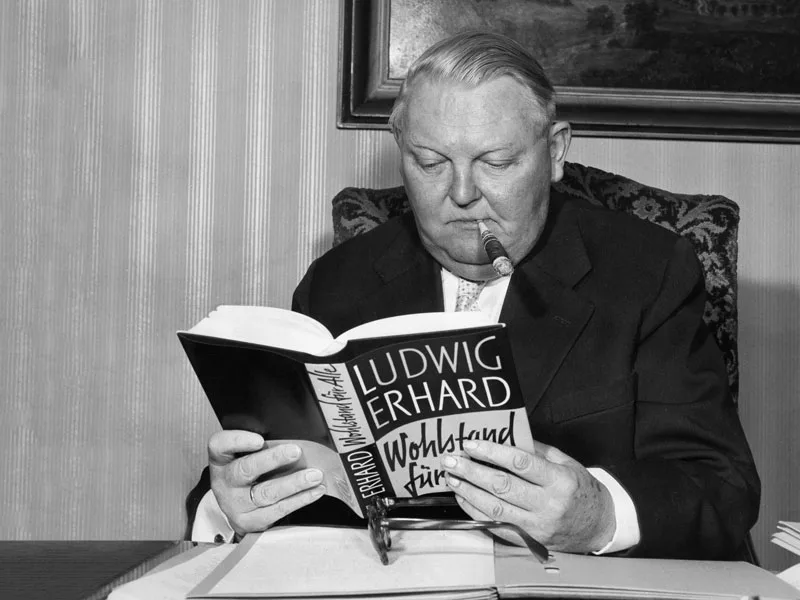
A pivotal moment in this economic revival was the currency reform orchestrated by Erhard. On June 20, 1948, the Deutsche Mark replaced the depreciated Reichsmark in the Bizone, the Anglo-American occupation zone. This reform effectively eliminated the "monetary overhang" – a surplus of currency fueling black market activity and shortages in the official economy – by converting Reichsmarks to Deutsche Marks at a 10:1 ratio. Acting decisively, Erhard unilaterally abolished most price controls and rationing on June 21st. This bold move, coupled with fiscal prudence and the infusion of Marshall Plan aid, led to a dramatic resurgence of goods in stores. Farmers, now compensated with tangible currency, were incentivized to bring their produce to market, alleviating food scarcity. The stabilized exchange rate further empowered German firms to export and sell domestically, stimulating hiring, investment, and production. This period saw West Germany achieve an unprecedented annual growth rate of six percent over the subsequent quarter-century, solidifying its position as a global economic leader.
However, recent historical scholarship challenges the conventional narrative of the Wirtschaftswunder’s origins. Two prominent economists, Carl-Ludwig Holtfrerich of the Free University of Berlin and Tobias Straumann of the University of Zurich, offer nuanced perspectives. Holtfrerich’s research suggests that Erhard, despite claiming credit throughout his political career, played no direct role in designing the currency reform itself. Straumann, meanwhile, argues that the 1948 reforms, while crucial, did not guarantee the long-term sustainability of Germany’s economic recovery. He posits that the 1953 London Debt Agreement was instrumental, as it absolved Germany of the potentially crippling reparation obligations that had plagued it after World War I.
The London Debt Agreement, the result of extensive negotiations between Germany and 20 creditor nations led by the US, UK, and France, represented a significant departure from post-WWI reparations settlements. Straumann attributes this outcome to a profound "lessons of history" hypothesis. Negotiators recognized the devastating economic and political consequences of the 1921 reparations burden, which contributed to the Weimar Republic’s collapse and the rise of Nazism. Consequently, there was a collective imperative to avoid a similar catastrophe.
While the historical lessons were undoubtedly influential, the broader geopolitical context of the Cold War played a critical role. The urgent need to rebuild West Germany as a bulwark against Soviet expansionism created an economic imperative absent in the post-WWI era. Normalizing Germany’s financial relations was essential for its integration into the global economy, enabling it to secure foreign loans and export goods without fear of asset seizure. The London Debt Agreement stipulated that Germany would service existing pre-war and post-war loans but deferred Nazi-era war debts and occupation costs, with all reparation obligations contingent on future German reunification.
Crucially, the agreement coincided with a burgeoning European integration movement. French Foreign Minister Robert Schuman’s proposal for joint control of French and German heavy industry, leading to the European Coal and Steel Community (ECSC), was a direct response to the Soviet threat. The ECSC aimed to harness Germany’s industrial capacity for the benefit of Western Europe while allaying fears of a resurgent German military threat. The success of the debt negotiations likely facilitated the launch of the ECSC, though it was met with initial skepticism from British officials. Furthermore, the London Debt Agreement empowered the German government to normalize relations with Israel, enabling significant German aid and imports to the nascent Jewish state, a vital step in confronting the legacy of the Holocaust.
Holtfrerich’s biography of Edward Tenenbaum, whom he identifies as the true architect of the currency reform, sheds further light on the technical aspects of this critical economic intervention. Tenenbaum, born in Poland and educated in the United States, served as an intelligence officer during WWII before joining the Office of Military Government, United States (OMGUS). It was in his civilian capacity at OMGUS that he designed the currency reform. His work was closely connected with Charles Kindleberger, a prominent figure in international economics and economic history, who later informed Holtfrerich of Tenenbaum’s pivotal role.
The question of why Erhard, rather than Tenenbaum, received widespread credit for the currency reform is addressed by Holtfrerich through three main explanations. Firstly, Tenenbaum was remarkably self-effacing, reportedly unconcerned with personal accolades. Secondly, Erhard was a master of self-promotion, adept at adapting his policy stances to prevailing political winds, transitioning from advocating state intervention to championing sound money and private enterprise. Finally, post-war Germany desperately needed positive role models and a revitalized national identity, making the narrative of a homegrown economic hero like Erhard particularly resonant.
Today’s Germany stands as a direct legacy of the post-war Wirtschaftswunder: a wealthy, democratic nation deeply embedded within the European framework. However, this prosperity is not immutable. The challenges of global economic shifts, including the rise of new economic powers and evolving trade dynamics, coupled with domestic political and social pressures, necessitate a proactive approach. Preserving the economic gains of the past seven decades requires a commitment to innovation, adaptability, and effective leadership capable of navigating the complexities of the 21st-century global economy. Germany, once the architect of its own miracle, now faces the task of orchestrating a new chapter of economic evolution.