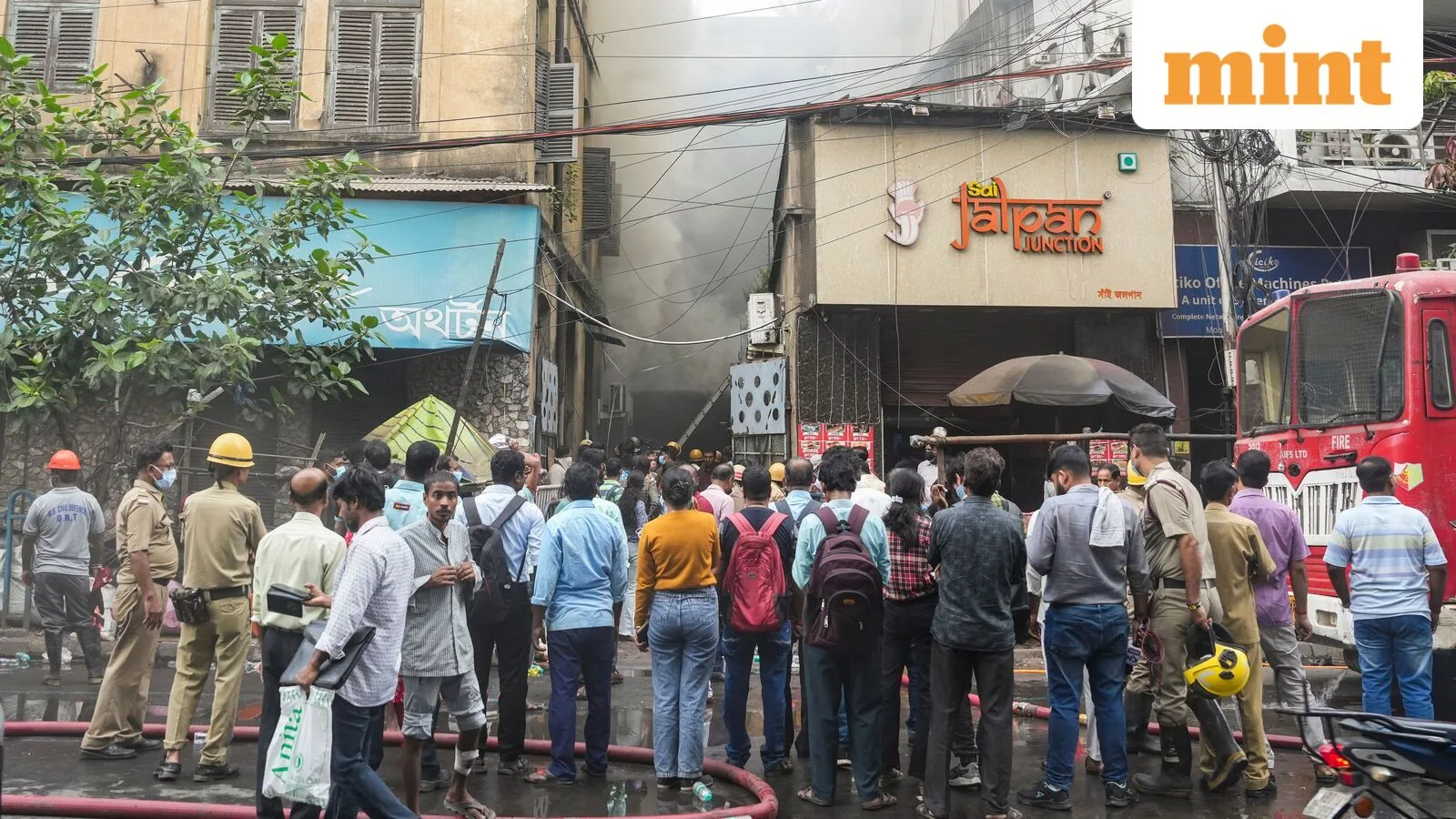
The smouldering ruins of a Kolkata warehouse in late January serve as a stark, tragic emblem of a pervasive crisis plaguing India’s burgeoning industrial and commercial landscape. What began as an inferno at a godown in Anandpur rapidly claimed at least 25 lives, including relatives and friends of 38-year-old Swapan Shaow, a former worker at the very same facility. This devastating event, rooted in profound safety lapses like the absence of fire clearance certificates and basic fire extinguishers, is far from an isolated incident. Across the nation, factories, hotels, markets, and informal units are routinely engulfed in flames, exacting a heavy toll on human life, disrupting economic activity, and exposing deep-seated systemic vulnerabilities in India’s rapid, often unregulated, development trajectory.
The human cost of these industrial conflagrations is staggering, disproportionately affecting the nation’s vast informal workforce. Swapan Shaow’s personal tragedy resonates with countless others who navigate a perilous economic reality. For years, he and hundreds of other workers, employed by various contractors, lived and toiled in conditions where the threat of fire was a constant, unspoken dread. "We knew that if there was a fire, none of us would survive," Shaow recounted, a chilling premonition of the Anandpur disaster. The grief of Gobindo Ghosh, who lost a neighbour and witnesses the daily struggle of a widow and her three-year-old daughter, underscores the profound emotional and social ripple effects of such incidents. These workers, often migrating from rural areas in search of better wages—Shaow, for instance, could earn ₹950 a day during peak season in floral decoration—are the most vulnerable. They typically lack formal contracts, social security, and, critically, insurance coverage, leaving their families to bear the brunt of medical bills and the complete loss of livelihood when tragedy strikes.
National statistics paint a grim picture, though experts suggest a significant underreporting of incidents. According to the National Crime Records Bureau (NCRB) for 2023, India recorded over 7,000 fire accidents resulting in 6,891 deaths. While residential dwellings account for over 54% of these fatalities, the industrial and commercial sectors contribute significantly to the remaining toll. The World Health Organization (WHO) highlights that over one million people in India suffer moderate to severe burns annually, attributing this alarming figure to factors like precarious occupations, poverty, overcrowding, and inadequate safety measures. These statistics, however, likely represent only the tip of the iceberg, as Santosh Poonia, director of India Labour Line at Aajeevika Bureau, notes that data often relies on lodged First Information Reports (FIRs), which can be manipulated to weaken charges, often absolving principal employers by shifting blame to contractors.
The litany of industrial fires over the past year underscores the breadth of the crisis. From a chemical factory in Rajasthan’s Bhiwadi claiming seven lives and a similar blaze in Faridabad injuring dozens, to oil and chemical factory infernos in Ahmedabad and Bengaluru, and warehouse fires in Mumbai and Howrah, the pattern is disturbingly consistent. Beyond manufacturing and storage units, congested markets and hotels have also become death traps, exemplified by the Rituraj Hotel fire in Kolkata’s Burrabazar area which killed 14 people, and a nightclub fire in Goa that claimed 25 lives. These incidents are not merely random occurrences but symptoms of systemic failures spanning regulatory oversight, urban planning, and societal attitudes towards safety.

A significant contributing factor, as observed by urban planner K.T. Ravindran, is the prevalence of electrical origin fires, exacerbated by inadequate building codes and lax enforcement, particularly in informal settlements. These informal hubs, often operating without proper permits or adherence to safety standards, become fertile grounds for disaster. Fire safety authorities, despite being responsible for compliance verification and license reissuance, often fail to effectively utilize their databases, leading to widespread compromises on workplace safety, as Poonia points out. The challenges are compounded by India’s rapidly expanding urban centres, where congested streets impede emergency response. Fire tenders often struggle to navigate heavy traffic and narrow lanes, delaying critical intervention and escalating the scale of destruction and loss of life. Uday Vijayan, managing trustee of Beyond Carlton, a citizens’ movement advocating for fire safety, laments the lack of integration of fire stations into urban planning, arguing that most Indian cities are severely under-equipped with this basic infrastructure. Former West Bengal Fire and Emergency Services Director General Ranvir Kumar stresses that ensuring compliance requires accountability from every stakeholder, acknowledging that no single agency can enforce regulations effectively in isolation.
Despite the existence of robust legal frameworks like The Factories Act, 1948, which mandates proper fire exits, equipment, and worker training, the ground reality remains grim. "Poor enforcement of labour laws in factories is often the root cause of accidents leading to fire," states Poonia. A 2021 report by Aajeevika Bureau, surveying fire hazards in Gujarat’s textile hub of Narol, revealed that 97% of interviewed workers encountered combustible materials at their workplaces, and a staggering 82% estimated it would take 30-60 minutes to exit the premises in case of a fire. Labour economist Ravi Srivastava highlights that each incident exposes how fundamental safety measures are consistently overlooked, with workers bearing the maximum risk, including loss of life. Namrata Kapoor of the Indian Institute of Human Settlements points to a broader structural issue: the shift of formal industrial jobs since the 1980s into informal setups within bastis (slums) and urban peripheries. This informalization deepens labor precarity and significantly deteriorates the built environment, turning everyday workplaces into potential death traps. Rima Mondal, an assistant professor at IIM Calcutta, further notes that while formal manufacturing units might be insured, the subcontracted labor in these informal hubs rarely enjoys such benefits, leaving them without recourse when their livelihoods are abruptly halted by a fire.
The economic repercussions of these unchecked fires are substantial, extending far beyond immediate property damage. The Ficci-Pinkerton 2018 India Risk Survey identified fire outbreaks as the third-largest threat to business, citing non-compliance with safety norms and under-equipped fire services as major causes. The direct costs include extensive damage to property, assets, and equipment, requiring costly repairs or replacements. However, the indirect costs often go unmeasured but are equally devastating. Fires lead to abrupt shutdowns of operations, causing significant losses in output and revenue. For industries heavily reliant on complex supply chains, such as the one sustained by Mumbai’s Dharavi, an informal settlement and bustling economic hub, a single fire can cause a complete breakdown, impacting numerous ancillary businesses and disrupting market flows, as highlighted by Mondal. Srivastava emphasizes that recurrent fires erode overall workplace productivity and business continuity, a larger issue that remains poorly understood and consequently neglected in policy discussions. A 2023 report by the International Copper Association of India, executed by Green Globe, detailed the full spectrum of economic damage, from health implications for survivors to extensive asset losses and prolonged operational disruptions. The lack of insurance coverage for a vast segment of the workforce and informal businesses means that the economic shock is absorbed by the most vulnerable, hindering recovery and perpetuating cycles of poverty.
Addressing India’s burning predicament requires a multi-pronged, concerted effort. Firstly, there must be a rigorous overhaul of regulatory enforcement, ensuring that fire safety authorities are not merely compliance checkers but proactive guardians of workplace safety, utilizing data effectively and holding all stakeholders, including principal employers, accountable. Secondly, urban planning needs to fundamentally integrate fire safety infrastructure, ensuring adequate numbers of well-equipped fire stations and designing urban spaces, particularly in congested areas, to facilitate rapid emergency response. As Namrata Kapoor suggests, the solution for informal settlements is not criminalization but rather support and upgrade: investing in improved building materials, decentralized fire safety measures, cooling solutions, and shared amenities to reduce everyday risks. Furthermore, a national shift in mindset is crucial, fostering greater awareness and personal responsibility towards safety, both in residential and commercial spaces. For workers like Swapan Shaow, who agonizingly questions, "If we think about safety, how will we get work?", the dilemma underscores a profound systemic failure. India’s economic growth cannot be sustainable if it continues to be built on the precarious foundations of unsafe labor and neglected infrastructure. The imperative for change is not just moral; it is an economic necessity to protect lives, secure livelihoods, and ensure the resilience of its industrial future.