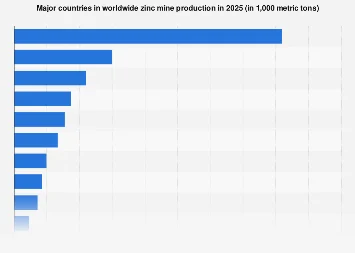
The global zinc market is a critical barometer for industrial activity, underpinning sectors ranging from construction and automotive manufacturing to agriculture and pharmaceuticals. As economic forecasts for 2025 take shape, the perennial question of which nations will lead in zinc production looms large. While precise, up-to-the-minute production figures are often proprietary or subject to revision, analysis of historical trends, announced expansions, and geopolitical factors allows for a robust projection of the leading zinc-producing countries in the coming year. This foresight is invaluable for commodity traders, investors, and policymakers seeking to understand the intricate supply chains and potential market dynamics.
Historically, a handful of nations have consistently dominated the global zinc output. China, with its vast mineral reserves and significant industrial capacity, has long held a commanding position. Its influence extends not only to primary mine production but also to smelting and refining, making it a central node in the global zinc value chain. The sheer scale of China’s manufacturing sector creates a powerful domestic demand pull, often dictating production levels and export strategies. Projections for 2025 suggest that China will likely maintain its top-tier status, although the pace of its growth and its reliance on imported raw materials will continue to be closely watched by market participants.
Australia, with its rich endowment of mineral resources and established mining infrastructure, stands as another perennial giant in the zinc production hierarchy. The country boasts some of the world’s largest and most economically viable zinc deposits, coupled with a sophisticated mining industry known for its technological advancements and environmental stewardship. Future production levels in Australia are influenced by a confluence of factors, including commodity prices, exploration success, regulatory frameworks, and the operational efficiency of its major mining companies. For 2025, Australia is expected to remain a crucial supplier to the global market, contributing significantly to the overall supply of mined zinc.
Following closely behind are Peru and India, two nations that have steadily increased their contributions to global zinc supply. Peru’s mining sector is a cornerstone of its economy, and zinc is among its most important commodities. The country benefits from a favorable geological setting and a government committed to fostering mining investment. Its production capacity has seen consistent growth, and it is poised to remain a key player in 2025. India, on the other hand, has been actively working to boost its domestic mining and refining capabilities to meet its burgeoning industrial demand. Strategic investments in new mines and processing facilities are expected to solidify its position among the leading producers in the coming year.
Beyond these established leaders, several other countries are significant contributors and are worth monitoring for their potential impact on the 2025 market. Canada, with its legacy of resource extraction and diverse mineral deposits, continues to be an important source of zinc. The nation’s stable political environment and advanced mining technologies contribute to its consistent output. Russia, despite geopolitical complexities, possesses substantial zinc reserves and a significant mining industry that plays a role in global supply. Its production capacity is often influenced by global demand and international trade relations.
The Democratic Republic of Congo (DRC) has emerged as a significant player in the base metals market, including zinc, particularly in its eastern regions. While facing challenges related to infrastructure and governance, the country’s vast mineral wealth means its production, especially from large-scale mining projects, can have a noticeable impact. As investments continue to flow into the DRC’s mining sector, its importance in the global zinc supply chain is likely to grow.
Looking ahead to 2025, the global zinc market will not only be shaped by the volume of production but also by evolving consumption patterns and technological advancements. The transition towards electric vehicles (EVs) and renewable energy infrastructure is creating new demand drivers for zinc, particularly in battery technologies and corrosion-resistant coatings for wind turbines and solar panels. This burgeoning demand could incentivize further investment in exploration and production, potentially altering the long-term production landscape.
Moreover, the price of zinc is a critical determinant of production viability. Fluctuations in global commodity prices, influenced by macroeconomic trends, geopolitical events, and the balance of supply and demand, directly impact the profitability of mining operations. For instance, sustained high prices can encourage the development of lower-grade or more challenging ore bodies, while sharp declines can lead to mine closures or reduced output. The London Metal Exchange (LME) zinc price, a widely followed benchmark, will continue to be a key indicator of market sentiment and production incentives.
Environmental, Social, and Governance (ESG) considerations are also increasingly shaping the mining industry. Companies are facing mounting pressure from investors, regulators, and the public to adopt sustainable mining practices, reduce their carbon footprint, and ensure ethical labor conditions. Countries with robust regulatory frameworks and a commitment to ESG principles may attract more investment and see more stable production growth. This trend could favor established mining nations with strong governance structures over those facing greater ESG-related challenges.
The global zinc industry is a dynamic ecosystem where production volumes are intricately linked to economic growth, technological innovation, and a complex web of international trade. While China and Australia are expected to remain at the forefront in 2025, the contributions of countries like Peru, India, and potentially emerging players will be crucial in meeting global demand. Understanding these production dynamics is essential for anyone seeking to navigate the complexities of the international commodity markets and anticipate the economic currents that will define the coming year. The ongoing evolution of demand, particularly from green energy sectors, coupled with the increasing importance of ESG factors, suggests that the global zinc production landscape will continue to adapt and transform.