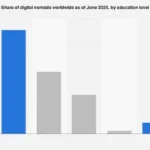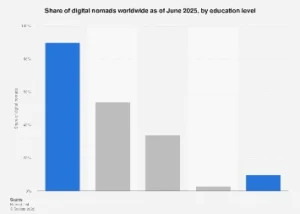

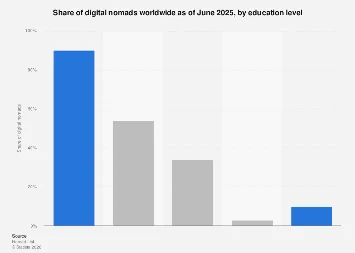
The burgeoning global community of digital nomads, individuals who leverage technology to work remotely while traveling, is increasingly characterized by a diverse and evolving educational profile as we approach 2025. While precise, universally aggregated data on the exact educational attainment of every digital nomad worldwide remains elusive due to the transient and often informal nature of this workforce, emerging trends and available market analyses paint a clear picture: higher education, particularly at the bachelor’s and master’s levels, is becoming a significant differentiator and a common denominator among those successfully navigating this lifestyle. This demographic is not solely comprised of individuals with basic degrees; a substantial and growing segment holds advanced postgraduate qualifications, underscoring the specialized skills and adaptability required in today’s digitally interconnected economy.
The allure of the digital nomad lifestyle, once perceived as primarily accessible to those in creative or freelance fields, is now attracting professionals from a far broader spectrum of industries. Sectors such as technology, marketing, finance, consulting, and even specialized areas within healthcare and education are witnessing an increasing number of their practitioners embracing remote work models. This expansion is directly correlated with the rising educational benchmarks within these professions. For instance, roles in software development, data science, cybersecurity, and digital marketing, which are highly sought after by the digital nomad community, typically demand at least a bachelor’s degree in a relevant discipline. Many individuals in these fields further enhance their credentials with master’s degrees or specialized certifications, enabling them to command higher salaries and secure more stable remote employment opportunities.
Market intelligence reports suggest that individuals with a bachelor’s degree constitute the largest segment within the digital nomad population. This foundational level of education equips them with critical thinking, problem-solving, and communication skills that are transferable across various remote work scenarios. However, the competitive landscape of the global remote job market is driving many to pursue further academic achievements. Master’s degrees, in particular, are increasingly becoming a pathway for digital nomads to specialize in niche areas, such as advanced analytics, international business, or specific software engineering specializations. These advanced qualifications not only boost earning potential but also provide the intellectual capital necessary to adapt to rapidly changing technological landscapes and evolving client demands.
The economic implications of this educational stratification are significant. Highly educated digital nomads often possess a greater capacity to negotiate favorable remote work contracts, secure positions with multinational corporations offering global benefits, and even launch their own entrepreneurial ventures. Their ability to leverage specialized knowledge translates into higher income, which in turn contributes more significantly to the economies of the countries they visit. This demographic is less likely to rely on low-paying gig work and more inclined to engage in high-value service exports, bringing foreign currency into host nations. Data from various surveys indicate that digital nomads with postgraduate degrees tend to have higher disposable incomes and spend more on local services, accommodation, and tourism, thereby acting as a valuable economic stimulus.
Globally, the trend mirrors developments in developed economies, where the digital nomad movement is gaining traction. Countries like the United States, Canada, and those in Western Europe have a high proportion of individuals with advanced degrees participating in this lifestyle. This is largely due to the robust higher education systems in these regions and the established infrastructure supporting remote work. However, the phenomenon is not confined to these areas. Emerging economies are also seeing a rise in educated individuals adopting the digital nomad model, often as a means to access global job markets while remaining connected to their home countries or exploring new opportunities. This cross-pollination of talent and ideas can foster innovation and economic growth in both sending and receiving regions.
Furthermore, the pursuit of lifelong learning is becoming an intrinsic part of the digital nomad identity. Many individuals in this community actively engage in online courses, bootcamps, and professional development programs to stay abreast of industry advancements. This continuous upskilling is often driven by the need to remain competitive in a global remote workforce and to adapt to the specific requirements of international clients or employers. This commitment to education, irrespective of formal degree attainment, underscores a profound shift towards a knowledge-based global economy where adaptability and continuous learning are paramount.
The impact of digital nomads on the global economy is multifaceted. Beyond direct spending, their presence can lead to the development of specialized co-working spaces, accommodation services tailored to long-term stays, and the expansion of digital infrastructure in popular destinations. Governments worldwide are increasingly recognizing the economic benefits of attracting this demographic, leading to the introduction of digital nomad visas and other incentives. These policies often target individuals with demonstrable professional skills and stable income streams, which are, in turn, strongly correlated with higher educational attainment. The educational background of digital nomads, therefore, not only influences their individual career trajectories but also shapes their economic contribution and the policy responses they elicit on a global scale. As we look towards 2025, the educated digital nomad is poised to remain a significant and influential force in the global economic landscape.