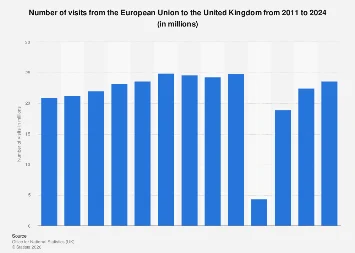
The United Kingdom continues to be a significant draw for European travelers, with inbound visits from European Union member states showing a positive trajectory in 2024 compared to the previous year. However, this resurgence, while welcome, has not yet fully restored visitor numbers to the levels seen before the global COVID-19 pandemic disrupted international travel. The ongoing recovery highlights the resilience of the UK’s tourism sector and its deep-rooted connections with its European neighbors, while also underscoring the lasting economic shifts and behavioral changes precipitated by the pandemic and evolving geopolitical landscapes.
Data indicates that while the number of inbound trips from the EU to the UK has been climbing, the total for 2024 still falls short of pre-pandemic benchmarks. This nuanced recovery pattern is not unique to the UK; many global destinations are experiencing similar trends as they navigate the post-pandemic era. The International Passenger Survey (IPS), a primary source for such data, employs rigorous methodologies, including interviews with arriving and departing passengers, to capture visits for all purposes—leisure, business, study, and visiting friends and family. Recent enhancements to the IPS estimation methods have also led to revisions of historical data, providing a more accurate reflection of travel patterns.
The impact of the COVID-19 pandemic was profound, leading to a significant contraction in international travel in 2020, with data for that year being unavailable. The subsequent year, 2021, saw further complexities with certain travel routes, such as the Eurotunnel and the Irish border, excluded from specific datasets, making year-on-year comparisons challenging during that period. Despite these data nuances, the overarching trend points to a gradual but incomplete rebound.
Understanding the economic implications of these visitor numbers is crucial. The tourism industry is a substantial contributor to the UK’s Gross Domestic Product (GDP) and a significant source of employment. A robust inflow of European visitors not only boosts revenue for hotels, restaurants, attractions, and transportation services but also supports a wide ecosystem of related businesses, from retail to local crafts. The shortfall from pre-pandemic levels suggests a tangible loss of economic activity, impacting foreign exchange earnings and the wider balance of payments.
Several factors are likely influencing the pace of recovery. The lingering effects of the pandemic, including evolving travel regulations and traveler confidence, continue to play a role. Furthermore, economic conditions within EU member states, such as inflation rates, disposable income levels, and currency exchange rates, directly influence their citizens’ propensity to travel abroad. The UK’s own economic climate, including the cost of living and the perceived value for money for tourists, also plays a part.
The United Kingdom’s strategic decision to leave the European Union, commonly known as Brexit, has introduced a new dimension to its relationship with EU travelers. While direct causal links between Brexit and current tourism figures are complex and subject to ongoing debate, the shift in the UK’s relationship with the EU has undoubtedly altered the broader economic and political context. Changes in visa requirements for some nationalities, although not directly impacting EU citizens for short stays, and the broader perception of the UK as a destination, may subtly influence travel decisions over the long term. For EU citizens, visa-free travel for short stays remains a significant facilitator, but the overall ease of travel, customs procedures, and the perceived welcoming nature of the destination are all elements that contribute to traveler choice.
Looking at global tourism trends provides further context. Destinations worldwide are competing for a share of the recovering travel market. Countries that have successfully managed pandemic recovery, offer competitive pricing, or possess unique cultural and natural attractions are often seeing faster rebounds. The UK’s tourism strategy, therefore, needs to be agile, focusing on its unique selling propositions—its rich history, vibrant cultural scene, iconic landmarks, and diverse landscapes—while also addressing potential barriers to entry and ensuring a positive visitor experience.
The composition of EU visitors is also an important consideration. While the total number is a key metric, understanding the breakdown by nationality, purpose of visit (leisure versus business), and spending patterns can offer deeper insights into the economic impact. For instance, an increase in high-spending leisure tourists can have a disproportionately positive effect on the economy compared to a rise in short-stay business trips.
The UK’s tourism industry is actively working to attract and retain visitors. Marketing campaigns highlighting the diversity of experiences available across England, Scotland, Wales, and Northern Ireland are ongoing. Efforts to promote off-season travel and explore new tourism hubs beyond the traditional major cities are also being undertaken to spread the economic benefits more widely and to manage visitor flows.
Moreover, the rise of digital platforms and social media has transformed how travelers research and book their trips. The UK tourism sector’s online presence, the ease of accessing travel information, and the promotion of authentic experiences through digital channels are critical for engaging with modern travelers, particularly those from the EU who are often well-connected and informed.
The future trajectory of EU inbound tourism to the UK will likely depend on a confluence of factors: sustained global economic stability, effective management of public health concerns related to travel, the UK’s ongoing efforts to enhance its tourism offerings, and the broader geopolitical and economic relationship between the UK and the EU. While the recovery is progressing, the challenge remains to not only return to but also surpass pre-pandemic visitor numbers, ensuring the long-term health and prosperity of one of the UK’s vital economic sectors. The resilience shown thus far is promising, but continued strategic focus and adaptation will be key to unlocking the full potential of this crucial market.