



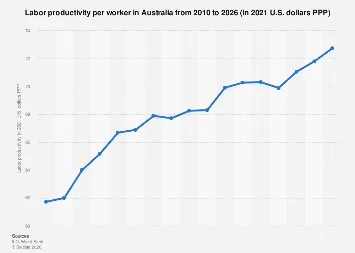
Australia’s economic trajectory in the coming years will be significantly shaped by its ability to foster robust labor productivity growth. Projections indicate a continued, albeit measured, expansion in output per worker, a critical metric for national prosperity and global competitiveness. Understanding the factors influencing this growth, potential headwinds, and the policy levers available is paramount for businesses, policymakers, and investors alike. The economic landscape is increasingly dynamic, with technological advancements, shifts in global trade, and evolving workforce demographics all playing a role in defining the productivity narrative.
The concept of labor productivity – the amount of goods and services produced per unit of labor input – is a cornerstone of economic health. It directly influences real wages, corporate profitability, and a nation’s standard of living. For Australia, a developed economy heavily reliant on its natural resources and increasingly diversifying into services and advanced manufacturing, maintaining and enhancing productivity is not merely an economic goal but a strategic imperative. Forecasts from reputable economic institutions suggest that while challenges exist, the Australian economy is poised for incremental gains in this vital area.
Several key drivers are expected to underpin Australia’s productivity outlook leading up to 2026. Foremost among these is the ongoing digital transformation. Investment in automation, artificial intelligence, and advanced data analytics is poised to streamline operations across various sectors. Industries like mining and agriculture, long the bedrock of the Australian economy, are increasingly adopting sophisticated technologies to optimize resource extraction and crop yields, leading to higher output per hour worked. Similarly, the services sector, which now constitutes a larger share of the Australian GDP, stands to benefit from digital tools that enhance efficiency in areas such as customer service, financial management, and logistics.
Furthermore, a renewed focus on innovation and research and development (R&D) is anticipated to yield positive results. Government initiatives aimed at incentivizing R&D spending by businesses, coupled with investments in higher education and scientific research, are creating an environment more conducive to technological breakthroughs and the adoption of new methodologies. The ability to translate these innovations into practical applications within the workforce will be a critical determinant of productivity gains. This includes not only the development of new technologies but also the refinement of existing processes and the creation of more efficient business models.
The composition of the Australian workforce itself presents both opportunities and challenges for productivity. An aging population may necessitate adjustments in retirement ages and increased participation of older workers, potentially bringing valuable experience but also requiring adaptation in terms of training and work environments. Conversely, a growing influx of skilled migrants can inject new expertise and dynamism into the labor market. The critical factor will be the effective integration of these diverse groups and ensuring they possess the skills demanded by an evolving economy. Upskilling and reskilling initiatives will be essential to equip the workforce for the jobs of the future, particularly those that leverage new technologies.
Global economic conditions will also inevitably influence Australia’s productivity performance. As a trading nation, Australia’s fortunes are intertwined with global demand for its exports, particularly commodities. Fluctuations in commodity prices and demand from major trading partners, such as China, can impact investment levels and, consequently, productivity-enhancing capital expenditure. A stable and growing global economy would provide a more favorable backdrop for Australian businesses to invest in productivity-enhancing technologies and practices. Conversely, global economic uncertainty or trade protectionism could dampen investment and slow productivity growth.
The Australian government and the Reserve Bank of Australia (RBA) are keenly aware of the importance of productivity. Monetary policy, while primarily focused on inflation and employment, can indirectly influence productivity by maintaining economic stability and encouraging investment. Fiscal policy plays a more direct role. Investments in infrastructure – from transportation networks to digital connectivity – are crucial for enabling businesses to operate more efficiently. Policies that support education and training, facilitate business start-ups, and promote competition can also have a significant impact on the productivity landscape. The debate continues regarding the optimal balance of public and private investment in areas that drive productivity, such as digital infrastructure and advanced manufacturing capabilities.
Looking at international benchmarks provides valuable context. Many developed economies are grappling with similar productivity challenges, often referred to as the "productivity puzzle." Factors such as slowing technological diffusion, measurement issues, and the increasing dominance of the services sector, where productivity gains can be harder to capture and measure than in manufacturing, contribute to this global phenomenon. Australia’s performance will be judged not only on its absolute gains but also in comparison to its peers in the OECD. Countries that have successfully navigated these challenges often exhibit strong collaboration between industry, academia, and government, coupled with a proactive approach to workforce development and technological adoption.
Specific sectors within Australia are poised for significant productivity gains. The burgeoning renewable energy sector, for instance, requires substantial investment in new technologies and infrastructure, offering opportunities for efficiency improvements as the sector matures. Similarly, the healthcare sector, facing increasing demand due to an aging population, can leverage digital health solutions and advanced medical technologies to improve patient outcomes and operational efficiency. The challenge lies in ensuring that these advancements translate into measurable increases in output per worker.
However, potential impediments to productivity growth cannot be ignored. Labor market rigidities, while offering certain protections, can sometimes hinder the efficient allocation of talent. The pace of technological adoption can be uneven across different industries and regions, leading to a widening productivity gap. Moreover, the "digital divide" – disparities in access to technology and digital skills – could exacerbate inequalities and limit the broad-based benefits of technological progress. Ensuring inclusive growth will be a critical aspect of Australia’s productivity journey.
The forecasts for Australia’s labor productivity leading up to 2026 suggest a path of steady, rather than explosive, growth. This nuanced outlook reflects the complex interplay of global economic forces, domestic policy decisions, and the inherent challenges of driving productivity in a mature, diversified economy. The focus for businesses will be on strategic investments in technology, human capital, and operational efficiency. For policymakers, the emphasis will be on creating an enabling environment through targeted investments, supportive regulatory frameworks, and robust education and training systems. The ultimate success of Australia’s productivity agenda will hinge on its ability to adapt, innovate, and foster a collaborative approach across all sectors of the economy. The next few years will be a critical period in charting this course, with the nation’s long-term economic prosperity hanging in the balance.