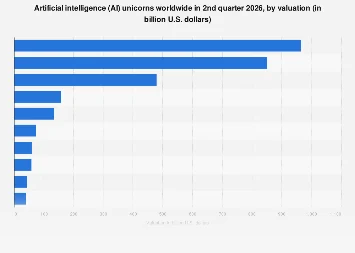
The artificial intelligence sector is poised for an unprecedented expansion, with projections indicating a significant proliferation of "unicorn" companies – privately held startups valued at over $1 billion – by the year 2026. This anticipated boom is not merely a reflection of investor optimism but a tangible signal of the profound economic and technological shifts driven by AI’s accelerating capabilities across a multitude of industries. As foundational AI technologies mature and their applications become more sophisticated and accessible, a new wave of innovators is emerging, capturing substantial market share and attracting significant venture capital.
The current landscape of AI funding reveals a robust and dynamic ecosystem. Venture capital firms, hedge funds, and corporate venture arms are channeling record sums into AI startups, recognizing the immense potential for disruptive innovation and substantial returns. This influx of capital is fueling research and development, enabling companies to scale their operations rapidly, and accelerating the commercialization of cutting-edge AI solutions. The growth trajectory suggests that the number of AI unicorns will not only increase but that their collective valuation will also see a substantial uplift, reshaping global economic power structures.
Several key drivers are contributing to this projected surge. Firstly, the increasing availability of massive datasets, coupled with advancements in computing power and algorithmic efficiency, has unlocked new possibilities in machine learning and deep learning. This has allowed AI to move beyond theoretical concepts into practical, revenue-generating applications. Secondly, the widespread adoption of AI across various sectors, from healthcare and finance to retail and manufacturing, is creating a fertile ground for specialized AI solutions. Companies are no longer viewing AI as a futuristic concept but as a critical tool for enhancing efficiency, personalizing customer experiences, and driving competitive advantage.
The financial implications of this trend are considerable. The rise of AI unicorns signifies a significant transfer of wealth and influence within the global economy. These companies, often born from university research labs or incubated within established tech giants, are disrupting traditional business models and creating entirely new markets. Their valuations are a testament to their perceived future earning potential and their ability to solve complex problems with innovative technological approaches. The economic impact extends beyond the companies themselves, creating jobs, stimulating innovation in related industries, and potentially leading to increased productivity across the global workforce.
Examining the global distribution of AI innovation, North America and Asia continue to be dominant hubs, driven by strong venture capital ecosystems, access to talent, and supportive government initiatives. However, Europe is rapidly closing the gap, with a growing number of AI startups emerging from countries like the UK, Germany, and France, often focusing on specialized AI applications in areas like industrial automation and healthcare. The competitive landscape is intensifying, with companies vying for talent, market share, and investor attention.
The projected growth in AI unicorns by 2026 is not without its challenges. The ethical considerations surrounding AI, including data privacy, bias, and job displacement, are becoming increasingly important and will require careful navigation. Regulatory frameworks are still in their nascent stages, and their evolution will play a crucial role in shaping the future of the AI industry. Furthermore, the intense competition for skilled AI professionals could lead to salary inflation and a talent crunch, potentially hindering the growth of some startups.
Despite these challenges, the fundamental economics of AI remain overwhelmingly positive. The ability of AI to automate tasks, analyze vast amounts of data, and generate predictive insights offers unparalleled opportunities for businesses to optimize operations, reduce costs, and create new revenue streams. For instance, in the healthcare sector, AI is revolutionizing drug discovery, diagnostics, and personalized treatment plans, leading to improved patient outcomes and significant cost savings. In finance, AI-powered algorithms are transforming fraud detection, risk management, and algorithmic trading, enhancing market efficiency and security.
The automotive industry is another prime example, with AI at the core of autonomous driving technology, advanced driver-assistance systems, and predictive maintenance, promising a future of safer and more efficient transportation. The retail sector is leveraging AI for personalized marketing, inventory management, and supply chain optimization, leading to enhanced customer satisfaction and increased profitability. Even the agricultural sector is benefiting from AI-driven precision farming techniques, optimizing crop yields and reducing resource waste.
The valuation metrics for AI startups are often based on a combination of factors, including the size of their addressable market, the uniqueness of their technology, the strength of their intellectual property, the caliber of their leadership team, and their projected revenue growth. Companies that can demonstrate a clear path to profitability and a sustainable competitive advantage are attracting the most significant investment. The ability to scale quickly and capture market share is also a critical determinant of valuation.
Looking ahead, the increasing integration of AI into everyday life and business operations suggests that the trend of AI unicorn creation is likely to persist beyond 2026. As AI capabilities expand into new domains, such as generative AI for content creation and advanced robotics for complex tasks, new investment opportunities will undoubtedly emerge. The economic impact will be further amplified as these technologies become more deeply embedded in global supply chains and critical infrastructure.
The development of AI is not a monolithic event but rather a series of incremental advancements and disruptive breakthroughs. The current wave of investment is largely driven by practical applications of machine learning and deep learning, but future growth may be fueled by advancements in areas like artificial general intelligence (AGI) or novel AI architectures. The companies at the forefront of these developments are likely to be the next generation of AI giants.
In conclusion, the projected increase in AI unicorns by 2026 signifies a pivotal moment in the global economy. It underscores the transformative power of artificial intelligence and its capacity to drive innovation, create new markets, and generate substantial economic value. While challenges and ethical considerations remain, the relentless progress in AI technology and its expanding applications suggest a future where AI-powered businesses will play an increasingly central role in shaping the global economic landscape. The race to build the next generation of AI leaders is well underway, and the coming years promise to be a period of intense innovation and significant economic growth.