The geopolitical landscape of the 21st century is increasingly defined not by territorial borders, but by the digital frontiers of artificial intelligence. At the recent APEC Digital Weeks in Chengdu, China, a significant milestone was reached as the 21 member economies of the Asia-Pacific Economic Cooperation (APEC)—including the world’s two largest superpowers, the United States and China—found a rare, albeit cautious, common ground. The resulting "Chengdu Statement" on Artificial Intelligence marks a pivotal shift in global tech governance, signaling a collective move toward supporting open-source AI development, provided it is underpinned by "strong security assurance."
This multilateral agreement arrives at a time when the debate over AI development has reached a fever pitch. On one side, the libertarian roots of the open-source movement advocate for a decentralized, transparent, and collaborative approach to coding. On the other, sovereign states are increasingly anxious to exert control over a technology that promises to revolutionize everything from military intelligence to financial markets. The Chengdu Statement attempts to bridge this divide, emphasizing a commitment to security, data protection, and intellectual property rights while acknowledging that the future of innovation may lie in open-weight systems rather than the "walled gardens" of proprietary software.
The endorsement of open-source AI by such a diverse group of nations—representing roughly 60% of global GDP and nearly half of world trade—is a recognition of the shifting technological tides. For years, the AI sector was dominated by "closed" models developed by Western giants like OpenAI and Anthropic. These companies maintain strict control over their algorithms, offering access primarily through paid interfaces. However, a new wave of development, spearheaded largely by Chinese firms, is challenging this hegemony. Models such as DeepSeek and GLM 5.2 have gained global traction by being free to download and modify, allowing developers worldwide to build upon their foundations. This democratization of AI has accelerated innovation but has also raised alarms in Washington regarding the potential for intellectual property theft and the misuse of powerful tools by bad actors.
The inclusion of the phrase "strong security assurance" within the Chengdu Statement is the linchpin of this new international consensus. It provides a diplomatic framework that allows security-conscious economies to support open models while simultaneously demanding rigorous testing, transparency, and deployment controls. This reflects a transition from "Open Source 1.0"—characterized by a lack of oversight and a "move fast and break things" mentality—to a more regulated "Open Source 2.0." Under this new paradigm, the debate is no longer a binary choice between open and closed systems. Instead, the focus has shifted to which nations and corporations can build an open ecosystem that is sufficiently trusted by governments and enterprises for large-scale deployment.
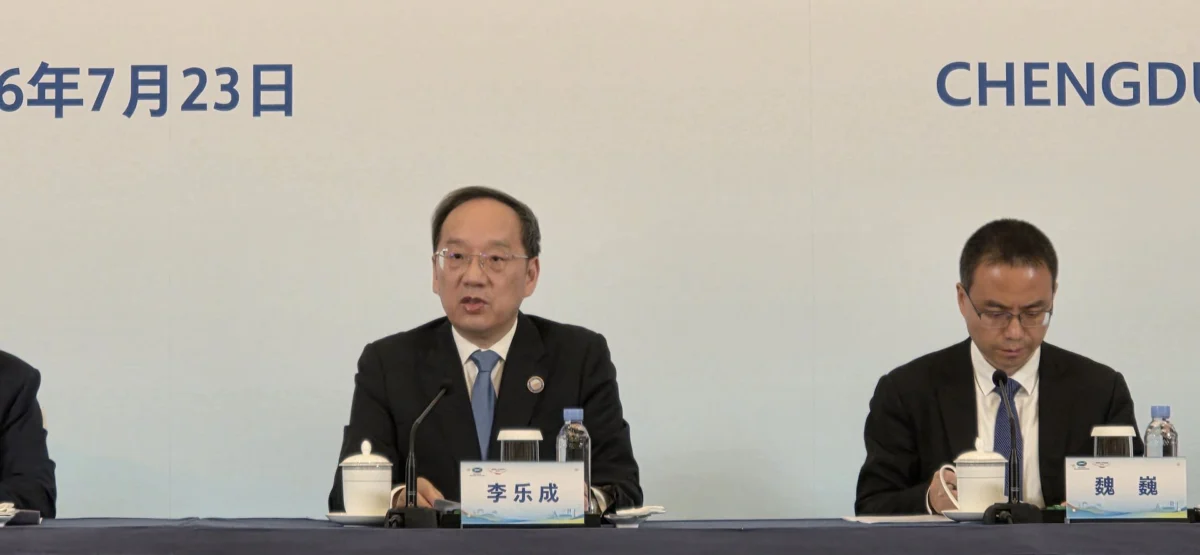
For China, the summit provided a platform to showcase its growing leadership in the AI space. Li Lecheng, China’s Minister of Industry and Information Technology, who chaired the leaders’ meeting, highlighted that this was the first ministerial-level statement to explicitly include open-source cooperation. The Chinese strategy has been to leverage open-source models to bypass some of the hurdles created by U.S. export controls on high-end semiconductors. By fostering a robust open-source ecosystem, Beijing aims to create a standard that is adopted across the Global South and the Asia-Pacific region, thereby reducing reliance on American proprietary technology.
However, the U.S. participation in the Chengdu Statement suggests that Washington is also recalculating its stance. While the U.S. has expressed concerns about Chinese companies "stealing" American tech to bolster their own models, there is a growing realization that open-source AI is an unstoppable force. Major American players like Meta have already embraced an open-weight strategy with their Llama models, arguing that transparency leads to better security through community-driven bug fixes and ethical auditing. By signing the Chengdu Statement, the U.S. is signaling its intent to shape the international standards of this open ecosystem rather than attempting to suppress it.
The economic implications of this shift are profound. Experts suggest that the Asia-Pacific region is moving toward a model where open-weight AI systems are integrated into state-coordinated infrastructure, including energy grids, telecommunications, and digital finance. This "full-stack" approach to AI development treats compute power as a public utility. As nations invest in massive data centers and specialized AI hardware, the ability to run efficient open-source models becomes a matter of national competitiveness. The Chengdu Statement’s alignment around compute infrastructure confirms that the race for AI supremacy is as much about the physical hardware and energy required to run these models as it is about the code itself.
The dialogue in Chengdu also touched upon the inherent risks of AI, ranging from cybersecurity threats to the proliferation of online scams and the resilience of global supply chains. The ministers encouraged a multi-stakeholder approach, involving academia and the private sector, to share information on emerging threats. This is particularly relevant as AI-driven cyberattacks become more sophisticated, capable of bypassing traditional security protocols at a speed and scale previously unimaginable.
Adding another layer of complexity to the discussions was the looming shadow of quantum computing. Janet De Silva, chair of the APEC Business Advisory Council’s Digital and Innovation Working Group, urged ministers to prepare for a post-quantum world. The "Q-Day" scenario—the moment a quantum computer becomes powerful enough to break current encryption standards—poses an existential threat to the global financial system. The Chengdu discussions emphasized that "trusted encryption" must be a cornerstone of the digital economy. In this context, AI is seen as both a potential vulnerability and a solution, with the capacity to develop new, quantum-resistant cryptographic methods.
Market analysts note that the Chengdu Statement could serve as a blueprint for other international bodies, such as the G20 or the OECD. By establishing a baseline for "trusted" open-source AI, APEC members are providing a degree of regulatory certainty that could unlock billions of dollars in enterprise investment. Companies that have been hesitant to adopt AI due to legal or security concerns may find the Chengdu framework a useful guidepost for risk management.
The path forward, however, is fraught with tension. While the statement speaks of cooperation, the underlying rivalry between the U.S. and China for technological dominance remains. Export bans, tariff threats, and disagreements over data sovereignty continue to complicate the relationship. The Chengdu Statement represents a "managed competition" where both sides agree on the rules of the road while continuing to race for the finish line.
As the APEC Digital Weeks concluded, the sentiment in Chengdu was one of cautious optimism. The transition of open-source AI from a niche community of developers to a central pillar of international diplomacy marks a new era in the digital age. The focus has moved beyond the mere creation of intelligence to the governance of its distribution and use. In a world where AI will soon permeate every aspect of human endeavor, the Chengdu Statement serves as a reminder that while the code may be open, the responsibility for its impact remains firmly in the hands of sovereign states.
Ultimately, the success of the Chengdu Statement will be measured by its implementation. Will nations truly share information on cybersecurity threats? Will "strong security assurance" become a meaningful standard or merely a buzzword used to justify protectionist policies? As the quantum era approaches and AI models continue to evolve at a breakneck pace, the 21 economies of APEC have set a high bar for themselves. They have acknowledged that in the digital realm, isolation is no longer a viable strategy. In the pursuit of technological sovereignty, the most powerful tool a nation can possess may not be a closed algorithm, but a secure and open one.