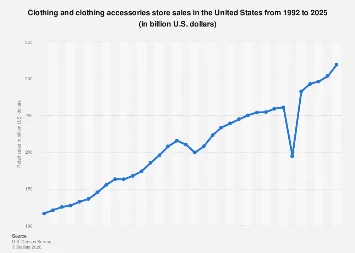
The United States apparel and clothing accessories retail sector is projected to reach approximately $319 billion in sales by the close of 2025, signaling continued robust performance for one of the world’s largest and most influential fashion markets. This forecast, based on industry analysis and market data, underscores the resilience and adaptive capacity of American retailers operating from fixed physical locations, as defined by the North American Industry Classification System (NAICS). These businesses are the primary conduits through which consumers access the vast spectrum of clothing and accessory products that define American style and consumption patterns.
The U.S. apparel market consistently ranks as the preeminent global leader in terms of scale and consumer spending. Monthly retail sales within clothing stores regularly surpass the $15 billion mark, demonstrating a dynamic and high-volume marketplace. The most recent available data, for December 2024, indicated a significant surge to $27 billion in clothing store sales, reflecting seasonal shopping trends and a strong consumer appetite for fashion. This consistent inflow of revenue highlights the sector’s foundational role in the broader U.S. retail landscape.
Delving deeper into market segmentation, the women’s and girls’ apparel segment is a dominant force, generating an estimated $191.4 billion in revenue in 2024. This substantial figure underscores the significant purchasing power and diverse fashion needs of female consumers in the United States. Concurrently, the men’s and boys’ apparel market, while smaller, remains a substantial contributor, with revenues approximating $111 billion during the same period. The interplay between these segments, influenced by evolving fashion trends, demographic shifts, and economic conditions, shapes the overall trajectory of the industry.
Brand loyalty and consumer perception play a critical role in driving sales within this competitive environment. Levi’s, a venerable name in denim and casual wear, continues to demonstrate its enduring appeal among American consumers. A survey conducted in the fourth quarter of 2024 identified Levi’s as one of the most popular apparel brands, a testament to its consistent quality, timeless designs, and effective brand messaging. This consumer preference translates directly into financial performance, with Levi Strauss & Co. reporting an all-time high in global net sales of $6.4 billion in 2024. This achievement not only reflects the brand’s strength in its domestic market but also its global reach and the sustained demand for its products across international territories.
The economic impact of the U.S. apparel retail sector extends far beyond direct sales figures. It encompasses a complex supply chain, supporting manufacturing, logistics, marketing, and a vast workforce. The industry’s ability to adapt to changing consumer behaviors, such as the increasing prominence of e-commerce and the growing demand for sustainable and ethically produced goods, will be crucial for its continued success. While physical retail stores remain a cornerstone, their integration with online channels and the development of omnichannel strategies are becoming increasingly vital for capturing a broader customer base and enhancing the overall shopping experience.
Global comparisons further illustrate the significance of the U.S. market. While other regions like Europe and Asia also boast substantial apparel markets, the sheer volume of consumer spending and the influence of American fashion trends on a global scale position the United States as a pivotal player. The rapid pace of innovation in textiles, manufacturing processes, and retail technologies originating from or adopted by U.S. brands often sets international benchmarks.
Looking ahead, several factors will shape the 2025 outlook. Economic indicators such as disposable income levels, inflation rates, and consumer confidence will directly influence spending patterns. Geopolitical events and global trade dynamics can also introduce complexities, affecting supply chain costs and product availability. Furthermore, the ongoing evolution of consumer preferences, driven by social media influence, a growing awareness of environmental sustainability, and a desire for personalized fashion experiences, will necessitate continuous adaptation from retailers.
The emphasis on sustainability, for instance, is no longer a niche concern but a significant driver of purchasing decisions for a growing segment of consumers. Brands that can demonstrate transparent sourcing, utilize eco-friendly materials, and adopt circular economy principles are likely to gain a competitive edge. Similarly, the integration of technology, from AI-powered personalization to augmented reality fitting rooms, offers opportunities to enhance customer engagement and streamline the purchase journey.
The revenue generated by the men’s and boys’ apparel market, while smaller than its women’s counterpart, is not to be underestimated. This segment has seen a noticeable shift in consumer expectations, with an increased demand for versatility, comfort, and a blend of athletic and casual wear. Brands that successfully cater to these evolving tastes, offering stylish yet functional apparel, are well-positioned for growth. The influence of athleisure, which has transcended its initial trend status to become a staple in many wardrobes, continues to shape product development and marketing strategies.
The performance of individual brands, like Levi’s, serves as a barometer for broader industry trends. The brand’s ability to maintain relevance across generations and adapt its product offerings while staying true to its heritage speaks to effective brand management and a deep understanding of its target audience. The success of such established players often inspires innovation and strategic adjustments among competitors, fostering a dynamic and competitive marketplace.
In conclusion, the projected $319 billion in sales for U.S. clothing and clothing accessories stores in 2025 signifies a healthy and dynamic sector. While challenges and evolving consumer demands persist, the industry’s inherent adaptability, coupled with strong consumer spending power and the continued influence of American fashion on a global scale, suggests a promising future. Retailers will need to navigate technological advancements, sustainability imperatives, and shifting demographic preferences to capitalize on the opportunities that lie ahead, ensuring continued growth and relevance in this ever-evolving market. The interplay of brick-and-mortar presence and digital engagement will be key, as will a commitment to understanding and meeting the diverse needs of the modern consumer.