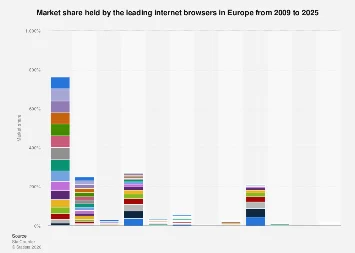
The European internet browser market has undergone a seismic transformation over the past decade and a half, marked by the dramatic decline of once-dominant players and the meteoric rise of Google Chrome. Projections for 2025 indicate that Chrome will continue its reign as the undisputed leader, solidifying its position as the primary gateway to the digital world for a vast majority of European users across desktops, tablets, mobile devices, and even consoles. This ongoing evolution has profound implications for technology companies, advertisers, content creators, and cybersecurity firms operating within the continent’s digital economy.
For years, Microsoft’s Internet Explorer (IE) was the default browser for many, a ubiquitous presence that defined early internet navigation. However, the data reveals a stark narrative of its obsolescence. In 2009, IE held a commanding market share of over 46.84 percent across Europe. By 2025, this figure has dwindled to a mere fraction, projected at just over 0.10 percent. This precipitous fall is not merely a statistical anomaly; it represents a fundamental shift in user preference, driven by factors such as the introduction of more innovative and user-friendly alternatives, evolving web standards, and security concerns that plagued older iterations of IE.
Similarly, Mozilla Firefox, another strong contender in the early to mid-2010s, has experienced a significant, albeit less dramatic, erosion of its market share. From a high of nearly 40 percent in 2009, Firefox’s projected share for 2025 stands at approximately 4.39 percent. While still a notable player, its trajectory reflects the broader trend of users consolidating their choices around a few key browsers offering superior performance, extensibility, and integration with broader digital ecosystems.
The ascendancy of Google Chrome began around 2010, mirroring its global surge. Its intuitive interface, rapid development cycles, robust extension ecosystem, and seamless integration with Google’s suite of services propelled its adoption. By 2025, Chrome is anticipated to command an impressive 60.52 percent of the European browser market. This level of dominance presents both opportunities and challenges. For businesses, it means that optimizing web experiences for Chrome is paramount, as a significant portion of their European audience will be interacting with their digital properties through this single platform.
Beyond the duopoly of Chrome and the declining IE, other browsers have carved out their niches, though none have approached the scale of Chrome’s dominance. Apple’s Safari, primarily used on its ecosystem of devices, has maintained a steady presence. Its market share has seen a gradual increase over the years, reaching an estimated 19.55 percent by 2025. This consistent performance underscores the loyalty of Apple users and the effectiveness of Safari’s integration within the Apple environment.
Microsoft’s newer browser, Edge, which replaced the legacy IE, has shown a more promising, albeit slower, growth trajectory. Launched as a modern alternative, Edge has gradually gained traction, particularly with the increasing adoption of Windows 10 and 11. Its projected market share for 2025 is around 6.51 percent, indicating a rebuilding effort by Microsoft to regain a significant foothold in the browser wars. The "Edge Legacy" designation, representing older versions, has all but disappeared, highlighting the shift towards the more contemporary Edge Chromium-based engine.

The mobile browser landscape presents its own nuances. While Chrome often leads on Android devices, Safari is the default on iOS. Samsung Internet, pre-installed on Samsung smartphones, has also secured a respectable market share, estimated at 3.26 percent for 2025, demonstrating the importance of native device integration in the mobile sphere. Opera, known for its innovative features like built-in VPN and ad-blocking, maintains a smaller but dedicated user base, projected at 2.81 percent for 2025. Yandex Browser, popular in Eastern Europe, shows a slow but steady increase, reaching an estimated 1.35 percent by 2025.
The "Others" category, encompassing a multitude of less prevalent browsers, has seen its share shrink significantly over the years, from over 1 percent in the early years to a projected 0.51 percent in 2025. This consolidation signifies a market that is increasingly polarized, with a few dominant players capturing the lion’s share of users, and a long tail of niche or specialized browsers serving smaller segments. Notably, emerging browsers like Brave, focused on privacy and ad-blocking, have begun to register their presence, with a projected 0.63 percent share in 2025, hinting at future competitive dynamics centered around user privacy.
The economic implications of this browser market concentration are far-reaching. For advertisers, the overwhelming dominance of Chrome means that campaign targeting and optimization efforts must heavily prioritize this platform. Understanding Chrome’s user behavior, cookie policies, and ad serving capabilities becomes critical. Similarly, website developers and designers must ensure their sites are not only compatible with Chrome but are also optimized for its rendering engine and JavaScript execution, which can significantly impact page load times and user experience.
The rise of Chrome also raises questions about antitrust concerns and the potential for market monopolization. While competition in the browser space exists, the sheer scale of Chrome’s market share grants Google considerable influence over the digital advertising ecosystem, search engine results, and the broader web development landscape. Regulatory bodies in Europe and globally continue to monitor these dynamics closely.
From a cybersecurity perspective, the concentration of users on a few major browsers can create both vulnerabilities and opportunities. Malicious actors may focus their efforts on exploiting security flaws in the most popular browsers, making robust security updates and user vigilance crucial. Conversely, browser developers can leverage their large user bases to rapidly deploy security patches and implement new privacy-enhancing features. The increasing awareness of data privacy is likely to fuel the growth of privacy-focused browsers, as seen with Brave’s nascent presence.
Looking ahead, the browser market is unlikely to see a radical upheaval that dethrones Chrome in the short to medium term. However, subtle shifts are discernible. The increasing focus on user privacy, the potential rise of progressive web apps (PWAs) that blur the lines between web and native applications, and the continued evolution of web technologies could introduce new competitive pressures. The battle for the European internet user’s attention is a perpetual one, and while Chrome currently holds a commanding lead, the digital landscape is ever-changing, driven by innovation, user preference, and evolving technological paradigms. The data from 2009 to the projections for 2025 paints a clear picture of consolidation and the profound impact of technological evolution on market dominance.