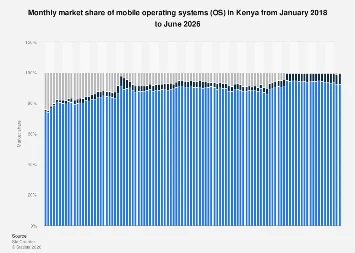
Kenya’s mobile operating system market continues to be overwhelmingly dominated by Google’s Android, a trend that has persisted since at least 2018 and is projected to remain firm through mid-2026. As of June 2026, Android commanded a substantial share, estimated to be in the high 90s, solidifying its position as the de facto standard for mobile devices across the East African nation. This widespread adoption underscores the affordability and accessibility of Android-powered smartphones, which are crucial in a market where cost-consciousness is a significant factor for consumers.
The second most significant player in Kenya’s mobile OS arena is Apple’s iOS. While a distant second to Android, iOS holds a notable, albeit smaller, market share. This segment is typically comprised of users who prioritize the premium user experience, robust ecosystem, and advanced security features offered by Apple’s devices. The presence of iOS, even with its premium pricing, highlights a segment of the Kenyan market with higher disposable income or a strong preference for Apple’s integrated hardware and software approach.
The vast disparity between Android and iOS in Kenya is a microcosm of a broader African trend. Across the continent, Android’s open-source nature and the diverse range of manufacturers producing affordable devices have made it the dominant operating system. This has fostered a digital ecosystem where app developers and service providers primarily target Android users to maximize reach. The cost-effectiveness of Android devices has been instrumental in driving mobile penetration rates in developing economies, enabling access to information, financial services, and communication for a burgeoning population.
Beyond the two leading operating systems, a small but persistent "Other" category exists. This segment typically includes legacy operating systems, niche platforms, or devices running custom versions of Android. While its market share is minimal, its presence indicates a degree of fragmentation and the potential for alternative solutions to gain traction, though currently, they pose no significant threat to the duopoly of Android and iOS.
The sustained dominance of Android in Kenya is driven by several key economic and market factors. The influx of budget-friendly smartphones from manufacturers like Tecno, Infinix, and Samsung, all heavily reliant on Android, has made these devices accessible to a wider demographic. This price sensitivity is a critical differentiator in markets where smartphones are often the primary, and sometimes only, gateway to the internet. Furthermore, the availability of a vast array of affordable applications and services on the Google Play Store complements the appeal of Android devices, catering to diverse user needs, from communication and social media to mobile banking and entertainment.
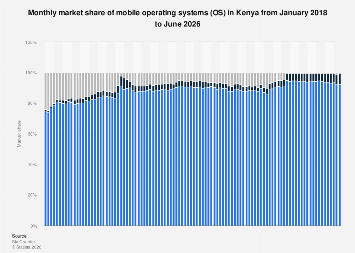
Looking ahead, the projections for the Kenyan mobile OS market suggest a continuation of this established trend. The forecast extending to mid-2026 indicates that Android will maintain its commanding lead. This stability is not unexpected, given the entrenched nature of Android in the market and the economic realities that favor its affordability. However, subtle shifts within this dominance might occur. For instance, while the overall Android share might remain high, there could be an increase in the penetration of higher-end Android devices as consumers upgrade or as more feature-rich, yet still competitively priced, models become available.
The economic impact of this OS landscape is profound. The dominance of Android facilitates the growth of the digital economy in Kenya. Mobile money services, a cornerstone of Kenya’s financial inclusion success story, are largely delivered through mobile applications, predominantly on Android. E-commerce platforms, digital learning tools, and remote work solutions all rely on the widespread availability of affordable smartphones. The continued accessibility offered by Android ensures that these digital services can reach a larger segment of the population, fostering economic growth and social development.
From a global perspective, Kenya’s mobile OS market mirrors trends seen in many other emerging economies. While developed markets like North America and Western Europe often show a more balanced distribution or a stronger presence of iOS, Africa, Latin America, and parts of Asia lean heavily towards Android. This global bifurcation in OS preference is a critical consideration for international technology companies, app developers, and device manufacturers when formulating their market entry and product development strategies.
The longevity of Android’s dominance in Kenya can also be attributed to the network effect. As more users adopt Android, it becomes more attractive for developers to create apps and services for the platform, which in turn attracts more users. This self-reinforcing cycle is difficult for competing operating systems to break. Moreover, the robust ecosystem of repair services and readily available accessories for Android devices further contributes to their practical appeal.
While the data points to a stable future, continuous monitoring of market dynamics is essential. Factors such as evolving consumer preferences, potential shifts in pricing strategies by Apple, the introduction of new disruptive technologies, or government initiatives promoting digital literacy could subtly influence the market share over the long term. However, based on the current trajectory and underlying economic drivers, Android is poised to remain the undisputed leader in Kenya’s mobile operating system market for the foreseeable future. The accessibility and affordability it offers are fundamental to Kenya’s ongoing digital transformation and its integration into the global digital economy.