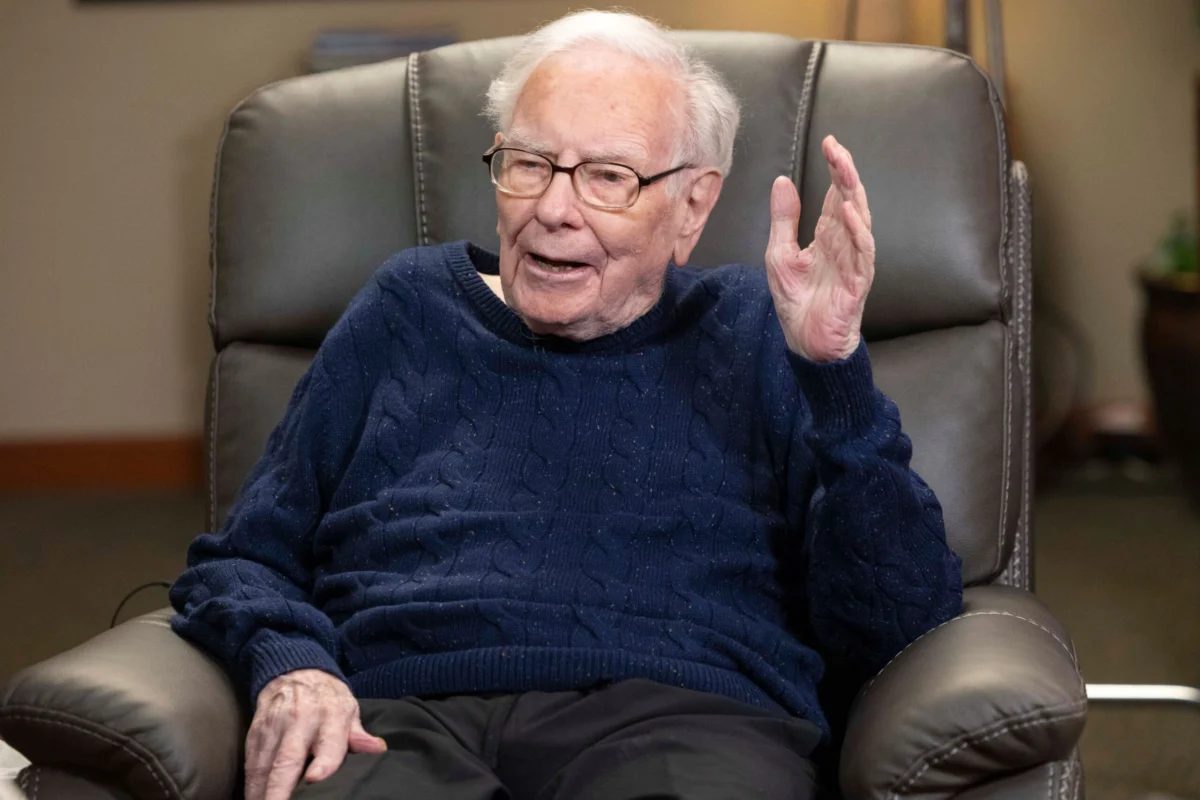
In the hallowed halls of American finance, few voices carry the weight of Warren Buffett. For over seven decades, the Chairman and CEO of Berkshire Hathaway has served as the primary architect of value investing, a philosophy rooted in the meticulous analysis of intrinsic worth and the patient accumulation of productive assets. However, in a recent assessment of the contemporary financial landscape, the 95-year-old billionaire offered a sobering critique of a market he believes has drifted dangerously far from its fundamental purpose. Buffett’s core contention is that the stock market, once a mechanism for capital allocation into enduring enterprises, is increasingly functioning as a digital casino, driven by a surge in speculative behavior that masks true economic value.
The difficulty of identifying attractive investment opportunities is not merely a matter of high valuations; it is a systemic byproduct of a culture that prioritizes short-term "gambling" over long-term stewardship. When the prevailing market sentiment is dictated by the thrill of the trade rather than the durability of the underlying business, the traditional metrics used by value investors—such as price-to-earnings ratios, free cash flow, and competitive moats—become secondary to price momentum and social media-driven hype. This shift has created an environment where, in Buffett’s view, the search for genuine value has become an exercise in futility against a backdrop of frantic speculation.
The Institutionalization of the Market Casino
Buffett’s critique is punctuated by a vivid metaphor: the modern stock market resembles a "church with a casino attached." This imagery suggests a dual reality where the foundational institutions of the economy—the "church"—remain vital, yet are increasingly overshadowed by the high-stakes, high-frequency activities of the "casino" floor. Central to this transformation is the explosive growth of zero-days-to-expiration (0DTE) options. These financial instruments, which expire within 24 hours of being issued, have seen their trading volumes skyrocket, now accounting for nearly half of all S&P 500 option activity.
To Buffett, the popularity of 0DTE options is the ultimate expression of the gambling instinct. These contracts allow traders to make highly leveraged bets on minute-by-minute price movements, offering the potential for massive returns on small outlays but carrying a high probability of total capital loss. This is not investing in the classic sense; it is a form of financial arbitrage on volatility itself. The proliferation of such instruments, supported by commission-free trading apps and the gamification of brokerage interfaces, has lowered the barrier to entry for speculative behavior, drawing in a new generation of retail participants who treat the equity market with the same psychological intensity as a sports book or a poker table.
Navigating the "Wall of Worry" and AI Euphoria
The current market rally has been nothing short of extraordinary, with major indices reaching all-time highs despite a series of significant macroeconomic and geopolitical headwinds. Investors have successfully "climbed a wall of worry," ignoring an energy shock precipitated by escalating tensions with Iran and the ongoing volatility in global oil markets. Typically, such geopolitical instability would trigger a flight to safety; instead, the market has doubled down on risk, fueled largely by the rapid expansion of the artificial intelligence (AI) sector.
The build-out of AI infrastructure has become the primary engine of the current bull market, leading to a concentration of wealth in a handful of technology giants. However, Buffett and other market skeptics argue that the fervor surrounding AI has decoupled stock prices from current earnings realities. This speculative fever is visible in the intense retail interest in semiconductor companies like Micron and the anticipation surrounding high-profile initial public offerings and private valuations of firms like SpaceX. While these companies represent genuine technological innovation, the "gambling" element enters when the market prices in decades of flawless growth today, leaving no margin of safety for potential setbacks or competitive shifts.
The use of leveraged exchange-traded funds (ETFs) has further amplified this trend. By offering double or triple the daily return of an index or a specific sector, these vehicles provide the "juice" that speculative traders crave. However, they also introduce systemic fragility, as sudden downward corrections can lead to forced liquidations and cascading sell-offs, further detaching market prices from the underlying health of the economy.

The Business of Cultivating Gamblers
Perhaps the most cynical aspect of the current financial era, according to Buffett, is the incentive structure of the financial services industry itself. He observes that there is significantly more profit to be made in "cultivating gamblers than there are cultivating investors." For Wall Street brokerages, investment banks, and market makers, the ideal customer is not the "buy and hold" investor who trades once a decade. The ideal customer is the high-frequency trader who generates massive volume, payment for order flow (PFOF), and advisory fees.
This misalignment of incentives has led to a financial ecosystem that rewards churn. The more the public views the market as a venue for quick riches, the more the industry profits from the resulting friction. Buffett’s critique suggests that the financial industry has a vested interest in maintaining the "casino" atmosphere, as it ensures a constant stream of transaction-based revenue, even if it comes at the expense of the long-term wealth of the average participant. This structural bias makes it increasingly difficult for disciplined investors to find "fat pitches"—opportunities where the price of a stock is significantly lower than its intrinsic value—because the "gamblers" are constantly bidding up prices based on the next day’s headlines rather than the next decade’s dividends.
The Virtue of Inactivity in an Overheated Market
At 95, Warren Buffett’s perspective is shaped by a deep historical memory. He has witnessed the Nifty Fifty era of the 1970s, the Black Monday crash of 1987, the Dot-com bubble of the late 1990s, and the Global Financial Crisis of 2008. In each of these instances, the prevailing sentiment was that "this time is different," and in each case, the laws of economic gravity eventually reasserted themselves.
Buffett’s current strategy at Berkshire Hathaway reflects his cautious outlook. The conglomerate’s cash pile has reached record levels, exceeding $180 billion, a signal that the "Oracle" finds the current market too rich for his blood. While the public often views a large cash position as "drag" on performance, Buffett views it as "optionality." In a market dominated by gambling, the most courageous act for a value investor is often to do nothing at all.
"There are times when opportunities are just thrown at you so fast… it’s unbelievable," Buffett remarked. "And then there’s other times when you’re very, very lucky if you find one thing in a couple of years." This discipline—the ability to wait for a clear misalignment between price and value—is what separates the investor from the speculator. However, in a culture of instant gratification, such patience is a rare commodity.
The Psychological Toll of the Modern Market
Beyond the economic implications, the shift toward a "gambling" market has profound psychological consequences. Behavioral economics suggests that the human brain is wired for the dopamine hits associated with variable rewards—the same mechanism that makes slot machines addictive. By turning the stock market into a high-speed, high-frequency game, the financial industry is tapping into these primal instincts.
This environment creates a feedback loop where rising prices attract more speculators, which in turn drives prices higher, regardless of fundamentals. This "momentum" trading works until it doesn’t. When the music stops, those who were "gambling" rather than "investing" often find themselves without a seat, having ignored the basic tenets of risk management. Buffett’s warning serves as a reminder that while the "casino" may offer more excitement, the "church" of sound investing is the only path to sustainable, long-term wealth.
As the global economy continues to grapple with the transformative power of AI, shifting interest rate environments, and geopolitical re-alignments, the tension between gambling and investing will likely intensify. For Warren Buffett, the message remains unchanged: value is found in the productive capacity of human enterprise, not in the flickering numbers on a trading screen. In an era where everyone is looking for a quick win, the ultimate competitive advantage may simply be the willingness to wait.