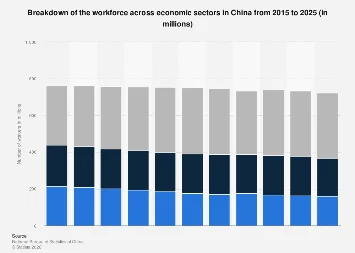
China’s economic engine is undergoing a significant transformation, with projections for 2025 indicating a continued reshuffling of its vast workforce across key sectors. This evolution is not merely a statistical shift but a reflection of deeper structural changes, technological advancements, and evolving national economic priorities. Understanding these sectoral workforce dynamics is crucial for investors, policymakers, and businesses seeking to navigate the complexities of the world’s second-largest economy.
Historically, China’s economic miracle was fueled by a massive labor pool migrating from agriculture to manufacturing. This demographic dividend propelled the nation to become the "world’s factory." However, as wages rise and the cost of labor becomes a more significant factor, coupled with a demographic slowdown and an increased focus on higher value-added industries, the landscape is irrevocably changing. Projections for 2025 suggest a further maturation of this process, with a noticeable, albeit gradual, reallocation of human capital.
The primary driver of this shift is China’s strategic pivot towards innovation, technology, and services. The government’s emphasis on "Made in China 2025" and subsequent industrial policies aims to move the nation up the global value chain, transitioning from low-cost manufacturing to high-tech production, advanced services, and a burgeoning digital economy. This ambition directly translates into demand for a more skilled and specialized workforce. Consequently, while the manufacturing sector, particularly in its traditional, labor-intensive forms, may see a plateau or even a slight decline in its share of overall employment, its high-tech and advanced manufacturing segments are expected to grow in importance, demanding more engineers, researchers, and skilled technicians.
Simultaneously, the services sector is poised for continued expansion. As China’s middle class grows and disposable incomes rise, demand for consumer services – including finance, healthcare, education, entertainment, and retail – escalates. This burgeoning domestic consumption is a cornerstone of China’s economic rebalancing strategy, moving away from export-led growth. Therefore, the services sector is projected to absorb a significant portion of the transitioning workforce, offering a wider array of job opportunities in both traditional and digitally-enabled roles. The digital economy, in particular, is a major growth area, encompassing e-commerce, digital content creation, platform services, and the burgeoning artificial intelligence (AI) and big data industries, all of which require a new breed of digitally literate professionals.
Agriculture, while still a significant employer, particularly in rural areas, is expected to see its share of the workforce continue to shrink. Modernization and mechanization within the agricultural sector, alongside urbanization trends, mean that fewer people are needed to produce more food. While this might lead to displacement for some, it also presents opportunities for those with skills in agricultural technology, logistics, and food processing, further contributing to the broader economic restructuring.
The implications of these sectoral shifts are far-reaching. For policymakers, the challenge lies in managing this transition effectively, ensuring that displaced workers are retrained and redeployed into emerging sectors. This requires substantial investment in education and vocational training programs, with a curriculum aligned with the demands of the future economy. Failure to do so could lead to structural unemployment and social instability. The emphasis will be on fostering skills in areas like AI, robotics, advanced materials, biotechnology, and modern logistics, all of which are critical to China’s long-term economic competitiveness.
From an economic perspective, this recalibration promises a more sustainable growth model. A greater reliance on services and high-value manufacturing can lead to higher productivity, increased innovation, and a more resilient economy less susceptible to global trade fluctuations. The growth of the domestic services sector also provides a buffer against external economic shocks, reinforcing China’s domestic demand-driven growth strategy. Furthermore, the increased focus on technology and R&D is expected to boost China’s innovation capacity, potentially leading to the development of new global industries and further solidifying its position as a technological leader.
Market data and forecasts from various economic institutions paint a consistent picture. Research indicates that while the overall size of China’s labor force may not drastically change by 2025, its composition will be markedly different. Projections suggest that the services sector could account for over 50% of total employment, a significant increase from previous decades. Manufacturing, while still substantial, might see its share stabilize or slightly decrease as a percentage of the total, but its composition will shift towards higher-skilled, automated, and technologically advanced sub-sectors. The agricultural share will likely continue its downward trend, though its absolute numbers will remain considerable.
Global comparisons highlight China’s trajectory. Many developed economies have already completed or are well into their transition towards service-dominated economies. China’s current phase of development mirrors aspects of these transitions, but with its unique scale and speed. The rapid pace of technological adoption, particularly in areas like mobile payments, e-commerce, and AI applications, means that China is not just catching up but in some instances leading the way, creating new job categories that did not exist a decade ago. This rapid digital transformation is a key differentiator in its workforce evolution.
The economic impact analysis of this sectoral shift is complex. On one hand, it signifies a move towards a more sophisticated and potentially more stable economy. Higher wages in skilled sectors and a robust services industry can drive domestic consumption and reduce income inequality. On the other hand, the transition period can be challenging. Automation in manufacturing could displace lower-skilled workers, necessitating robust social safety nets and retraining initiatives. The increasing demand for specialized skills could also lead to skill gaps, where the available workforce does not match the needs of employers. This necessitates a proactive approach to education and lifelong learning.
Furthermore, the geopolitical implications are noteworthy. As China moves up the value chain, its economic relationships with other nations will evolve. Its demand for raw materials may shift towards those required for advanced manufacturing and technology, and its export basket will increasingly feature high-tech goods and services. This could lead to increased competition in advanced technology sectors and a realignment of global trade patterns.
In conclusion, the projected workforce breakdown across China’s economic sectors by 2025 represents a critical juncture. It is a testament to the nation’s ongoing economic modernization and its strategic pursuit of innovation-driven growth. While the path of transition presents challenges, the overall direction indicates a move towards a more diversified, technologically advanced, and service-oriented economy. The ability of China to successfully manage this demographic and economic evolution will be a key determinant of its future prosperity and its role in the global economic order. The coming years will be characterized by continuous adaptation, significant investment in human capital, and a dynamic interplay between technological advancement and labor market demands.