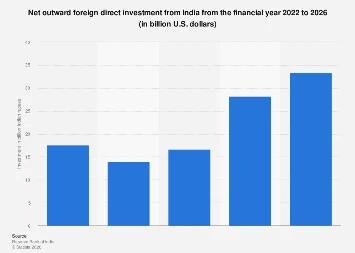
India’s outward foreign direct investment (OFDI) is projected to witness a substantial surge, culminating in a significant increase by the financial year 2026. While precise figures remain subject to market dynamics and proprietary data access, forecasts indicate a robust expansion in the capital that Indian enterprises are deploying internationally. This trend underscores a maturing Indian economy with increasingly ambitious global ambitions, seeking to diversify its operations, secure strategic assets, and tap into new growth markets.
The trajectory of OFDI from India is a crucial indicator of its economic integration and the growing confidence of its corporate sector on the global stage. As Indian companies increasingly look beyond their domestic borders for opportunities, they are reshaping global investment flows and establishing a more prominent presence in international markets. This outward push is not merely about capital export; it represents a strategic move to enhance competitiveness, acquire advanced technologies, gain access to new consumer bases, and build diversified revenue streams.
Understanding the nuances of this OFDI trend requires an examination of the underlying economic drivers and the strategic imperatives guiding Indian businesses. Several factors are contributing to this outward investment momentum. Firstly, the robust domestic economic growth experienced by India in recent years has generated significant surplus capital within its corporate sector, providing the financial wherewithal for international ventures. Companies that have achieved scale and profitability domestically are now looking for avenues to deploy this capital more effectively and to achieve higher returns through global diversification.
Secondly, the pursuit of technological advancement and innovation plays a pivotal role. Indian companies are increasingly investing overseas to acquire cutting-edge technologies, intellectual property, and research and development capabilities that can bolster their domestic operations and global competitiveness. This is particularly evident in sectors such as information technology, pharmaceuticals, automotive, and renewable energy, where rapid technological evolution necessitates continuous innovation and global collaboration.
Furthermore, the desire to secure access to raw materials, natural resources, and key supply chain components is a significant motivator for OFDI. Indian industries, particularly those reliant on imported inputs, are strategically investing in countries rich in natural resources or those with established manufacturing bases to ensure a stable and cost-effective supply chain. This not only mitigates risks associated with global supply chain disruptions but also allows Indian companies to exert greater control over their production processes.
The expansion of Indian multinational corporations into new and emerging markets is also a key driver. By establishing a presence in diverse geographical regions, Indian companies aim to tap into untapped consumer demand, diversify their market risk, and build a global brand presence. This expansion is often characterized by mergers, acquisitions, joint ventures, and greenfield investments, each serving specific strategic objectives.
Statistics on OFDI, when available, provide a quantifiable measure of this growing trend. While specific figures for FY 2026 are typically released with a time lag and may be subject to subscription-based data access, projections and historical trends offer valuable insights. For instance, if we consider a hypothetical scenario where OFDI in FY 2025 stood at a certain billion USD, an anticipated increase by FY 2026 would signify a considerable upward revision in investment flows. This increase could be attributed to a combination of factors, including favorable global economic conditions, supportive government policies, and the strategic decisions of leading Indian corporations.
The impact of this outward investment on the Indian economy is multifaceted. On one hand, it signifies the growing maturity and global competitiveness of Indian businesses, enhancing the nation’s economic standing on the international stage. It can lead to the repatriation of profits and dividends, contributing to foreign exchange reserves and national income. Moreover, the knowledge and technology acquired through OFDI can be leveraged to foster innovation and industrial development within India.
On the other hand, there are considerations regarding the potential impact on domestic employment and investment if capital is significantly diverted from local opportunities. However, a balanced approach to OFDI, where it complements rather than replaces domestic investment, is generally viewed as beneficial. The Indian government has been actively promoting outward investment through various policy initiatives, including bilateral investment treaties, tax agreements, and financial support mechanisms, recognizing its strategic importance for economic growth and global integration.
Globally, India’s OFDI trends are observed with keen interest. As a major emerging economy, its investment patterns can influence regional and global capital flows. The strategic sectors in which Indian companies are investing – such as technology, renewable energy, and infrastructure – often reflect global investment priorities and highlight India’s growing influence in these critical areas. For example, Indian companies venturing into African nations for infrastructure development or into Southeast Asia for manufacturing bases are indicative of broader geopolitical and economic shifts.
The financial year 2026, as a projected milestone, suggests that the momentum of outward investment is expected to continue or even accelerate. This growth is likely to be driven by a combination of opportunistic acquisitions, strategic partnerships, and organic expansion by Indian firms seeking to establish a stronger global footprint. The increasing sophistication of Indian financial markets and the availability of diverse financing options further facilitate these international ventures.
In conclusion, the projected growth in India’s net outward foreign direct investment through financial year 2026 is a testament to the evolving economic landscape of the nation. It signifies a strategic pivot by Indian businesses towards global markets, driven by a quest for growth, technology, resources, and market diversification. This trend not only enhances the global standing of Indian corporations but also contributes to the broader narrative of India’s ascent as a significant player in the global economy, with profound implications for both domestic development and international economic relations. The ongoing expansion of OFDI is a clear indicator of India’s ambition to be a more integrated and influential participant in the world economy.