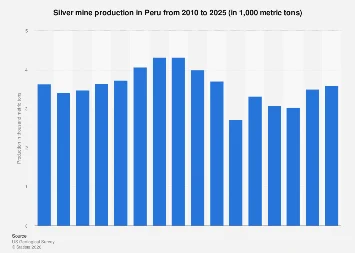
Peru, a long-standing titan in the global silver mining landscape, is charting a course for sustained production through 2025, a period expected to be shaped by evolving market dynamics, technological advancements, and the persistent global appetite for this precious and industrial metal. While specific granular forecasts often reside behind proprietary data walls, the broader trends indicate a robust outlook for the Andean nation, which consistently ranks among the top three silver-producing countries worldwide, alongside Mexico and China. The country’s rich geological endowment, characterized by vast, high-grade silver deposits, provides a fundamental advantage that underpins its significant contribution to the global supply chain.
The Peruvian mining sector, a cornerstone of the nation’s economy, has historically been a major driver of export revenues and employment. Silver, in particular, holds a special place, not only for its intrinsic value as a precious metal but also for its critical role in various industrial applications. From electronics and solar panels to medical equipment and automotive components, the demand for silver is intricately linked to global economic growth and technological innovation. As the world increasingly embraces renewable energy technologies and advances in miniaturized electronics, the industrial demand for silver is projected to remain strong, providing a stable underlying market for Peruvian producers.
Recent years have seen fluctuating silver prices, influenced by a confluence of macroeconomic factors, including inflation concerns, interest rate movements, and geopolitical uncertainties. However, the long-term trajectory suggests a resilience driven by both investment demand, particularly during periods of economic volatility, and the escalating needs of industrial sectors. For Peru, this translates into an environment where maintaining and potentially expanding production levels is strategically vital. The projected production figures for 2025 are therefore not just abstract numbers, but indicators of the country’s ability to capitalize on these market forces.
Key to Peru’s continued success in silver mining are several interconnected factors. Firstly, ongoing investment in exploration and mine development is crucial. Major mining companies, both domestic and international, are continuously assessing new prospects and expanding existing operations. This includes the adoption of more efficient extraction and processing technologies, which can lower operating costs, improve recovery rates, and minimize environmental impact. The deployment of advanced geological modeling, automation, and data analytics in exploration can significantly de-risk and accelerate the discovery of new economically viable silver deposits.
Secondly, the Peruvian government’s commitment to fostering a stable and attractive investment climate plays a pivotal role. While challenges related to social license to operate, environmental regulations, and infrastructure development persist, efforts to streamline permitting processes and ensure regulatory certainty are essential for attracting the substantial capital required for large-scale mining projects. A predictable policy framework encourages long-term investment, which is indispensable for the sustained growth of Peru’s silver output. International mining industry bodies often highlight the importance of such stability when assessing investment destinations.
Furthermore, the global shift towards sustainability and responsible mining practices presents both challenges and opportunities for Peru. As investors and consumers become more discerning about the origins and ethical production of raw materials, Peruvian mines are increasingly focused on implementing best practices in environmental management, community engagement, and labor relations. This includes investing in water management technologies, reducing greenhouse gas emissions, and ensuring fair treatment and development opportunities for local communities. Companies that demonstrate a strong commitment to ESG (Environmental, Social, and Governance) principles are likely to gain a competitive edge and secure long-term market access.
Looking at global comparisons, Peru’s silver production capacity is substantial. While Mexico often leads in annual output, Peru’s reserves and potential for expansion remain immense. The country’s mining operations are characterized by a mix of large-scale, open-pit mines and smaller, underground operations, each contributing to the overall production volume. The operational efficiency and technological sophistication of these diverse entities will be a determining factor in meeting future production targets. For instance, advancements in heap leaching and solvent extraction-electrowinning (SX-EW) technologies have significantly improved the economics of processing lower-grade ores, expanding the life of many mines.
The economic impact of Peru’s silver mining industry extends far beyond the direct revenues generated. It creates a significant multiplier effect through its linkages with other sectors of the economy, including logistics, manufacturing, and services. Employment generation, both direct and indirect, is substantial, providing livelihoods for thousands of Peruvians. Moreover, the tax revenues and royalties collected from mining operations are vital for funding public services and infrastructure development, contributing to the nation’s overall socio-economic progress. The stability of silver production directly correlates with the stability of these economic contributions.
In terms of market outlook, analysts predict a continued upward trend in silver demand, driven by the accelerating transition to a green economy. The electrification of transport, the expansion of renewable energy grids, and the growing adoption of smart technologies all rely heavily on silver as a critical component. For example, solar photovoltaic panels, a key technology in decarbonization efforts, utilize significant amounts of silver. Estimates suggest that the demand for silver in solar energy alone could grow by over 50% in the coming decade. This burgeoning industrial demand provides a strong and reliable counterpoint to the more volatile investment-driven demand.
However, the Peruvian silver mining sector is not without its hurdles. Social conflicts, often stemming from land use disputes and environmental concerns, can disrupt operations and delay new projects. The ongoing need for dialogue and collaboration between mining companies, local communities, and governmental bodies is paramount. Furthermore, fluctuating energy costs and the availability of skilled labor can impact operational profitability. Investing in training and development programs for the local workforce can help mitigate these challenges and foster a more sustainable and inclusive mining industry.
The projected production figures for Peru in 2025, therefore, represent a dynamic interplay of geological potential, technological innovation, market demand, and the nation’s ability to navigate complex socio-economic and environmental landscapes. As the world continues to rely on silver for both its traditional roles and its emerging applications, Peru’s strategic position as a major producer is set to remain a critical element of the global supply chain, underscoring the importance of continued investment, responsible stewardship, and forward-thinking policy. The nation’s capacity to adapt to these evolving conditions will ultimately determine the extent to which it can fully realize its silver mining potential in the coming years.