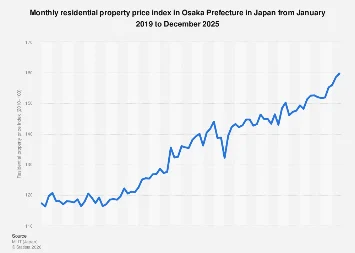
Osaka Prefecture, a vital economic hub in Japan, is projected to witness a steady, albeit moderate, increase in its residential property price index through the end of 2025. Preliminary data for December 2025 indicates the index will reach a yet-to-be-disclosed level, building upon the figures observed in preceding months. This sustained upward trend underscores the resilience and ongoing appeal of Osaka’s real estate market, reflecting a complex interplay of demographic shifts, economic fundamentals, and evolving investor sentiment.
The residential property price index for Osaka Prefecture serves as a crucial barometer for the region’s housing market. It encompasses a broad spectrum of residential assets, including residential land, detached houses, and condominiums. This comprehensive approach ensures that the index captures the overall health and direction of the housing sector, providing valuable insights for developers, investors, policymakers, and prospective homebuyers alike. The base year for this index is 2010, with an established value of 100, allowing for a clear comparison of price movements over time. The data is meticulously collected through the System to Provide Real Estate Transaction Price Data, managed by Japan’s Ministry of Land, Infrastructure, Transport and Tourism, and is based on transactions between private entities, ensuring its relevance to market dynamics.
While specific figures for December 2025 are subject to a proprietary data access model, the general trajectory indicates a continuation of the growth observed in previous periods. This sustained appreciation, even if modest, is significant in the context of Japan’s broader economic landscape. The nation has historically grappled with deflationary pressures and a declining birthrate, factors that can exert downward pressure on asset prices. However, Osaka’s market appears to be charting a distinct course, driven by its robust local economy, its status as a major international tourist destination, and ongoing urban development initiatives.
Understanding the components of the index is key to appreciating the market’s nuances. The performance of residential land prices, detached houses, and condominiums can vary, influenced by factors such as location, property type, amenities, and local infrastructure development. For instance, areas undergoing significant regeneration or experiencing increased demand for family housing might see stronger growth in detached house prices, while the condominium market may be more sensitive to urban living trends and rental yields. The index’s methodology, which includes seasonally adjusted figures, aims to provide a clearer picture of underlying market trends by smoothing out short-term fluctuations.
The projected modest growth in Osaka’s residential property prices is occurring against a backdrop of several influential global and national economic forces. In recent years, many major global cities have experienced significant real estate appreciation, often fueled by low interest rates and increased liquidity. While Japan’s monetary policy has remained largely accommodative, the impact on real estate has been more nuanced compared to some Western economies. However, Osaka, as a major metropolitan area with a dynamic industrial and service sector, benefits from its inherent economic vitality. Its proximity to other key economic centers in the Kansai region, coupled with its strategic importance as a gateway for international trade and tourism, provides a solid foundation for sustained property value.
Furthermore, government policies aimed at revitalizing regional economies and promoting inbound tourism likely contribute to the positive outlook for Osaka’s real estate. Initiatives to encourage foreign investment, develop world-class tourist attractions, and improve transportation infrastructure can directly stimulate demand for residential properties, both for investment and for long-term occupation. The upcoming 2025 World Expo, slated to be held in the Osaka Bay area, is expected to provide a significant boost to the local economy and real estate market in the years leading up to and following the event, driving demand for both residential and commercial properties.
From a comparative perspective, Osaka’s property market trends can be contrasted with those in Tokyo and other major global cities. While Tokyo often leads in terms of sheer transaction volume and capital appreciation, Osaka offers a potentially more accessible entry point for investors and a different lifestyle proposition. The average property prices in Osaka, while rising, generally remain more affordable than in Tokyo, making it an attractive option for a wider range of buyers. This affordability, combined with strong economic fundamentals, creates a compelling investment case.
The economic impact of a stable or growing residential property market extends beyond individual property owners. It influences consumer confidence, construction sector activity, and local government tax revenues. A healthy real estate market can encourage homeownership, which in turn can lead to greater consumer spending on furnishings, renovations, and related services. It also supports jobs in construction, real estate services, and ancillary industries. For Osaka, continued property value appreciation can reinforce its position as an attractive place to live and work, fostering economic growth and urban development.
Looking ahead, several factors will continue to shape Osaka’s residential property market. The ongoing demographic shifts, including an aging population and urbanization trends, will play a crucial role. While the declining birthrate is a national challenge, Osaka’s status as a magnet for both domestic and international talent can help to mitigate some of these effects. The pace of new housing construction, the availability of financing, and the broader economic health of Japan and the global economy will also be critical determinants of future price movements. The preliminary figures for December 2025 suggest a market that is navigating these complexities with a degree of success, projecting a future of steady, sustainable growth for Osaka’s residential property sector. The index’s continued tracking will be essential for understanding the evolving dynamics and identifying emerging opportunities and challenges within this key Japanese real estate market.