JCDecaux SE, a titan in the global out-of-home (OOH) advertising industry, concluded the 2025 fiscal year with a substantial worldwide workforce, reflecting its extensive operational reach and strategic market presence. While precise figures are often proprietary, available data indicates a robust employment base that underpins its expansive network of digital and traditional advertising infrastructure across diverse geographical landscapes. The company’s commitment to maintaining a strong regional presence is a cornerstone of its business model, enabling localized content delivery and responsive client engagement.
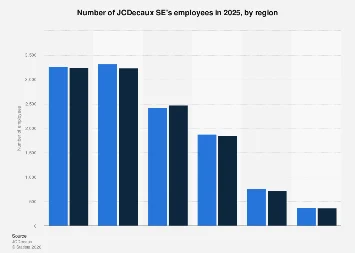
The distribution of JCDecaux’s employees across its various operating regions provides a telling snapshot of its strategic priorities and market penetration. As of December 31, 2025, the company’s global headcount, measured in full-time equivalents (FTEs), represents a significant human capital investment. A considerable portion of this workforce is anchored in the company’s home market, France, underscoring the foundational importance of its domestic operations. This concentration of talent in France likely supports key corporate functions, research and development, and strategic planning, while also serving as a hub for innovation in OOH advertising technologies.
Beyond its French core, JCDecaux’s operations are segmented into distinct geographical zones, each requiring tailored management and operational expertise. The precise breakdown across these regions, while not fully disclosed in public aggregate data, is crucial for understanding the company’s global strategy. This includes significant operations in Europe, North America, Asia-Pacific, Latin America, and emerging markets. The company’s supplementary notes often group a broad array of territories under a single umbrella, such as "Latin America, Ukraine, Central Asia, the Middle-East, and Africa," highlighting the complexities of managing diverse and often rapidly evolving markets.
The OOH advertising sector, in which JCDecaux operates, is inherently tied to urban development and public spaces. The company’s workforce is therefore strategically deployed in areas with high footfall and vehicular traffic, including airports, train stations, shopping malls, and street furniture. The density of employees in a particular region often correlates with the scale of JCDecaux’s infrastructure and the volume of advertising contracts managed within that territory. For instance, regions with a higher concentration of premium advertising real estate, such as major metropolitan centers in Europe and North America, are likely to host a larger proportion of the company’s operational and sales teams.
The growth trajectory of JCDecaux’s revenue in 2025, which saw an approximate increase of * percent to nearly ** billion euros, directly influences its employment needs. Expansion in revenue typically necessitates a corresponding expansion in workforce to manage increased inventory, sales efforts, and operational complexities. This growth may be driven by organic expansion into new cities, acquisitions of existing OOH media assets, or the adoption of new digital advertising technologies that require specialized technical and creative personnel. The company’s investment in digital out-of-home (DOOH) formats, which have seen significant market growth, has likely spurred demand for employees with expertise in digital content management, programmatic advertising, and data analytics.
The regional distribution of employees also reflects the regulatory environments and market maturity of different geographies. In more established markets, JCDecaux may have a more streamlined operational structure, with a focus on optimizing existing assets and leveraging advanced analytics. In contrast, emerging markets might require a more hands-on approach, with a larger field force dedicated to site acquisition, installation, and local client relationship management. The company’s ability to adapt its workforce strategy to these diverse conditions is a testament to its global operational agility.
The economic impact of JCDecaux’s employment footprint extends beyond its direct workforce. The company indirectly supports numerous jobs in related sectors, including manufacturing of street furniture and digital screens, installation and maintenance services, media planning and buying agencies, and content creation studios. Its presence in a region also contributes to local economies through the payment of taxes, procurement of local services, and the creation of vibrant urban environments that attract businesses and tourism.
Furthermore, JCDecaux’s strategic deployment of its workforce is closely linked to its innovation pipeline. The company is a leader in developing smart city solutions and integrating advertising with urban infrastructure. This requires a multidisciplinary team, from engineers and software developers to urban planners and data scientists. The concentration of such specialized talent in key innovation hubs globally is likely a significant factor in its regional staffing decisions.
While specific numbers for each region are masked, the overall magnitude of JCDecaux’s global workforce, coupled with its reported revenue growth, paints a picture of a company that is both deeply entrenched in its established markets and actively pursuing opportunities for expansion worldwide. Understanding the nuances of its regional employee distribution offers critical insights into the operational backbone of one of the world’s largest OOH advertising companies and its strategic approach to navigating the dynamic global media landscape. The continuous evolution of urban environments and the increasing demand for integrated digital advertising solutions will undoubtedly continue to shape JCDecaux’s future workforce needs and its global operational footprint.