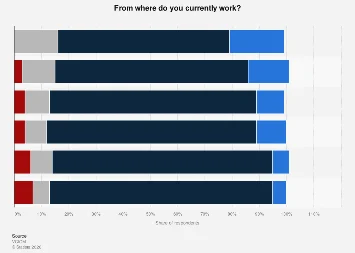
The landscape of Russian employment in 2022 presented a nuanced picture of work arrangements, with significant variations observed across different settlement types. A comprehensive survey conducted in May 2022, encompassing 1,806 respondents aged 18 and above, illuminated the evolving preferences and realities of the Russian workforce regarding their daily work locations. The data reveals a distinct dichotomy, with metropolitan hubs like Moscow and Saint Petersburg exhibiting higher adoption rates of remote and hybrid work models, while smaller towns and villages remained predominantly anchored to traditional on-site employment.
In the nation’s two largest cities, Moscow and Saint Petersburg, a notable 20% of employees reported working mostly from home or remotely. This figure, while substantial, was surpassed by the 63% who continued to predominantly work in the office, on-site, or through job-related travel. A further 16% navigated a hybrid model, splitting their workdays between home and the office. This suggests that while remote work had gained a foothold in these urban centers, the established office-centric culture remained the dominant paradigm. The relatively low "difficult to answer" percentage (0%) in these cities indicates a clear understanding and categorization of work arrangements among respondents.
As the survey moves to cities with over one million inhabitants, the trend shifts, albeit with subtle differences. Here, the proportion of employees working mostly from home dipped to 15%, while on-site work saw a slight increase to 71%. The hybrid model accounted for 12% of the workforce. This data point suggests that while large urban agglomerations share some characteristics with the capitals, the prevalence of remote work might be marginally less entrenched, potentially reflecting a more diverse economic base or varied industry concentrations. The "difficult to answer" category saw a small rise to 3%, indicating a slightly less definitive self-assessment of work modes in this segment.
The data then illustrates a more pronounced trend towards on-site employment as settlement size decreases. In cities with populations between 500,000 and 950,000, only 10% of employees worked predominantly from home. The on-site workforce constituted a commanding 76%, with the hybrid model at 9%. This segment, along with cities in the 100,000 to 500,000 inhabitant range (where 11% worked remotely, 77% on-site, and 8% hybrid), highlights a consistent pattern: larger urban centers, while not uniformly remote, still offered more flexibility than smaller ones. The "difficult to answer" percentage remained at a consistent 4% across these two tiers.
The divergence becomes even more stark when examining towns with up to 100,000 inhabitants and villages. In towns, a mere 6% of the workforce operated predominantly from home, while the on-site contingent swelled to 81%. The hybrid option was utilized by 8% of employees. This represents a significant majority committed to traditional workplace settings. Similarly, in villages, the remote work share was even lower at 5%, with 82% of individuals reporting working mostly on-site. The hybrid arrangement was adopted by 6% of village dwellers. In both these smaller settlement types, the "difficult to answer" category saw a noticeable increase to 6% and 7% respectively, possibly reflecting a less formal employment structure or a greater proportion of individuals in non-traditional roles where categorizing work mode is less straightforward.
These findings offer valuable insights into the socio-economic fabric of Russia and the impact of global trends on its labor market. The post-pandemic era has seen a global re-evaluation of work models, with many developed economies experiencing a significant and sustained rise in remote and hybrid arrangements, particularly in sectors like technology, finance, and professional services. For instance, in the United States, surveys consistently showed a substantial portion of the white-collar workforce opting for hybrid or fully remote roles even as offices reopened. Similarly, European nations have reported increased adoption of flexible working policies, driven by employee demand and a recognition of potential productivity gains.
The Russian data suggests that while the global shift towards flexibility has not bypassed Russia entirely, its penetration is heavily influenced by geographical and economic factors. The concentration of remote work in Moscow and Saint Petersburg aligns with global patterns where major economic hubs, often with a higher concentration of knowledge-based industries, are better equipped to support and implement remote work policies. These cities typically boast superior digital infrastructure, a more educated workforce, and a greater prevalence of job roles that are inherently conducive to remote execution.
Conversely, the overwhelming reliance on on-site work in smaller towns and villages points to the persistent importance of traditional industries and services in these areas. Agriculture, manufacturing, retail, and local public services often necessitate physical presence. Furthermore, the digital infrastructure in less urbanized regions may be less developed, posing a barrier to effective remote collaboration. Economic diversification may also be less advanced, leading to a workforce less concentrated in sectors amenable to remote work.
The economic implications of these differing work modes are multifaceted. For the major cities, increased remote work can lead to reduced strain on urban infrastructure, lower commuting times and costs for employees, and potentially a wider talent pool for employers as geographical barriers diminish. However, it can also impact urban commercial real estate, local retail and service economies that rely on office worker foot traffic, and raise concerns about social isolation among remote employees.
In smaller towns and villages, the dominance of on-site work signifies continued economic activity tied to local businesses and industries. It supports local employment and can contribute to a stronger sense of community. However, it may also mean limited job opportunities for residents seeking specialized roles that are not available locally, potentially leading to outward migration of skilled workers. The lower adoption of remote work in these areas might also reflect a gap in digital literacy or access to reliable internet, highlighting a potential area for policy intervention to foster greater inclusivity in the evolving world of work.
The survey’s methodology, an online survey conducted in May 2022, provides a timely snapshot of the Russian labor market during a period of significant global economic and geopolitical flux. The "working population" demographic ensures the data is relevant to active members of the workforce. The detailed breakdown by settlement size allows for granular analysis, offering a clearer understanding of regional disparities in work arrangements.
Looking ahead, the persistent divide between urban centers and rural areas in Russia’s work modes is likely to remain a significant characteristic of the labor market. Factors such as government investment in digital infrastructure, policies promoting remote work feasibility in diverse sectors, and the continued evolution of job roles will all play a role in shaping future trends. While the allure of flexible work arrangements is undeniable, the realities of economic structure and infrastructure development will continue to dictate the pace and extent of their adoption across the vast expanse of the Russian Federation. The data from May 2022 serves as a crucial benchmark, underscoring the complex interplay of geography, economy, and evolving work culture in shaping the Russian professional landscape.