The world’s largest automotive market is currently navigating a period of profound structural adjustment, as a sharp contraction in domestic demand threatens to make 2026 the industry’s most challenging year since the pandemic-induced lows of 2021. After a year of unprecedented growth in 2025, when sales reached historic peaks, the Chinese passenger vehicle market has entered a cooling phase that is testing the resilience of both domestic giants and established global manufacturers. The downturn is characterized by a confluence of fading government incentives, rising operational costs, and a fundamental shift in consumer behavior that is reshaping the competitive landscape of the global auto industry.
Recent data from the China Passenger Car Association (CPCA) paints a sobering picture of the current trajectory. Following a significant 20.2% plunge in passenger vehicle sales during the first half of the year, the association was forced to drastically revise its full-year outlook. While initial projections for 2026 suggested a flat year-over-year performance, the CPCA now anticipates a 14% retail sales decline for the total year. This revision suggests a final delivery volume of approximately 20.4 million units, a stark contrast to the record-setting 23.7 million units delivered in 2025. With cumulative sales for the first six months of 2026 standing at only 8.7 million units, the industry is bracing for a "brutal" second half.
The volatility has prompted even more cautious assessments from private sector analysts. Xiao Feng, head of Hong Kong and China Industrials Research at Citic CLSA, has issued a projection that exceeds the industry association’s pessimism, suggesting that cumulative auto sales could tumble by as much as 20% year-on-year. While New Energy Vehicles (NEVs)—a category encompassing battery-electric vehicles and plug-in hybrids—remain a relative bright spot, they are no longer immune to the broader slowdown. Feng expects NEV sales to decline by 5% to 6% over the full year, marking a significant departure from the triple-digit growth rates seen in previous seasons.
The primary catalyst for this downward spiral is the expiration of the aggressive subsidy programs that previously fueled the Chinese EV miracle. For years, Beijing utilized a combination of direct consumer rebates, tax exemptions, and manufacturer incentives to catapult the nation to the forefront of the green energy transition. However, as these policies have been dialed back or eliminated to allow the market to mature, the underlying fragility of consumer demand has been exposed. Industry experts suggest that much of the record-breaking volume seen in 2025 was actually "frontloaded" demand—consumers rushing to finalize purchases before the withdrawal of favorable policy frameworks.
Compounding the policy shift is a significant rise in the cost of living and transportation. Data from China’s National Bureau of Statistics revealed that transportation energy costs surged by 15.3% year-over-year in June. This spike has been particularly devastating for the internal combustion engine (ICE) segment, which is increasingly viewed by Chinese consumers as an uneconomical legacy technology. Retail sales of ICE vehicles plummeted by 39% in June alone, with pure gasoline models suffering an even steeper 42% decline. In total, the collapse of the traditional gasoline car market accounted for 78% of the total decline in passenger vehicle sales during that month, signaling an accelerated "death spiral" for non-electric platforms in the region.

On the supply side, manufacturers are being squeezed by a pincer movement of rising input costs and falling retail prices. The cost of essential raw materials—most notably lithium for batteries and high-end memory chips for autonomous driving systems—has remained stubbornly high or volatile. This has decimated the industry’s profitability. According to Cui Dongshu, Secretary General of the CPCA, industry-wide profit margins for the period between January and May 2026 fell to a razor-thin 3.4%, with total industry profits dropping 20% compared to the previous year. Simultaneously, a desperate price war aimed at capturing what remains of the shrinking market saw passenger vehicle prices fall by more than 1% in June, further eroding the capital reserves of smaller players.
This environment is precipitating what many analysts believe will be a massive industry consolidation. The current Chinese automotive landscape is highly fragmented, populated by dozens of state-owned enterprises, private domestic firms, and foreign joint ventures. Experts at Citic CLSA predict that the ongoing market shakedown will eventually result in only seven or eight major players remaining by 2030. The survival of these companies will depend almost entirely on their ability to achieve massive economies of scale. In the current Chinese market, the break-even point for a carmaker is estimated at 500,000 units annually. To achieve sustainable profits, that figure rises to 1 million units, while a volume of 2 million units is required to realize the full benefits of a globalized supply chain.
The competitive outlook for foreign automakers, particularly those from the United States, appears increasingly grim. Analysts suggest that American brands may struggle to survive the hyper-competitive environment as domestic champions like BYD and Geely continue to leverage their vertical integration to keep costs low. Currently, BYD remains the dominant force, reporting 1.8 million sales in the first half of 2026, putting it well on the path to maintaining its market leadership. In contrast, traditional European and Japanese powerhouses are finding the transition difficult. Despite a pivot toward electrification, the Volkswagen Group reported a 25.9% year-on-year drop in Chinese deliveries for the first half of the year, totaling 973,000 units. Toyota, long a favorite in the Chinese market, posted 579,000 deliveries through May, reflecting the broad-based nature of the downturn.
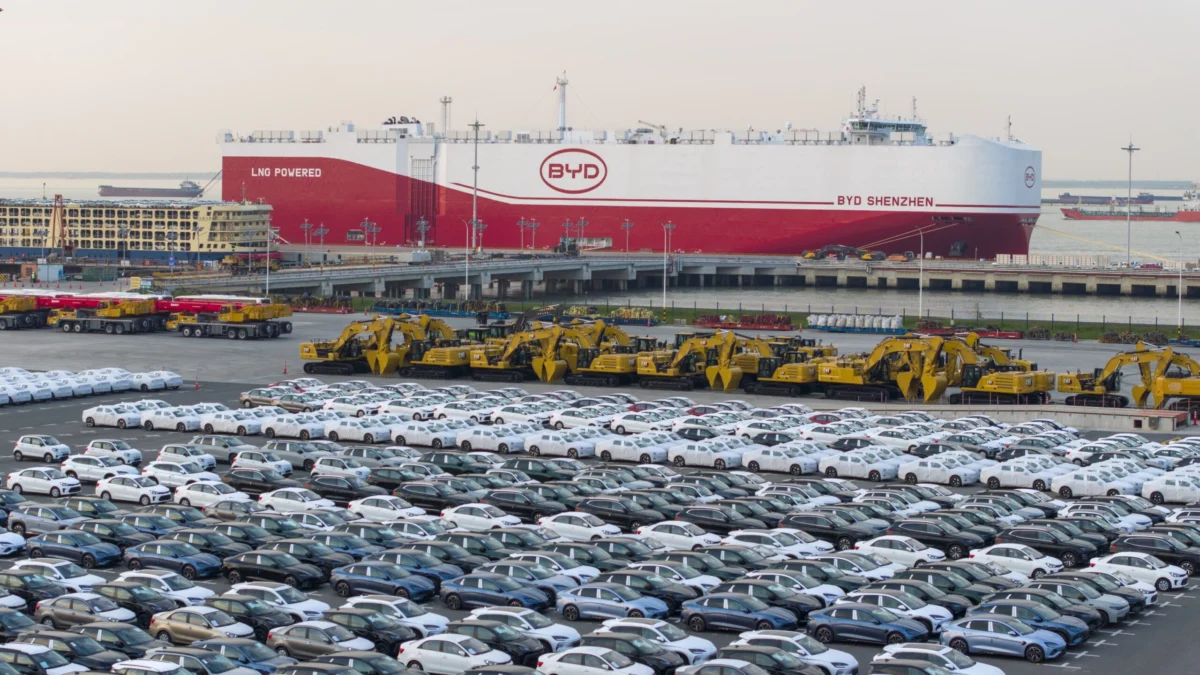
However, the domestic crisis is forcing a strategic pivot that has significant implications for the global economy: an unprecedented surge in exports. As the domestic market saturates and demand falters, Chinese automakers are aggressively looking toward international markets to offload excess inventory. In June, total passenger vehicle exports surged by 82.3% year-on-year, reaching 877,000 units. This export boom is being fueled by global geopolitical instability and rising energy costs elsewhere. Ongoing conflicts in the Middle East have disrupted global shipping and driven up fuel prices in Europe and Southeast Asia, making Chinese-made EVs—known for their competitive pricing and advanced tech stacks—increasingly attractive to foreign buyers looking to reduce their operational costs.
While the immediate outlook for 2026 remains bleak, there is a prevailing sense among economists that the market will eventually find a new equilibrium. The automotive sector is inherently cyclical, and China’s massive vehicle fleet will eventually require a replacement cycle. As older vehicles age out and the broader economic outlook potentially stabilizes, a rebound is anticipated for 2027. This recovery, however, will likely feature a very different roster of companies than the one that entered the decade.
The current "brutal year" serves as a crucible for the industry. The firms that survive will be those that can navigate the transition from a policy-supported growth model to one driven by genuine consumer value and technological efficiency. For the global automotive industry, the lesson is clear: the era of easy growth in China has ended, replaced by a high-stakes battle for efficiency where only the most capitalized and vertically integrated entities can hope to endure. As the market consolidates and the "weak" are purged, the remaining Chinese titans will likely emerge as even more formidable competitors on the world stage, using their hard-won domestic resilience to challenge established incumbents in every corner of the globe.