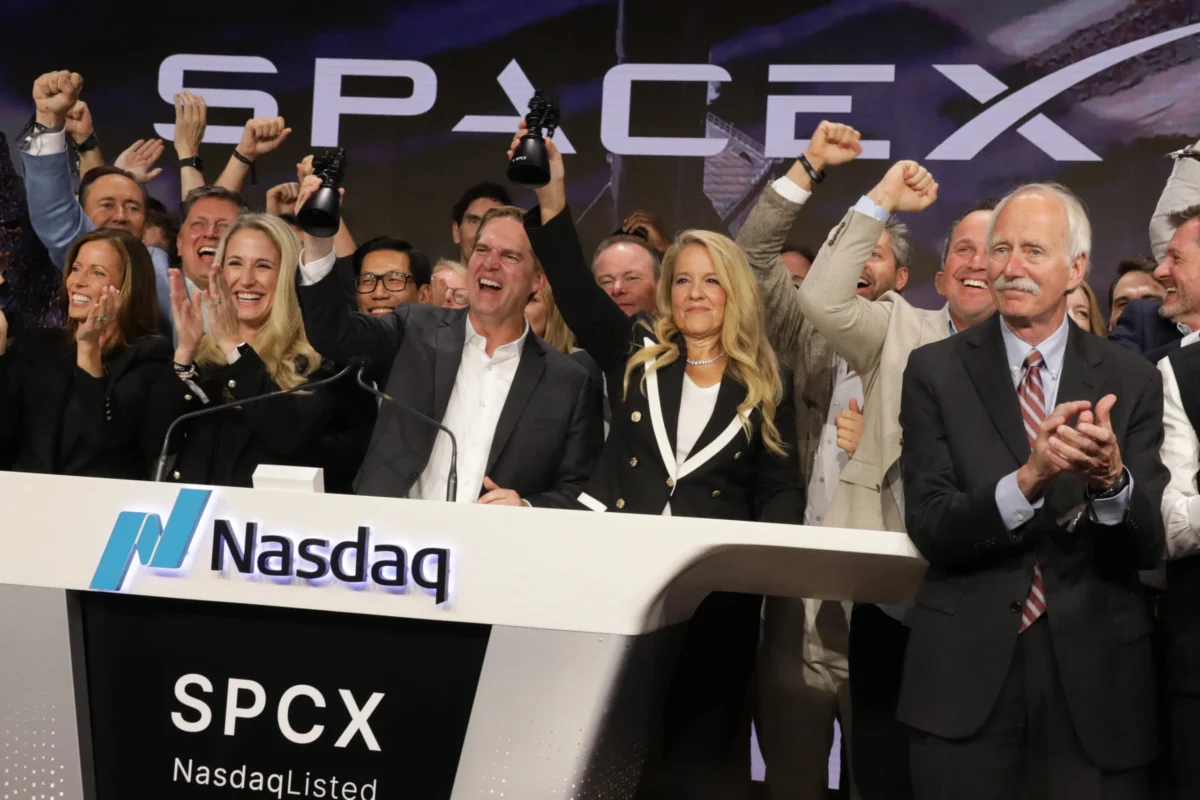
The recent public debut of SpaceX on the Nasdaq exchange represents more than just a milestone for the aerospace industry; it serves as a seismic shift in the architecture of global equity markets. While the initial surge in share price captured the headlines, seasoned market analysts suggest that the true financial impact of Elon Musk’s rocket company is only beginning to unfold. As the dust settles on a historic opening day, the focus of institutional investors is shifting from the initial public offering (IPO) price action to the intricate schedule of index inclusions and rebalancings that will dictate the stock’s liquidity and valuation for years to come.
SpaceX’s entry into the public sphere was met with an appetite rarely seen in the modern era of capital markets. Closing its first day of trading at $160.95, the stock posted a 19% gain, propelling the company’s market capitalization past the $2 trillion threshold. This valuation places SpaceX in an elite tier of global "mega-caps," rivaling the market weights of established tech titans like Apple, Microsoft, and Nvidia. However, unlike traditional tech firms that rely on software margins or hardware cycles, SpaceX sits at the nexus of telecommunications, national security, and deep-tech manufacturing. This unique positioning has created a complex roadmap for its integration into the benchmarks that govern trillions of dollars in passive and active investment capital.
According to analysis from TD Securities, the most significant catalysts for SpaceX’s stock performance are not found in the rearview mirror of its IPO, but in the upcoming calendar of index adjustments. Peter Haynes, Head of Index and Market Structure at TD Securities, emphasizes that the "Day 1" hype is merely a prelude to a series of structural events. The most immediate of these is the anticipated rebalancing of the Nasdaq 100. Scheduled for approximately 15 days post-listing—specifically targeting July 6—this rebalance will force a massive influx of capital as exchange-traded funds (ETFs) and mutual funds that track the Nasdaq 100 are required to purchase shares to match the index’s new composition.
The inclusion process is a multi-staged evolution. Beyond the Nasdaq 100, the company is eyeing entry into the S&P Total Market Index, the MSCI Global Index, and the Russell suite of indices. Each of these inclusions triggers a "forced buying" phenomenon, where institutional managers must acquire the stock regardless of valuation to maintain their tracking error mandates. For a company with a $2 trillion valuation, these flows are not merely incremental; they are multi-billion-dollar liquidity events that can provide a floor for the stock price while simultaneously driving volatility during the rebalancing windows.
However, the path to benchmark dominance has encountered a notable regulatory hurdle. In a move that surprised many market participants, the S&P 500 Index Committee recently declined to "fast-track" SpaceX into the world’s most followed equity benchmark. Under standard S&P 500 rules, a company must generally trade for at least one year before becoming eligible for inclusion. While the committee has the discretion to waive this requirement for exceptionally large or significant listings, they opted to maintain the status quo. This means SpaceX will likely remain outside the S&P 500 until at least mid-2027, a decision that Haynes characterized as "controversial" given the company’s sheer size and systemic importance to the industrial sector.
This delay creates a unique market dynamic. For the next twelve months, SpaceX will be a "missing piece" in many diversified portfolios, potentially leading to a divergence between Nasdaq-heavy growth funds and more traditional S&P 500-tracking instruments. It also places a premium on the upcoming July 6 Nasdaq rebalance, as it remains the primary vehicle for institutional exposure in the near term. Analysts expect that as more shares become "freely tradable"—moving from the hands of private employees and early venture capital backers into the public float—the indices will continue to adjust their weightings, creating recurring waves of demand.

The underlying economic engine of SpaceX justifies this intense market scrutiny. The company’s dominance in the launch sector is near-absolute; in 2023, SpaceX accounted for the vast majority of all orbital mass launched globally. Its Falcon 9 and Falcon Heavy rockets have commoditized access to space, while the development of Starship—the largest flight system ever built—promises to lower the cost per kilogram to orbit by an order of magnitude. Furthermore, the Starlink satellite constellation has transitioned from a speculative project to a global telecommunications powerhouse, boasting over three million subscribers and providing a steady stream of recurring high-margin revenue that offsets the capital-intensive nature of rocket development.
From a global economic perspective, the SpaceX IPO is a bellwether for the "New Space" economy, which McKinsey & Company and the World Economic Forum estimate could be worth $1.8 trillion by 2035. By providing a liquid, public valuation for the industry leader, the market is effectively setting the "cost of capital" for the entire sector. Competitors, ranging from Jeff Bezos’ Blue Origin to established European giants like ArianeGroup, will now be measured against SpaceX’s public transparency and quarterly performance. The listing also provides a boost to the broader aerospace and defense ecosystem, as SpaceX’s "Starshield" division increasingly captures lucrative government contracts for secure communications and Earth observation.
The successful execution of the SpaceX IPO was also a victory for market infrastructure. The sheer volume of trades and the massive capital flows involved in a $2 trillion debut could have strained the technical systems of the Nasdaq exchange. However, market makers and clearinghouses demonstrated remarkable resilience. Haynes noted that the industry "passed the test," proving that the infrastructure supporting modern equity trading can handle the entry of a "decacorn" into the public markets without the systemic glitches that have plagued high-profile IPOs in the past.
Investors must also consider the "Elon Musk Factor," which brings both a premium and a degree of volatility to the stock. Much like Tesla’s trajectory, SpaceX’s valuation is built on a foundation of "future-casting." The market is not just pricing in current launch schedules or Starlink subscriptions; it is pricing in the potential for lunar logistics, Martian exploration, and point-to-point terrestrial travel. This visionary outlook often leads to a disconnect between traditional fundamental analysis—such as price-to-earnings ratios—and the growth-at-any-cost mentality of the company’s leadership.
As the summer progresses, the focus will remain squarely on the technicalities of the "free float." In the world of index investing, it is not just the total market cap that matters, but the amount of stock available for public trading. Because a significant portion of SpaceX remains in the hands of Musk and early insiders, the initial index weightings may be lower than the $2 trillion headline figure suggests. However, as lock-up periods expire and secondary offerings occur, the "investable" market cap will rise, triggering subsequent rounds of index buying.
The SpaceX story is far from over. While the IPO was a singular event, the structural integration of the company into the global financial fabric is a process that will play out over years. The July 6 Nasdaq rebalance serves as the first major checkpoint in this journey. For the broader investment community, SpaceX represents a new asset class—a bridge between the industrial age of heavy manufacturing and the digital age of global connectivity. As it moves from a private "unicorn" to a public powerhouse, its influence on index performance and market sentiment will likely make it the most closely watched ticker of the decade. The launch was successful, but for the financial markets, the real mission has only just reached the upper atmosphere.