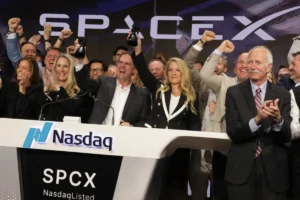
The evolution of Space Exploration Technologies Corp., more commonly known as SpaceX, from a precarious startup on the brink of bankruptcy to a global aerospace titan valued at approximately $1.8 trillion represents one of the most significant shifts in the history of industrial economics. For nearly two decades, as the company disrupted the traditional "cost-plus" model of the aerospace industry, a select group of institutional investors, venture capitalists, and hedge funds quietly built massive positions. These backers, who provided the "patient capital" necessary to fuel Elon Musk’s vision of multi-planetary life, are now on the precipice of a liquidity event that could redefine the benchmarks of venture capital success.
As SpaceX prepares for its highly anticipated initial public offering (IPO) at a valuation that rivals some of the world’s largest publicly traded entities, the financial world is focusing on the specific players who navigated the company’s complex capitalization table. This is not merely a story of speculative gains; it is a case study in high-conviction investing within a sector—commercial space—that many traditional analysts once dismissed as a bottomless pit for capital. The impending windfall for early and mid-stage investors underscores a broader trend in the modern economy: the concentration of immense value within private markets before they ever reach the retail investor.
Among the most prominent beneficiaries of this astronomical rise is veteran investor Ron Baron. Through Baron Capital, the billionaire stock picker began accumulating shares in 2017, long before the company’s dominance in the satellite launch market was a foregone conclusion. At the time of Baron’s initial entry, through employee tender offers, SpaceX was valued at a relatively modest $22 billion. Since then, Baron has participated in 27 separate funding rounds, demonstrating a level of commitment rarely seen in the volatile world of tech investing. By the end of the first quarter of 2025, SpaceX had become a foundational pillar of Baron’s portfolio, accounting for roughly 33% of the $10.4 billion Baron Partners Fund. Baron’s total investment of approximately $2 billion has blossomed into a stake worth an estimated $12 billion, a testament to the power of compounding in a winner-take-all market.
The narrative of SpaceX’s valuation is intrinsically tied to its technological breakthroughs. While the company began as a launch provider, its current valuation is increasingly driven by Starlink, its satellite internet constellation, and Starship, the fully reusable heavy-lift launch vehicle. Cathie Wood’s Ark Invest has been a vocal proponent of this multi-faceted business model. The Ark Venture Fund, which holds SpaceX as its largest position at 11.4% of net assets, views the company through the lens of "technological convergence." In Wood’s estimation, SpaceX is no longer just a rocket company; it is a vertically integrated artificial intelligence and infrastructure play. By combining aerospace engineering with advanced robotics and energy storage, and integrating it with the massive data-processing needs of modern AI, SpaceX is positioning itself as the central nervous system of the burgeoning space economy.
The entry of mutual fund giant Fidelity Investments in 2015 marked a turning point for SpaceX’s institutional credibility. Led by former portfolio manager Gavin Baker, Fidelity took a stake when the company was valued at roughly $10 billion. This early move allowed Fidelity to secure significant allocations in subsequent rounds that were largely closed to other institutional players. Today, the exposure is spread across some of the world’s largest actively managed funds. The $177 billion Fidelity Contrafund and the $103 billion Fidelity Blue Chip Growth Fund both hold substantial positions, effectively giving millions of retirement savers an indirect stake in the Musk-led venture.
The scarcity of SpaceX shares has been a defining feature of its rise. Unlike many Silicon Valley "unicorns" that frequently dilute their equity to fuel growth, SpaceX has maintained a remarkably tight grip on its capitalization table. This exclusivity has created a secondary market where shares often trade at a premium, and where only the most well-connected firms—such as Sequoia Capital, Andreessen Horowitz, and Founders Fund—can gain access. Peter Thiel’s Founders Fund, an early backer that stepped in as far back as 2008, remains one of the most successful early-stage participants. This "gated community" approach to equity management has ensured that when the IPO eventually occurs, the supply of shares will meet an enormous wall of pent-up demand.
Beyond the high-profile venture firms, the "quiet" winners of the SpaceX era include public pension funds and university endowments. These institutions, responsible for the long-term financial health of teachers and the funding of academic research, have seen their portfolios bolstered by the company’s performance. The Ontario Teachers’ Pension Plan (OTPP), for instance, committed over $200 million in 2019, identifying the satellite broadband market as a critical growth engine. Similarly, Washington University in St. Louis made a strategic $50 million investment nearly a decade ago. That stake has appreciated to the point where it now represents more than 10% of the university’s $17 billion endowment, providing a massive buffer for the institution’s operational and scholarship budgets.
From an economic impact perspective, the $1.8 trillion valuation reflects a paradigm shift in how the global market values infrastructure. SpaceX has effectively monopolized the launch industry, carrying more mass to orbit than all other companies and nations combined. This dominance has allowed it to dictate the economics of space. The Starlink division, meanwhile, is transitioning from a capital-intensive project into a high-margin recurring revenue stream. With over three million subscribers and expanding contracts with the Department of Defense and commercial airlines, Starlink is often cited by analysts as the primary driver for the company’s eventual public market premium.
The broader implications for the global aerospace sector are profound. SpaceX’s success has forced a reckoning for traditional "Old Space" players like Boeing and Lockheed Martin, whose legacy models have struggled to compete with Musk’s rapid iteration and reusable hardware. Furthermore, the SpaceX IPO is expected to act as a catalyst for the "New Space" ecosystem, potentially opening the floodgates for other private space companies seeking public capital. However, the sheer scale of SpaceX—a company valued more highly than the total GDP of many developed nations—suggests that it will occupy a category of its own for the foreseeable future.
As the company moves toward its public debut, the focus will shift from private "paper gains" to real-world market performance. The transition from a private entity to a public one brings increased scrutiny, particularly regarding Elon Musk’s management style and the company’s ambitious timelines for Mars exploration. Yet, for the investors who entered the fray when SpaceX was still recovering from its third consecutive rocket failure in 2008, the current valuation is a validation of a high-risk, high-reward philosophy.
The wealth generated by SpaceX’s ascent is not merely a windfall for the ultra-wealthy; it is a redistribution of value toward those who were willing to back an existential bet on humanity’s future in the stars. Whether it is a pension fund in Canada or a mutual fund in Boston, the rewards of the SpaceX journey are being felt across the global financial landscape. As the company prepares to enter the public markets at a valuation that was once thought impossible for a hardware-centric startup, it stands as a monument to the power of visionary leadership supported by unwavering, long-term capital. The $1.8 trillion milestone is not just a number; it is the financial realization of a new era in human industry.