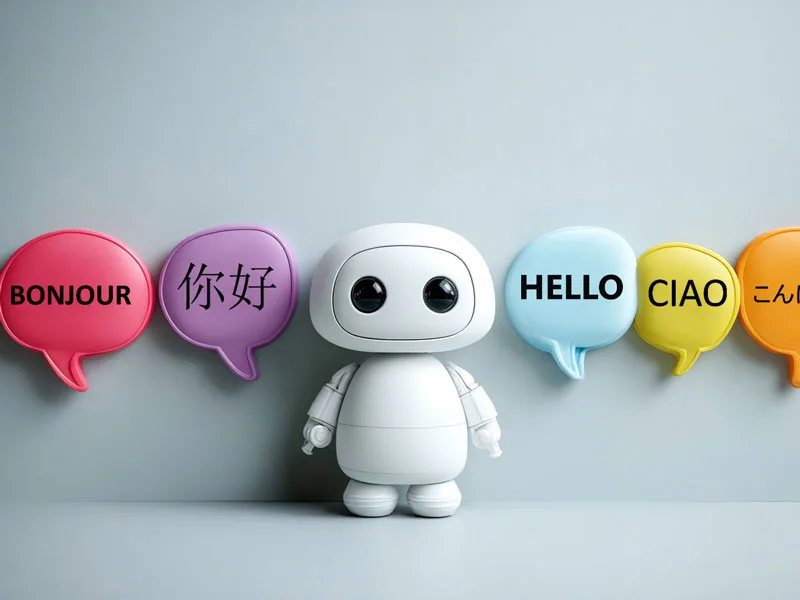
The accelerating integration of artificial intelligence into the global economy is sparking widespread debate, with many organizations citing AI-driven efficiencies as justification for workforce restructuring. This has naturally led to fervent speculation about the future of employment, with a prevalent narrative suggesting AI’s ultimate trajectory is one of human replacement. However, a more nuanced and arguably more profound transformation is unfolding: AI’s evolving capacity to understand the human dimension – the intricate web of intention, emotion, and context that underpins every action and task. From the perspective of sectors at the vanguard of this technological evolution, such as language and translation, the critical question is not merely what AI can automate, but how deeply it can truly comprehend us.
Language, recognized as a cornerstone of human evolution and interconnectedness, has been a focal point for AI development. The founding of companies dedicated to bridging linguistic divides, leveraging AI to facilitate understanding across cultures, underscores the immense potential for AI to foster global connection. This endeavor positions the language and translation industry as a unique vantage point from which to observe and interpret the broader implications of AI.
The initial wave of mass AI adoption was significantly propelled by the synergy of language and artificial intelligence, most notably in the development of large language models (LLMs). These models, capable of generating coherent responses tailored to user preferences, are the product of decades of research in machine translation and linguistics. While AI has demonstrably enhanced the speed and accuracy of translation, a crucial insight has emerged: it does not obviate the necessity of human sensitivity. Instead, AI excels at managing repetitive and time-consuming tasks, thereby liberating skilled professionals to concentrate on more complex aspects of their roles. This allows human experts to dedicate their efforts to the elements of translation that are most imbued with emotion, cultural nuance, and the ineffable quality of "human-ness."
The prevailing discourse surrounding AI within many corporate environments continues to center on productivity gains and the potential for labor displacement. Questions like "Which jobs will be eliminated?" and "How many will remain?" are frequently posed, reflecting understandable anxieties among the workforce and prompting critical considerations for future generations entering the job market. Yet, a more forward-looking and potentially more impactful line of inquiry posits: "What are human beings uniquely adept at?" and "How can AI empower us to amplify these uniquely human capabilities?"
For AI to truly function as a collaborative partner within a human workforce, its next evolutionary leap must be towards a deeper understanding of human beings. Pioneering projects are emerging to address this very challenge, aiming to move beyond models that merely process historical data. These initiatives are focused on developing AI systems capable of integrating and interpreting diverse sensory inputs – vision, audio, and environmental data – enabling real-time engagement with the physical world and fostering a more profound contextual awareness. This ambitious undertaking requires significant investment and collaborative effort, often involving extensive public and private sector partnerships across multiple nations, as exemplified by substantial European seed funding allocated to such projects.
The advancement of AI must be accompanied by robust ethical frameworks and global dialogue to ensure its responsible deployment. International forums, bringing together leading AI scientists, ethicists, and policymakers, are increasingly crucial for navigating the social, cultural, and ethical dimensions of artificial intelligence. Discussions at these high-level meetings often emphasize that AI’s primary purpose should be to serve humanity, upholding human dignity rather than undermining it. A consensus frequently emerges that AI’s most significant positive contributions will lie in accelerating scientific discovery and fostering greater global human understanding.
For leaders and organizations charting a course in the age of AI, a paradigm shift in perspective is imperative. The focus should transition from simply identifying tasks that AI can perform to understanding how AI can elevate human potential. The organizations poised for greatest success will be those that prioritize investment in contextual understanding and human insight over mere operational efficiency. True leadership in this era involves embedding empathy and ethical considerations at the heart of technological innovation, ensuring that AI amplifies our most fundamentally human attributes: our capacity for care, nuanced interpretation, and meaningful connection.
The trajectory of AI development over the next decade will not be solely defined by a reduction in the number of jobs or an increase in machine speed. Instead, it will be characterized by the emergence of machines capable of grasping context, discerning emotions, and recognizing human values. Concurrently, humans will increasingly leverage this enhanced understanding to excel in areas where they remain uniquely indispensable: building relationships, shaping culture, and leading with purpose.
The transformative moment for AI will arrive when machines can comprehend that a sentence is not merely a sequence of words, but an expression of human intent. When AI can discern not only the literal meaning of words but also the subtle cues of tone, gesture, and cultural context, we will transition from an era of automation to one of augmentation. This is the juncture at which AI will truly become an indispensable partner in human progress. Ultimately, the true measure of AI’s advancement will not be the number of jobs that disappear, but the multitude of new forms of human value that are created and amplified.