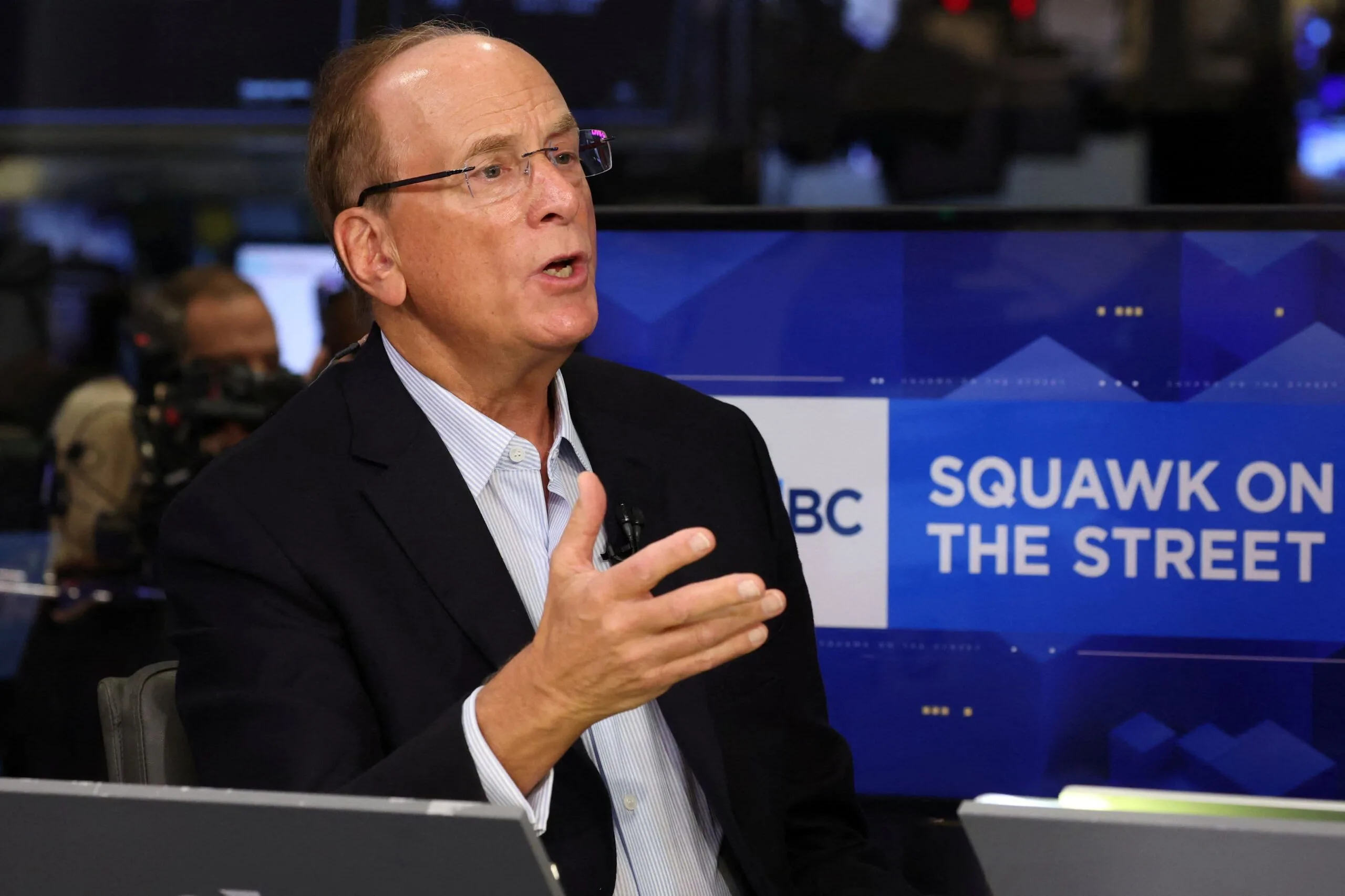
In an era defined by rapid-fire geopolitical shifts and the disruptive emergence of generative artificial intelligence, Larry Fink, the Chairman and CEO of BlackRock, has issued a pointed warning to the global investment community: the greatest threat to long-term wealth is not market volatility, but the impulse to outmaneuver it. In his annual chairman’s letter, released against a backdrop of heightening global tensions and shifting economic paradigms, Fink argued that the practice of market timing—attempting to predict the exact moments to enter or exit the equity markets—remains a losing proposition for the vast majority of investors.
The core of Fink’s argument rests on a mathematical reality that often eludes the emotional investor. Over the past two decades, the S&P 500 has demonstrated remarkable resilience, turning a single dollar into more than eight dollars for those who remained consistently invested. However, the penalty for hesitation is severe. According to data highlighted in Fink’s letter, missing just the ten best-performing days of the market over that twenty-year period would result in an investor earning less than half the total return of someone who stayed the course. This "timing gap" illustrates a fundamental truth of modern finance: the most significant gains often occur in short, unpredictable bursts, frequently during periods of maximum pessimism or immediately following a sharp downturn.
This perspective comes at a critical juncture for BlackRock, which ended 2025 managing a staggering $14 trillion in assets. As the leader of the world’s largest asset manager, Fink’s annual missives are viewed as a bellwether for institutional sentiment and a blueprint for how capital will flow in the coming years. His latest communication suggests that we are entering a "New Era of Fragmentation," where the traditional pillars of global capitalism are being dismantled in favor of national self-reliance and security-focused economic policies.
The Fracture of the Global Consensus
For decades, the prevailing economic model was built on the foundation of globalization—the seamless movement of goods, services, and capital across borders to maximize efficiency and lower costs. Fink notes that this model is now effectively fracturing. The drive for efficiency is being replaced by a drive for resilience, as nations grapple with the vulnerabilities exposed by recent supply chain disruptions and geopolitical conflicts.
"Countries are spending enormous sums to become self-reliant," Fink observed, pointing to three specific sectors: energy, defense, and technology. This shift toward "onshoring" or "friend-shoring" is inherently inflationary, as it prioritizes security over the lowest possible price point. In the United States and Europe, massive subsidies and industrial policies are being deployed to build domestic semiconductor capacity and transition to renewable energy sources. While these moves may bolster national security, they also require trillions of dollars in capital investment, creating a different set of risks and opportunities for investors.
The geopolitical landscape remains a primary driver of the "noise" Fink urges investors to ignore. Recent volatility in the energy markets, spurred by tensions between the United States and Iran, serves as a prime example. While markets rallied on news of potential de-escalation and the halting of strikes on infrastructure, Fink argues that such headlines are often symptoms of deeper, long-term structural shifts rather than isolated events. For the long-term investor, reacting to these daily fluctuations is often a recipe for underperformance.
The AI Paradox: Productivity vs. Inequality
Perhaps the most provocative aspect of Fink’s letter is his assessment of artificial intelligence. While much of Wall Street has focused on the productivity gains and the soaring valuations of tech giants, Fink raises a red flag regarding the social and economic consequences of the AI revolution. He warns that AI has the potential to amplify wealth inequality to unprecedented levels.
The historical trend of the last several generations shows that wealth creation has disproportionately benefited those who already own financial assets—equities, real estate, and private capital. Fink posits that AI is poised to accelerate this trend. Because AI is a capital-intensive technology that favors large-scale players and asset owners, the returns on this innovation are likely to accrue to the top of the economic pyramid.
"The massive wealth created over the past several generations flowed mostly to people who already owned financial assets," Fink stated. "And now AI threatens to repeat that pattern at an even larger scale." This creates a paradox for policymakers and investors alike: AI may drive the next great wave of economic growth, but if that growth is not broadly distributed, it could lead to further social fragmentation and political instability, which in turn creates more market volatility.
For BlackRock, the challenge is navigating this "concentrated" market. In recent years, a small handful of technology firms tied to the AI ecosystem have been responsible for a majority of the equity market’s gains. This concentration poses a risk for diversified portfolios that may not be as exposed to these "winners," yet Fink remains adamant that the solution is not to chase these stocks at any price, but to maintain a disciplined, long-term allocation that can withstand the inevitable corrections in high-growth sectors.
The Mathematics of Staying the Course
To understand why Fink is so staunchly opposed to market timing, one must look at the historical data of market "clusters." Statistical analysis of the S&P 500 over the last 50 years shows that the market’s best days and worst days often occur in close proximity. For instance, many of the strongest single-day gains in history occurred during the depths of the 2008 financial crisis and the 2020 pandemic-induced crash.
Investors who panic and sell during a downturn often miss the initial, most violent stage of the recovery. Because the recovery happens so quickly, missing just a few days of upward movement can permanently alter the trajectory of a retirement portfolio. This is particularly relevant in the current environment, where high-frequency trading and algorithmic execution mean that market sentiment can shift in milliseconds.
Fink’s letter emphasizes that the "unsettling headlines" of today—ranging from sovereign debt levels to the potential for regional wars—are exactly the moments when the temptation to exit the market is highest, yet the long-term cost of doing so is most damaging. He advocates for a shift in focus from "the noise of the now" to the "forces of the future."
A Global Comparison: Resilience in a Volatile World
The theme of staying invested is not unique to the U.S. market. Across the Atlantic, European indices have also shown that long-term participation outweighs short-term maneuvering, despite the continent’s proximity to the conflict in Ukraine and its ongoing energy transition. Similarly, in emerging markets, the volatility associated with currency fluctuations and political instability often scares off retail investors, yet institutional capital—like that managed by BlackRock—often uses these periods to build positions in foundational industries.
The "New Model of Global Capitalism" that Fink describes suggests that the future of returns will be found in the massive infrastructure projects required for the "Great Re-allocation" of resources. As countries invest in domestic power grids, AI data centers, and modernized defense systems, the demand for private capital will be immense. BlackRock is increasingly positioning itself as a bridge between this need for capital and the long-term savings of individuals.
The Institutional Responsibility
As the CEO of a firm with $14 trillion under management, Fink’s words also carry a weight of institutional responsibility. He argues that asset managers have a duty to help investors look past the immediate horizon. The "democratization of investing," while positive in terms of access, has also exposed more people to the psychological pressures of 24-hour news cycles and real-time portfolio tracking.
Fink’s message is ultimately one of disciplined optimism. He acknowledges the "fracturing" of the old world order but sees the massive capital expenditures in technology and energy as the engines of future growth. The warning against market timing is a reminder that the benefits of this growth are only available to those who have the stomach to remain in the arena.
In conclusion, Larry Fink’s annual letter serves as both a mathematical proof and a philosophical plea. By highlighting the 20-year performance of the S&P 500 and the dangers of missing its best days, he provides a data-driven defense of long-termism. By analyzing the fracturing of global capitalism and the risks of AI-driven inequality, he prepares investors for a world that will look vastly different from the one they knew a decade ago. For the global investor, the directive is clear: ignore the headlines, embrace the structural shifts, and above all, stay the course. The cost of missing the best days is simply too high to pay.