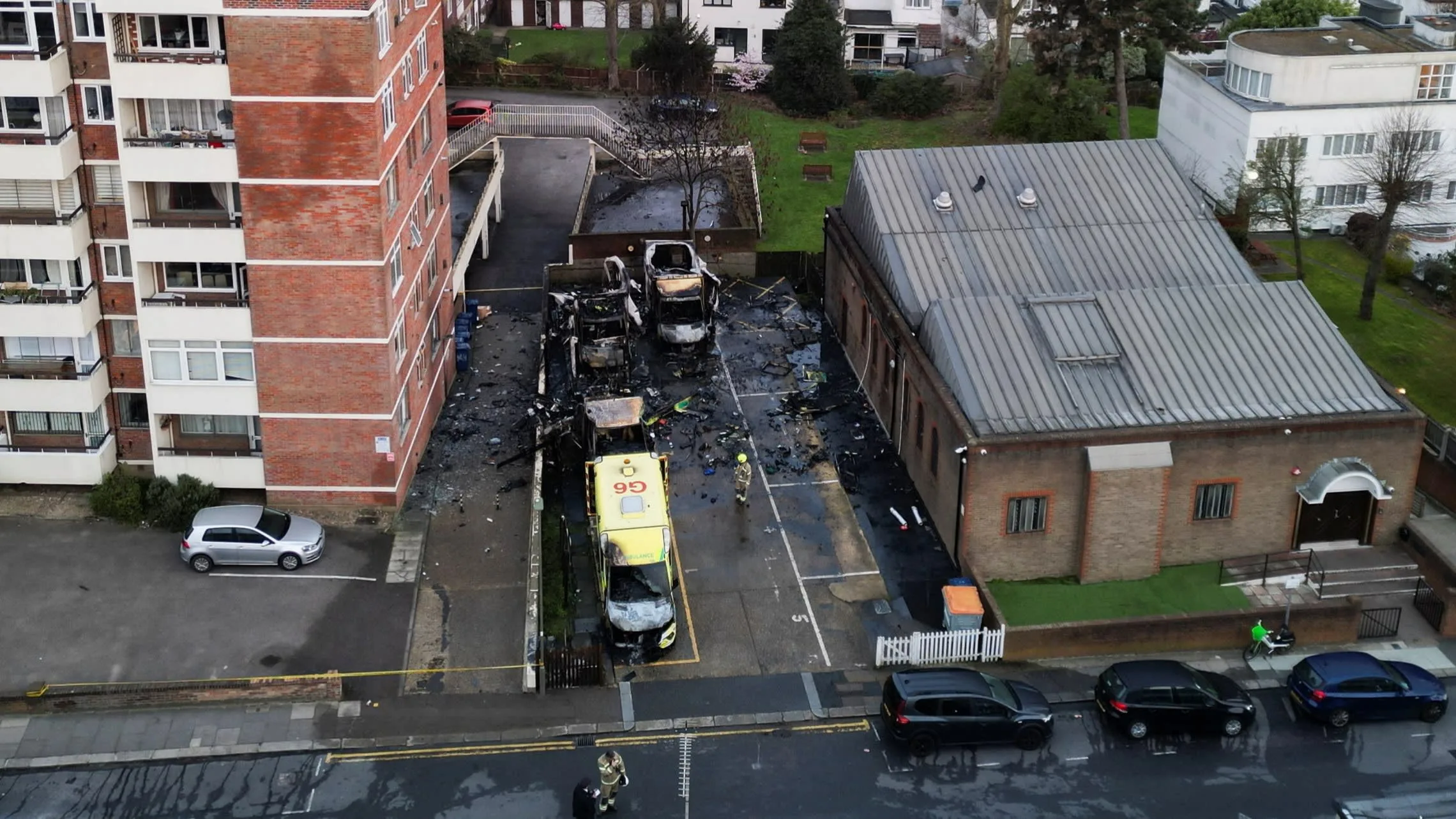
The deliberate incineration of emergency medical vehicles in North London has sent shockwaves through the capital’s security apparatus, marking a violent escalation in targeted property crimes that threaten both public safety and communal cohesion. The incident, which saw multiple ambulances belonging to a Jewish voluntary emergency service set ablaze, is currently being investigated by the Metropolitan Police as a suspected antisemitic hate crime. Beyond the immediate destruction of life-saving equipment, the attack underscores a burgeoning crisis in urban security, where geopolitical tensions increasingly manifest as domestic sabotage, placing an unprecedented burden on the city’s emergency infrastructure and the taxpayer-funded resources required to protect it.
The targeted vehicles belonged to Hatzola, a prominent volunteer-led ambulance service that provides critical rapid-response medical care primarily within the Jewish community but often assists the wider public during major incidents. The destruction of these vehicles represents a significant blow to the region’s medical surge capacity. Modern ambulances are not merely transport vehicles; they are sophisticated mobile intensive care units equipped with advanced telemetry, defibrillators, and specialized trauma kits. The replacement cost for a single fully-outfitted emergency vehicle can range from £150,000 to over £220,000, depending on the technical specifications and medical inventory on board. When factoring in the loss of operational hours and the logistical complexity of procuring specialized medical hardware amidst global supply chain sensitivities, the economic impact of this single act of arson extends well into the high hundreds of thousands of pounds.
This incident occurs against a backdrop of a staggering rise in antisemitic and Islamophobic incidents across the United Kingdom, a trend that has accelerated sharply since late 2023. According to data from the Community Security Trust (CST), a charity that monitors antisemitism in Britain, the country has witnessed record-breaking levels of reported incidents, ranging from verbal abuse to high-value property damage and physical assault. For the Metropolitan Police, the surge in hate-motivated crimes presents a fiscal and operational quagmire. The force has already been stretched thin by the need to police massive weekly demonstrations and increase patrols around sensitive religious and cultural sites. The diversion of resources toward guarding stationary infrastructure—such as ambulance depots, schools, and places of worship—represents a significant opportunity cost for a police service already grappling with a multi-million-pound budget deficit.
The economic ramifications of such targeted attacks extend into the private sector, particularly the insurance and risk management industries. As incidents of ideologically motivated arson increase, insurance premiums for community-based NGOs and religious organizations are expected to climb. Insurers are increasingly categorizing certain postcodes and institutional types as "high-risk," leading to a rise in "social inflation"—the rising costs of insurance claims resulting from societal shifts and increased litigation or crime. For voluntary organizations like Hatzola, which rely heavily on private donations rather than direct government funding, a spike in insurance costs or the need for 24-hour private security patrols can divert essential funds away from medical supplies and staff training, ultimately degrading the quality of care available to the public.
From a broader economic perspective, the stability of London’s social fabric is a key component of its attractiveness as a global hub for investment and talent. Periodic outbursts of communal violence or targeted sabotage create an atmosphere of instability that can deter international businesses and skilled professionals. Historical data from urban centers globally suggest that persistent low-level civil unrest and targeted property damage can lead to a "security tax" on local businesses, which must invest more in shutters, surveillance, and private policing. In North London, a vibrant economic zone characterized by diverse small businesses and a dense residential population, the specter of arson attacks on emergency services threatens to undermine the sense of safety necessary for local commerce to thrive.
The role of voluntary services like Hatzola is also a critical component of the UK’s broader healthcare economics. The National Health Service (NHS) is currently facing some of the most significant pressures in its history, with ambulance wait times and emergency room congestion remaining at critical levels. Voluntary services provide a vital safety valve, handling thousands of calls annually that would otherwise fall to the London Ambulance Service (LAS). By providing rapid localized response, these volunteer units often reach patients minutes before state-funded crews, frequently stabilizing patients and preventing the need for more expensive, long-term hospital interventions. When these services are hobbled by arson, the resulting "overflow" of patients back into the state system adds further strain to an already overleveraged NHS, creating a ripple effect that impacts patient outcomes across the city.
The Metropolitan Police’s Counter Terrorism Command and local forensic teams are currently analyzing CCTV footage and forensic evidence from the scene. The investigation is not only focused on identifying the perpetrators but also on determining whether the attack was an isolated incident or part of a coordinated campaign by extremist elements. Legal experts note that if the incident is proven to be motivated by religious or racial hatred, the sentencing for those involved will be significantly enhanced under the Criminal Justice Act. However, the challenge for the judiciary and the Home Office lies in balancing the need for firm deterrence with the reality of an increasingly polarized digital landscape where extremist ideologies can spread rapidly and inspire "lone wolf" attacks on soft targets like parked ambulances.
In response to the rising threat level, the UK government has recently increased funding for the Protective Security for Mosques scheme and the Jewish Community Protective Security Grant. This funding, totaling tens of millions of pounds, is intended to harden the defenses of vulnerable institutions through the installation of CCTV, reinforced gates, and alarm systems. Yet, as the recent arson attack demonstrates, the challenge is evolving. Security measures that protect buildings are less effective against mobile assets or vehicles parked in residential areas. This necessitates a shift in urban planning and security strategy, moving toward more integrated, intelligence-led monitoring of communal hubs.
Comparing London’s situation to other global cities reveals a troubling pattern. Cities such as Paris, Berlin, and New York have all reported similar spikes in targeted property damage linked to international geopolitical tensions. In these jurisdictions, the economic cost of protecting minority communities and their associated infrastructure has become a permanent line item in municipal budgets. The "globalization of local grievance" means that an event thousands of miles away can almost instantaneously trigger a security crisis in a London suburb, forcing local authorities to maintain a state of constant readiness.
The path forward for London involves more than just increased policing; it requires a concerted effort to address the underlying social fragmentation that allows such incidents to occur. Economic analysts argue that social cohesion is a "soft" economic asset that yields "hard" returns in the form of lower security costs and higher civic participation. When that cohesion breaks down, as evidenced by the targeting of ambulances—symbols of universal compassion and neutrality—the cost is borne by every citizen. The loss of these vehicles is a reminder that the infrastructure of a modern city is fragile, and its protection depends as much on mutual respect and the rule of law as it does on locks and cameras.
As the smoke clears from the charred remains of the Hatzola ambulances, the focus remains on the resilience of the community and the efficiency of the legal response. The ability of the city to replace these assets and bring the offenders to justice will be a litmus test for London’s broader strategy in managing a period of heightened social and political volatility. For now, the priority remains the restoration of services and the reassurance of a public that expects its emergency responders to be protected from the very violence they are trained to mitigate. The incident serves as a stark warning: in the current climate, even the most neutral and vital of services are not immune to the spillover of global tensions, and the price of this instability is one the city can ill afford to pay.