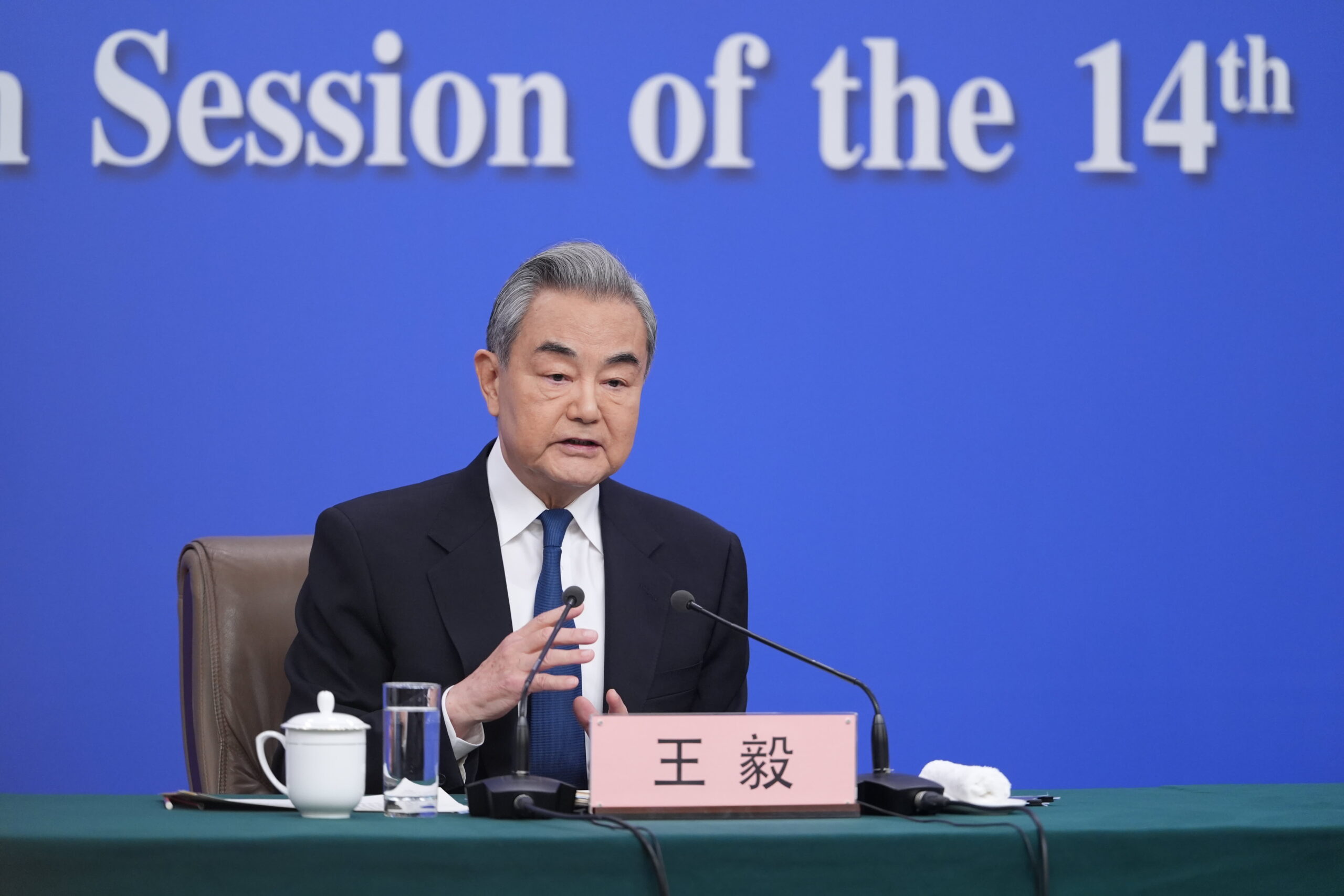
In the austere halls of the National People’s Congress in Beijing, the air of diplomatic caution is palpable as China’s top leadership signals that the path toward a stabilized relationship with the United States remains fraught with systemic risks. Speaking on the sidelines of the fourth session of the 14th National People’s Congress, Chinese Foreign Minister Wang Yi emphasized on Sunday that while high-level engagement remains a strategic priority, the "thorough preparations" required for a successful summit between President Xi Jinping and U.S. President Donald Trump are being complicated by a rapidly deteriorating global security environment. The remarks come at a pivotal moment, as the world’s two largest economies attempt to navigate a fragile rapprochement against the backdrop of an escalating conflict in the Middle East and a contentious trade landscape.
The diplomatic calendar had tentatively set the stage for a historic exchange, with President Trump scheduled to visit Beijing from March 31 to April 2. This would mark the first visit by a sitting American president to the Chinese capital since 2017, a period that has seen bilateral relations descend into a cycle of trade wars, technological "decoupling," and ideological friction. However, the official confirmation of these dates remains elusive. Wang Yi’s rhetoric suggests that while the "agenda of high-level exchanges is already on the table," the environmental conditions for such a meeting are currently suboptimal. The Foreign Minister’s call to "manage the risks that do exist and remove unnecessary disruptions" reflects a deep-seated anxiety in Beijing regarding the unpredictability of the current U.S. administration’s foreign policy maneuvers.
The most significant "disruption" currently looming over the bilateral relationship is the eruption of full-scale hostilities in Iran. The geopolitical landscape was fundamentally altered on February 28, following joint U.S.-Israeli kinetic operations that resulted in the death of Iran’s Supreme Leader, Ayatollah Ali Khamenei. This escalation, coupled with the U.S. capture of Venezuelan leader Nicolas Maduro, has projected an image of a more assertive, interventionist American foreign policy that sits in direct opposition to Beijing’s long-standing doctrine of non-interference and regional stability. Wang Yi was explicit in his assessment of the Middle Eastern theater, characterizing the conflict as a "war that should not have happened" and one that "does no one any good."

From a macroeconomic perspective, the conflict in Iran poses a dual threat to Chinese interests. As the world’s largest importer of crude oil, China is acutely sensitive to energy price shocks and maritime instability in the Persian Gulf. The threat of a wider regional conflagration endangers not only China’s energy security but also its significant investments in the Belt and Road Initiative throughout Central and Western Asia. Wang Yi has been hyper-active on the diplomatic front since the strikes began, engaging in high-level consultations with foreign ministers from Russia, Israel, and Iran. These efforts underscore Beijing’s desire to position itself as a stabilizing force and a proponent of a ceasefire, contrasting its "multilateral" approach with what it perceives as Washington’s destabilizing unilateralism.
The economic dimension of the relationship is equally precarious. While the two nations reached a fragile truce in October, agreeing to lower reciprocal tariffs to below 50%, the memory of the "tariff peak" remains fresh. Last spring, duties on a vast array of consumer and industrial goods had surged past the 100% mark, effectively paralyzing specific segments of the trans-Pacific supply chain. The current 50% threshold, while a significant reduction from the height of the trade war, remains a formidable barrier compared to pre-2018 norms. For global markets, the scheduled March summit is viewed as the "make-or-break" moment for the longevity of this truce. Investors are looking for signals that the "G2" relationship—a term President Trump has used to describe a duopoly of global leadership—can evolve into a predictable framework for trade.
However, Beijing has reacted coolly to the "G2" concept. Wang Yi’s pushback against the idea that two countries alone should lead the world highlights a fundamental philosophical divide. China continues to champion "multipolarity," a system where the Global South and emerging economies have a proportional say in international governance. By rejecting the G2 label, Beijing is signaling to its partners in the BRICS+ bloc and the ASEAN region that it does not seek a "new condominium" with Washington at the expense of other nations’ interests. This ideological stance is paired with a stern warning against the ongoing trend of "economic and technological decoupling." Wang’s metaphor—that using tariff barriers to manage competition is akin to "using kindling to put out a fire"—resonates with a Chinese leadership that views U.S. export controls on semiconductors and AI technology as a containment strategy disguised as national security.
The stakes for the global economy are immense. Analysts note that a failure to hold the March summit, or a meeting that ends in public discord, could trigger a "decoupling 2.0," characterized by even more aggressive reshoring and friend-shoring initiatives. The tech sector is particularly vulnerable; the process of separating U.S. software and design from Chinese manufacturing and hardware is already proving to be, in the words of market analysts, "long and uncomfortable." A breakdown in communication between Xi and Trump would likely accelerate this bifurcation, leading to higher costs for consumers and a fragmentation of global standards in telecommunications and green energy.

Domestically, the timing of these diplomatic maneuvers is critical for President Xi. The eight-day National People’s Congress is the primary venue for setting China’s economic targets and signaling the government’s confidence to domestic consumers and international investors. With China’s property sector still undergoing a painful deleveraging process and local government debt remains a persistent concern, the leadership is desperate for a stable external environment to facilitate domestic recovery. A successful summit with Trump would provide a "strategic safeguard," as Wang Yi noted, allowing Beijing to focus on its "New Quality Productive Forces" initiative without the constant threat of new, punitive American trade measures.
The capture of Nicolas Maduro in Venezuela adds another layer of complexity to the March agenda. China has significant financial exposure in Caracas, having extended billions in loans-for-oil deals over the past two decades. The sudden removal of the Maduro administration by U.S. forces is viewed in Beijing as a violation of sovereign integrity and a threat to Chinese assets in the Western Hemisphere. While Wang Yi did not name Maduro directly in his Sunday press conference, the subtext of "managing risks" and "removing disruptions" clearly encompasses the fallout from the U.S. actions in Latin America.
As the March 31 deadline approaches, the international community remains in a state of high alert. The "thorough preparations" Wang Yi spoke of likely involve intense, behind-the-scenes negotiations regarding the specific language of a potential joint statement. Beijing is seeking guarantees that the U.S. will not expand its list of restricted Chinese tech firms, while Washington is demanding greater market access and a commitment from China to reduce its support for the Iranian economy.
Ultimately, the potential Trump-Xi meeting represents more than just a bilateral check-in; it is a barometer for the stability of the 21st-century world order. If the two leaders can find common ground amidst the smoke of the Iran conflict and the friction of the trade war, it could provide the "suitable environment" necessary for global markets to breathe a sigh of relief. If, however, the "unnecessary disruptions" prove too great to overcome, the world may find itself sliding toward the "conflict or confrontation" that Wang Yi warned would "drag the whole world down." For now, the global economy hangs in a state of suspended animation, waiting to see if diplomacy can bridge the widening chasm between the world’s two most powerful capitals.