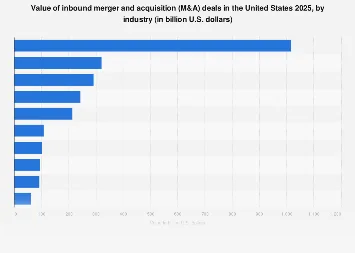
The landscape of mergers and acquisitions (M&A) within the United States is anticipated to undergo significant recalibration by 2025, with valuations across various industry sectors reflecting a complex interplay of technological advancement, economic headwinds, and strategic imperatives. While precise, granular data for future valuations often remains proprietary and subject to market fluidity, forward-looking analysis and prevailing trends suggest a discernible pattern of growth and contraction among key economic segments. The ongoing digital transformation, coupled with evolving consumer behaviors and global supply chain realignments, is not merely influencing business operations but fundamentally reshaping the perceived worth of companies within these industries.
For instance, the technology sector, a perennial engine of M&A activity, is expected to continue commanding substantial valuations, albeit with a greater emphasis on profitability and sustainable growth rather than sheer market share. Companies at the forefront of artificial intelligence, cloud computing, cybersecurity, and advanced data analytics are likely to remain prime acquisition targets. The rationale behind this sustained interest lies in the indispensable role these technologies play in enhancing operational efficiency, driving innovation, and creating new revenue streams across virtually every other industry. Venture capital funding trends and the increasing demand for specialized tech talent further bolster the attractiveness of these sub-sectors, translating into higher multiples and more competitive bidding for acquisition. Reports from leading financial institutions indicate that while the pace of mega-deals might moderate due to macroeconomic uncertainty, the volume of strategic tuck-in acquisitions aimed at acquiring specific capabilities or intellectual property is set to remain robust.
Conversely, industries traditionally reliant on physical infrastructure or legacy business models might experience more tempered valuation growth, or even a decline, unless they demonstrate a clear and credible pivot towards digital integration and sustainable practices. The energy sector, for example, is navigating a dual challenge: the persistent demand for traditional energy sources and the accelerating transition towards renewable energy. Companies with a strong portfolio in renewable technologies, energy storage, and grid modernization are likely to see their valuations appreciate, attracting significant investment from both strategic players and sustainability-focused funds. Established fossil fuel companies, on the other hand, face pressure to demonstrate clear decarbonization strategies to maintain or enhance their market valuation. This bifurcation within the energy sector underscores a broader trend: sustainability is no longer a niche concern but a critical determinant of long-term economic viability and, consequently, corporate valuation.
The healthcare and life sciences sector continues to be a bedrock of M&A activity, driven by factors such as an aging global population, advancements in biotechnology and pharmaceuticals, and the ongoing need for healthcare services and technologies. Companies specializing in personalized medicine, gene editing, digital health solutions, and innovative drug discovery are particularly attractive. The consolidation within the healthcare provider space, aimed at achieving economies of scale and improving patient outcomes through integrated care models, is also expected to fuel deal-making. Furthermore, the increasing focus on preventative care and the development of novel therapies for chronic diseases are creating new avenues for investment and acquisition. Analysts predict that the pharmaceutical and biotechnology segments, especially those with robust R&D pipelines, will continue to command premium valuations, reflecting the significant time and capital investment required for drug development and regulatory approval.
The retail and consumer goods sector is undergoing a profound metamorphosis, with e-commerce dominance and changing consumer preferences dictating new valuation metrics. While brick-and-mortar retailers continue to adapt, those that have successfully integrated robust online sales channels and personalized customer experiences are likely to see their valuations stabilize or grow. Acquisitions in this space are increasingly focused on companies with strong direct-to-consumer (DTC) models, advanced data analytics capabilities for understanding consumer behavior, and efficient supply chain management systems that can support agile fulfillment. The value proposition is shifting from mere product sales to the creation of seamless and engaging brand experiences across multiple touchpoints. Furthermore, the growing consumer demand for sustainable and ethically sourced products is also influencing valuations, rewarding companies that demonstrate genuine commitment to these principles.
The financial services industry is also witnessing a wave of consolidation and innovation, driven by regulatory changes, the rise of fintech, and the demand for more personalized and accessible financial products. Banks and traditional financial institutions are actively acquiring or partnering with fintech startups to enhance their digital offerings, streamline operations, and reach new customer segments. Valuations in this sector are increasingly tied to technological capabilities, customer acquisition costs, and the ability to leverage data for risk management and product development. The insurtech sub-sector, in particular, is expected to remain a hotbed for M&A, as established insurers look to integrate innovative technologies for underwriting, claims processing, and customer engagement. The increasing adoption of blockchain technology and the evolving regulatory landscape for digital assets could also present new opportunities and challenges for valuation in this sector.
The industrial and manufacturing sector, while perhaps less glamorous than technology or life sciences, is also experiencing significant M&A activity, albeit with a focus on modernization and efficiency. Companies that are embracing automation, robotics, the Industrial Internet of Things (IIoT), and advanced manufacturing techniques are becoming more attractive acquisition targets. The drive for reshoring and nearshoring supply chains, a trend accelerated by recent global disruptions, is also prompting strategic acquisitions aimed at bolstering domestic manufacturing capabilities. Valuations in this sector are increasingly influenced by the adoption of Industry 4.0 technologies, the ability to offer customized solutions, and the resilience of their supply chain networks. Companies that can demonstrate significant improvements in productivity, reduced waste, and enhanced product quality through technological adoption are likely to command higher valuations.
Globally, the U.S. M&A market remains a significant indicator of economic health and corporate strategy. While geopolitical tensions, inflation concerns, and rising interest rates have introduced a degree of caution into global deal-making, the underlying drivers for strategic consolidation and innovation remain strong. Companies are seeking to gain market share, acquire critical technologies, achieve cost synergies, and expand into new geographic regions. The ability of U.S. companies to adapt to these evolving economic conditions and to strategically deploy capital through M&A will be a key determinant of their long-term success and their valuation in the years leading up to 2025. The market is not merely about size or historical performance; it is increasingly about adaptability, technological prowess, and a clear vision for sustainable growth in a rapidly changing world. Investors and acquirers are scrutinizing not just balance sheets, but also the agility and forward-thinking strategies that will define industry leadership in the coming years.