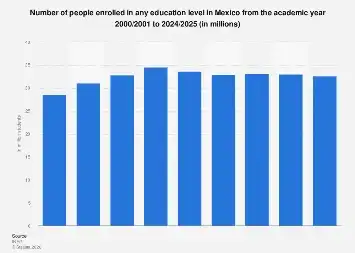
Mexico’s education system is undergoing a significant transformation, with enrollment figures reflecting demographic shifts, policy initiatives, and evolving societal needs. Projections for the academic year 2024/2025 indicate a continuation of these trends, offering a glimpse into the nation’s future human capital development. Examining enrollment data over the past two decades reveals a dynamic picture, highlighting periods of both substantial growth and subtle contraction across all educational levels.
Historically, the period between the academic years 2000/2001 and 2015/2016 saw a considerable surge in student enrollment. The academic year 2015/2016 marked a peak, with a significant number of students participating in formal education. This surge can be attributed to several factors, including a growing youth population, increased government investment in education infrastructure, and broader access to primary and secondary schooling. Conversely, the early 2000s, specifically the 2000/2001 academic year, represented a lower point in enrollment numbers. The difference between these two periods underscores the substantial progress Mexico has made in expanding educational opportunities, with the peak year demonstrating a notable percentage increase compared to the early 2000s.
The trajectory of student enrollment in Mexico is influenced by a complex interplay of socio-economic and demographic forces. A youthful population structure has historically meant a large cohort entering the education system. However, declining fertility rates, a trend observed in many Latin American nations, are likely to exert a moderating influence on future enrollment numbers, particularly at the foundational levels of education. This demographic shift necessitates a strategic focus on quality and retention, rather than solely on expanding capacity.
Government policies and educational reforms play a pivotal role in shaping enrollment figures. Initiatives aimed at increasing access to early childhood education, improving retention rates in secondary schools, and expanding opportunities in higher education and vocational training can significantly impact the overall student population. For instance, programs designed to reduce dropout rates, scholarships to support disadvantaged students, and investments in teacher training and curriculum development can all contribute to sustained or increased enrollment. The Mexican government’s commitment to universal access to education, enshrined in its constitution, provides a foundational framework for these efforts.
The economic implications of these enrollment trends are profound. A larger, better-educated populace generally translates into a more skilled and productive workforce, which is a critical driver of economic growth and competitiveness. Increased enrollment in higher education and vocational programs, in particular, can lead to a greater supply of professionals in fields such as technology, engineering, healthcare, and specialized trades, thereby supporting innovation and economic diversification. Conversely, declining enrollment could signal potential future labor shortages in certain sectors, necessitating proactive policy interventions and recalibrations in educational planning.
Furthermore, the distribution of enrollment across different educational levels provides insights into the structure of Mexico’s human capital. A robust primary and secondary education system is the bedrock, ensuring foundational literacy and numeracy for the majority of the population. Growth in secondary education enrollment indicates progress in ensuring that more young Mexicans complete their compulsory schooling, a crucial step towards further educational or vocational pursuits. Trends in higher education enrollment are particularly important for national development, as they reflect the nation’s capacity to produce researchers, innovators, and skilled professionals capable of competing on a global stage.
Global comparisons offer valuable context for understanding Mexico’s educational enrollment landscape. Many developing nations are grappling with similar challenges of expanding access while simultaneously improving quality and equity. Countries in Latin America and other emerging economies often face demographic pressures, resource constraints, and the need to align educational outcomes with the demands of a rapidly evolving global economy. Mexico’s experience in navigating these challenges can offer lessons and insights to its regional peers and beyond. For example, the digital divide, which affects access to online learning resources, remains a significant concern for many countries, including Mexico, particularly in light of the increased reliance on remote learning necessitated by global events.
Looking ahead, preliminary data and projections for the academic year 2024/2025 suggest a continued evolution of Mexico’s educational landscape. While precise figures for future years often depend on preliminary data and ongoing adjustments, the general direction of demographic trends and policy priorities provides a basis for anticipation. The focus is increasingly shifting towards ensuring that the education system not only accommodates a large number of students but also equips them with the skills and knowledge necessary for success in the 21st-century economy. This includes fostering critical thinking, digital literacy, and adaptability, skills that are increasingly in demand by employers worldwide.
The quality of education, measured by learning outcomes and graduate employability, is becoming as crucial as the quantity of students enrolled. Investments in curriculum modernization, pedagogical innovation, and robust assessment systems are essential to ensure that educational attainment translates into tangible economic and social benefits. The challenge for Mexico, as for many nations, lies in balancing the imperative of expanding access with the equally critical need to enhance the quality and relevance of its educational offerings. The success of these efforts will ultimately determine the nation’s capacity to foster sustainable development and improve the well-being of its citizens in the years to come. The ongoing analysis of enrollment data, coupled with qualitative assessments of educational quality and labor market demand, will be vital for informed policymaking and strategic planning within Mexico’s dynamic education sector.