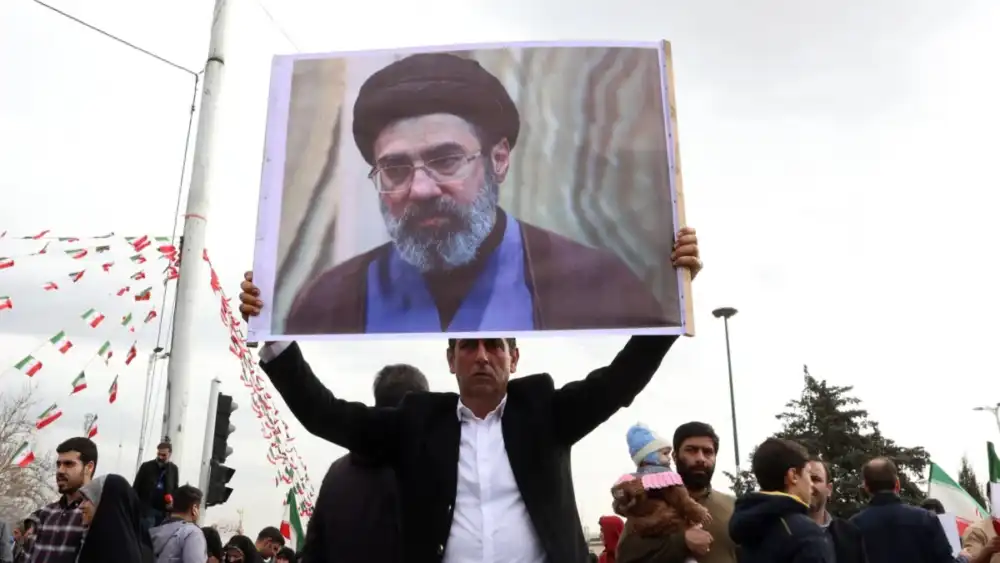
The internal corridors of power in Tehran are currently undergoing a seismic shift that promises to redefine the Islamic Republic’s trajectory for decades to come. For years, the question of who would succeed the 85-year-old Supreme Leader, Ayatollah Ali Khamenei, remained a matter of quiet speculation and intense behind-the-scenes maneuvering. However, recent developments surrounding the elevation of Mojtaba Khamenei, the Supreme Leader’s second son, suggest that the clerical establishment has moved toward a consensus intended to ensure ideological purity and institutional survival. This transition is not merely a matter of family lineage; it represents a strategic consolidation of the "deep state"—a fusion of the senior clergy and the Islamic Revolutionary Guard Corps (IRGC)—designed to withstand both domestic dissent and international economic pressure.
The ascent of Mojtaba Khamenei comes at a critical juncture for Iran’s economy, which has been characterized by systemic volatility and the crushing weight of international sanctions. For global markets and geopolitical analysts, the signal is clear: the era of "pragmatic reformism" or a return to the 2015 nuclear deal (JCPOA) framework is increasingly a relic of the past. By positioning a figure known for his proximity to the security apparatus and his uncompromising stance on revolutionary principles, Tehran is signaling its commitment to the "resistance economy." This economic model prioritizes self-sufficiency, illicit oil trade networks, and deep-seated integration with Eastern powers like China and Russia, rather than seeking a rapprochement with the West to unlock frozen assets or reintegrate into the SWIFT banking system.
Economically, Iran remains a nation of contradictions. Despite being home to some of the world’s largest proven oil and gas reserves, its GDP has struggled to maintain consistent growth under the "maximum pressure" campaign initiated by the United States in 2018. Inflation in the Islamic Republic has hovered between 40% and 50% for several years, severely eroding the purchasing power of the middle class and pushing millions toward the poverty line. The Iranian Rial has seen a catastrophic devaluation, trading at record lows against the US dollar on the open market. In this climate, the selection of a successor like Mojtaba Khamenei suggests that the regime’s priority is not economic liberalization, but rather the maintenance of the status quo through the IRGC’s vast economic empire.
The IRGC is estimated to control anywhere from 30% to 50% of the Iranian economy, with interests spanning telecommunications, construction, energy, and finance through various "bonyads" or charitable foundations. These entities operate with little transparency and are often exempt from taxes. A Mojtaba Khamenei leadership would likely entrench this military-industrial complex further. As a figure who has long managed his father’s office (the "Beit-e Rahbari") and maintained a close relationship with the IRGC’s top brass, Mojtaba is viewed as a guarantor of the Guard’s economic interests. For foreign investors, particularly those in Europe who once looked toward the Iranian market with optimism, this development reinforces the "high-risk" status of the Iranian jurisdiction, likely keeping the country on the Financial Action Task Force (FATF) blacklist for the foreseeable future.
The geopolitical implications of a Mojtaba-led succession are equally profound. Under the current leadership, Iran has aggressively pursued a "Pivot to the East" policy. This strategy was solidified by the 25-year strategic partnership agreement with China and Iran’s recent admission into the BRICS+ bloc and the Shanghai Cooperation Organisation (SCO). These moves are intended to create a sanctions-proof diplomatic and economic shield. China currently serves as the primary destination for Iranian "teapot" refinery exports, purchasing sanctioned crude at significant discounts. Expert analysis suggests that a hardline succession will accelerate this trend, moving Iran further into a Eurasian economic orbit where human rights records and nuclear non-proliferation are secondary to energy security and anti-Western alignment.
Furthermore, the rise of Mojtaba Khamenei raises significant questions about the internal legitimacy of the Islamic Republic. The 1979 Revolution was founded, in part, on the rejection of hereditary monarchy. The prospect of a son succeeding his father as Supreme Leader is ideologically fraught and has already drawn criticism from both the dwindling reformist camp and the more traditionalist clerical circles in Qom. However, the systematic pruning of the political field—most notably seen in the disqualification of moderate candidates in recent parliamentary and presidential elections—has left the Assembly of Experts, the body responsible for choosing the Supreme Leader, dominated by loyalists. This institutional capture ensures that the transition can be managed with minimal legal friction, even if it risks alienating a population that has increasingly turned to the streets to demand systemic change.
The "Woman, Life, Freedom" protests of 2022 and 2023 demonstrated a profound rift between the Iranian youth and the aging clerical elite. With over 60% of Iran’s population under the age of 30, the regime faces a demographic that is more connected, more secular, and more disillusioned than any previous generation. A Mojtaba Khamenei tenure would likely double down on the "digital iron curtain," expanding the National Information Network to restrict internet access and utilizing AI-driven surveillance to suppress dissent. From a business perspective, this continued focus on internal security over digital openness hampers the growth of Iran’s once-promising tech startup scene, leading to a "brain drain" of the country’s most talented engineers and entrepreneurs to hubs in Dubai, Istanbul, and the West.
Comparing Iran’s succession model to other regional powers provides a stark contrast. While Saudi Arabia’s transition toward Crown Prince Mohammed bin Salman has been marked by a radical—albeit authoritarian—economic liberalization through "Vision 2030," Iran’s transition appears to be moving in the opposite direction. While the Saudi model seeks to diversify away from oil and attract Western FDI, the Iranian model under the likely Mojtaba succession is one of retrenchment and the fortification of a "fortress economy." This divergence has significant long-term implications for regional stability. A hardline Tehran is less likely to engage in meaningful de-escalation with its neighbors unless it is on terms that preserve its regional "Axis of Resistance" proxies in Lebanon, Iraq, Yemen, and Syria.
In the energy sector, the prospect of a hardline continuation means that the global oil market must continue to account for the "Iran discount." As long as sanctions remain and a hardline leadership refuses to compromise on its nuclear ambitions, Iranian oil will continue to flow through the "shadow fleet" of tankers. This clandestine trade, while providing a lifeline for the regime, prevents Iran from modernizing its aging energy infrastructure, which requires an estimated $200 billion in investment to reach its full production potential. Without Western technology and capital, Iran’s gas fields, including the massive South Pars, face pressure drops and declining output, which could eventually turn a major energy exporter into a country struggling to meet its own domestic heating and industrial needs during winter months.
Expert insights from various geopolitical think tanks suggest that the international community should prepare for an Iran that is more ideologically rigid and less susceptible to economic incentives. The "carrot and stick" approach that defined Western diplomacy for two decades may have reached its limit. If Mojtaba Khamenei assumes the mantle of leadership, he will do so with the backing of a security apparatus that believes it has successfully weathered the worst of the Western sanctions and emerged as a pivotal player in a new, multipolar world order.
Ultimately, the elevation of Mojtaba Khamenei is a signal of continuity over change. It represents the triumph of the revolutionary vanguard over the technocratic class. For the global economy, it means that the "Iran risk" is now a permanent feature of the landscape. For the Iranian people, it suggests a narrowing of the political horizon. As the Islamic Republic prepares for its most significant leadership transition since 1989, the world is watching a nation that has chosen to double down on its foundational defiance, betting that its alliances in the East and its grip on domestic security will be enough to navigate the turbulent waters of the 21st century. The shadows of succession are clearing, revealing a future that looks remarkably like a more hardened version of the past.