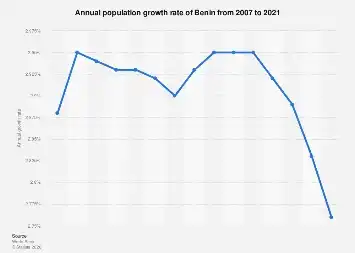
Benin, a West African nation strategically positioned along the Gulf of Guinea, has experienced a notable demographic expansion between 2007 and 2021, a period marked by significant shifts in its population dynamics. This growth, while indicative of broader development trends, presents both opportunities and challenges for the nation’s economic trajectory and social fabric. Understanding the nuances of this demographic evolution is crucial for policymakers, investors, and international development organizations seeking to foster sustainable progress in Benin.
From 2007 to 2021, Benin’s population grew substantially, reflecting a combination of factors including relatively high birth rates and declining mortality rates, common in many developing economies undergoing demographic transitions. While precise figures for the entire period are multifaceted, available data points to a consistent upward trend. For instance, by 2021, the country’s population had risen considerably from its 2007 baseline, placing increasing demands on resources and infrastructure. This demographic dividend, if harnessed effectively through investment in human capital and job creation, can fuel economic growth. Conversely, without adequate planning, it risks exacerbating existing socio-economic disparities and straining public services.
The economic implications of this population increase are far-reaching. A larger populace translates to a growing labor force, a key determinant of economic output. However, the quality of this labor force is paramount. Benin’s economic structure, heavily reliant on agriculture, requires diversification to absorb a burgeoning workforce into higher-value sectors. Projections for economic growth in Benin have historically been tied to its ability to leverage its human resources. A larger population can mean a larger domestic market, potentially driving consumption and stimulating local industries. However, this potential is contingent on rising disposable incomes, which in turn depend on job creation and wage growth.
Statistics from international bodies, such as the World Bank, illustrate Benin’s ongoing development efforts, often intertwined with its demographic realities. While specific compound annual growth rates for population during the 2007-2021 period are subject to detailed statistical analysis, the overall trend indicates a nation on an upward demographic curve. This growth rate, typically higher than the global average, places Benin in a category of countries with youthful populations, a demographic profile that can be a powerful engine for economic expansion if properly managed. The dependency ratio – the proportion of dependents (children and the elderly) to the working-age population – is a critical metric to monitor. A high dependency ratio can place a significant burden on the working population and government resources, necessitating investments in education and healthcare for the young and social safety nets for the elderly.
The agricultural sector, which employs a significant portion of Benin’s population, faces pressures from both a growing workforce and the need for modernization. Increasing agricultural productivity through improved farming techniques, access to technology, and market linkages is essential to ensure food security and provide sustainable livelihoods for a larger rural population. Simultaneously, fostering the growth of the services and manufacturing sectors is vital to create diverse employment opportunities and move up the value chain. The government’s focus on industrialization and promoting small and medium-sized enterprises (SMEs) can be instrumental in this regard.
Global comparisons offer valuable context. Many sub-Saharan African nations are experiencing similar demographic trends, grappling with the challenges and opportunities of rapid population growth. Countries that have successfully navigated this phase often did so by prioritizing education, healthcare, and inclusive economic policies. Benin’s progress in these areas will be a key determinant of its long-term economic prosperity. For instance, increased female education and access to family planning services are often correlated with a moderation in birth rates, leading to a more balanced demographic structure over time.
The social impact of population growth is equally profound. Access to education and healthcare services becomes a critical concern. A growing number of children require more schools, qualified teachers, and educational resources. Similarly, increased demand for healthcare necessitates expanded facilities, medical personnel, and access to essential medicines. Urbanization, often a consequence of population shifts, can strain city infrastructure, leading to challenges in housing, sanitation, and public transportation. Benin’s urban centers, particularly Cotonou, are likely experiencing these pressures. Effective urban planning and investment in public services are therefore paramount.
Furthermore, the demographic shifts can influence social cohesion and governance. Ensuring equitable distribution of resources and opportunities across different regions and demographic groups is crucial to prevent social unrest and foster national unity. Policies that promote youth engagement, entrepreneurship, and civic participation can help channel the energy of a young population constructively.
The economic impact analysis of Benin’s population growth involves assessing its contribution to Gross Domestic Product (GDP), consumption patterns, and the labor market. A larger population can boost domestic demand, a significant driver of economic activity. However, if this demand is met primarily through imports, it can lead to trade deficits. Therefore, strengthening domestic production capacity across various sectors is essential. The multiplier effect of investments in sectors that create jobs for a growing population, such as infrastructure development, renewable energy, and digital technologies, can be substantial.
Statistics on unemployment and underemployment rates are key indicators of how effectively Benin is absorbing its growing labor force. Addressing these challenges requires a multi-pronged approach, including vocational training programs, entrepreneurship support, and policies that incentivize private sector investment. The informal sector remains a significant employer in Benin, and efforts to formalize businesses and improve working conditions within this sector can yield significant economic and social benefits.
In conclusion, Benin’s population growth from 2007 to 2021 is a defining characteristic of its contemporary landscape. It presents a complex interplay of economic potential and developmental hurdles. By strategically investing in its human capital, diversifying its economy, enhancing its infrastructure, and implementing inclusive social policies, Benin can transform its demographic surge into a powerful catalyst for sustainable development and improved living standards for its citizens. The nation’s future prosperity hinges on its ability to effectively manage this evolving demographic reality.