The landscape of American trade policy has once again been thrust into a state of profound legal and economic volatility as a powerful coalition of 24 states, spearheaded by New York Attorney General Letitia James, moved to block the federal government’s latest attempt to impose sweeping global tariffs. This legal challenge, filed on Thursday in the U.S. Court of International Trade, represents a high-stakes confrontation between executive authority and the constitutional limits of trade regulation. The lawsuit arrives just days after the Supreme Court delivered a significant blow to the administration’s previous trade strategy, signaling a protracted battle that could redefine the boundaries of presidential power over the nation’s economy.
The crux of the litigation centers on the administration’s rapid pivot to a new legal justification for its protectionist agenda. Following the Supreme Court’s decision to strike down the "Liberation Day" tariffs—which were originally predicated on the International Emergency Economic Powers Act (IEEPA)—the White House immediately invoked Section 122 of the Trade Act of 1974 to implement a fresh 10% global levy. This new regime is not intended to be static; administration officials, including Treasury Secretary Scott Bessent, have already signaled intentions to escalate the rate to 15% in the near term. For the petitioning states, this move is viewed not as a legitimate exercise of trade policy, but as an "illegal end run" around the highest court in the land.
Legal experts and state prosecutors argue that the administration’s reliance on Section 122 is fundamentally flawed. Historically, this specific provision of the 1974 Trade Act was designed to address acute monetary imbalances during an era when the global economy was transitioning away from the gold standard. The statute was intended to provide the President with temporary authority to deal with "large and serious balance-of-payments deficits" through modest, short-term surcharges. However, the coalition led by Attorney General James contends that the current administration is distorting the original intent of the law, using it as a permanent tool to address structural trade imbalances that Section 122 was never meant to govern.
The economic implications of this renewed tariff regime are staggering. By imposing a blanket 10% duty on nearly all imported goods, the administration is effectively introducing a nationwide sales tax that disproportionately affects consumers and small businesses. In her statement, Attorney General James emphasized that the President is "ignoring the law and the Constitution to effectively raise taxes on consumers," warning of the "economic chaos" that follows such unpredictable shifts in trade policy. The states are not only seeking to halt the current tariffs but are also demanding full refunds for the duties already collected, a move that could cost the federal treasury billions of dollars.
From a macroeconomic perspective, the sudden re-imposition of tariffs threatens to destabilize supply chains that are only just beginning to recover from years of pandemic-related and geopolitical disruptions. Many American manufacturers rely on imported raw materials and intermediate components that cannot be easily sourced domestically. For these firms, a 10% or 15% increase in input costs must either be absorbed—thinning already tight profit margins—or passed on to consumers in the form of higher prices. This inflationary pressure comes at a sensitive time for the U.S. economy, as the Federal Reserve continues to navigate a delicate balance between controlling price growth and maintaining employment levels.
Market data suggests that the uncertainty surrounding trade policy is already weighing on investor sentiment. Sectors heavily dependent on global trade, such as technology, automotive manufacturing, and retail, have shown increased volatility as the legal battle unfolds. Analysts note that the "tariff-first" doctrine of the current administration creates a climate where long-term capital investment becomes difficult. If a company cannot predict the cost of its inventory or the price of its exports six months into the future, it is far more likely to delay expansion or hiring.

The White House, however, remains resolute in its defense of the policy. Spokesman Kush Desai articulated the administration’s position that the President is utilizing Congressionally granted authority to address "fundamental international payments problems." The administration argues that the persistent trade deficit is a national security concern and a drain on American wealth, necessitating aggressive intervention. By framing the tariffs as a tool to correct a "serious balance-of-payments deficit," the White House is attempting to fit its policy within the narrow window provided by Section 122, setting the stage for a technical and highly consequential debate in the Court of International Trade.
Beyond the technicalities of trade law, the lawsuit highlights a deepening constitutional rift. The U.S. Constitution grants Congress the primary power to "lay and collect Taxes, Duties, Imposts and Excises" and to "regulate Commerce with foreign Nations." Over the decades, Congress has delegated portions of this authority to the executive branch to allow for agility in crisis situations. The current litigation argues that the executive has overstepped these delegated powers, effectively seizing the "power of the purse" from the legislative branch. This separation-of-powers argument was central to the Supreme Court’s previous ruling against the IEEPA-based tariffs and remains the bedrock of the new challenge.
The international community is watching the proceedings with equal parts concern and preparation. Major trade partners, including the European Union, China, and Canada, have historically responded to U.S. tariffs with retaliatory measures of their own. This "tit-for-tat" cycle often targets American agricultural exports and high-value manufactured goods, further complicating the economic outlook for domestic producers who rely on foreign markets. The global nature of the 10% levy—applying to almost all nations regardless of their specific trade relationship with the U.S.—is also a point of legal contention, as the 1974 Trade Act generally requires tariffs to be applied consistently and fairly.
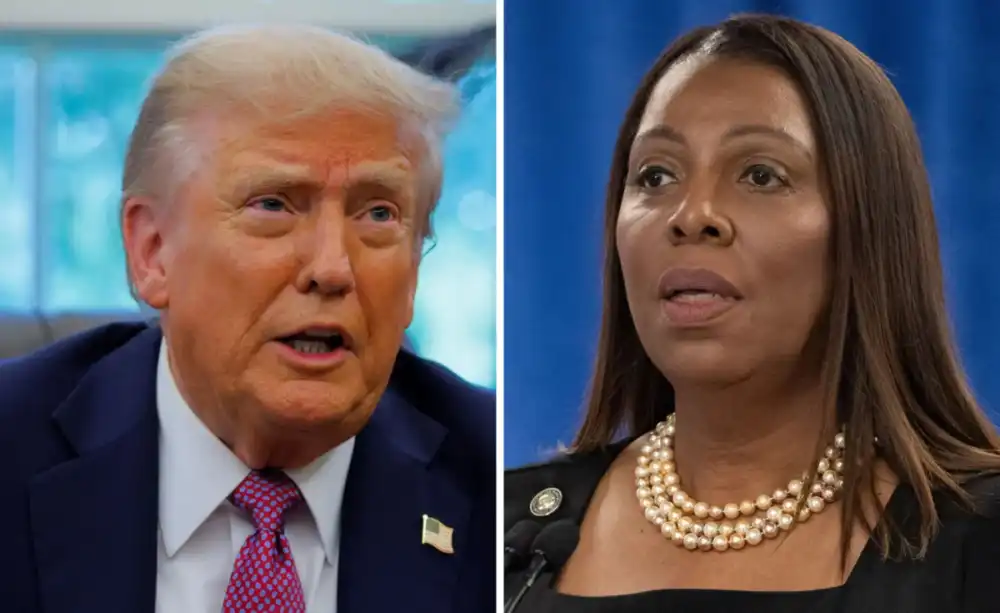
Adding a layer of personal and political drama to the legal proceedings is the long-standing friction between President Trump and Letitia James. The New York Attorney General has been a persistent legal antagonist to the President, and the two have been embroiled in various legal "entanglements" for years. Recently, the Department of Justice attempted to indict James on charges of bank fraud and making false statements—charges that were ultimately dismissed by a judge and rejected by two separate grand juries. While the White House maintains that its trade policies are based strictly on economic necessity, critics of the administration often view the aggressive tariff stance as part of a broader populist agenda that frequently clashes with the legal interpretations of state-level prosecutors.
The financial stakes of the lawsuit were underscored by a recent federal court ruling which determined that companies that paid the now-invalidated "Liberation Day" tariffs are entitled to billions of dollars in refunds. This precedent provides a powerful incentive for the 24 states to pursue their current claims aggressively. If the Court of International Trade finds that the Section 122 tariffs are similarly improper, the federal government could face a massive fiscal liability, further complicating the national budget and deficit projections.
As the case moves forward, the primary question for the judiciary will be whether the economic conditions of 2024 justify the use of a 1974-era monetary tool. While the administration points to the balance-of-payments deficit, the opposing states argue that the modern global financial system—characterized by floating exchange rates and complex digital capital flows—is fundamentally different from the world in which Section 122 was drafted. They contend that using such an antiquated law to justify a modern protectionist regime is a bridge too far for executive discretion.
In the interim, businesses across the United States are left to navigate a landscape of "calculated ambiguity." The possibility of a sudden 5% increase in the tariff rate, coupled with the potential for a court-ordered injunction or refund, makes financial planning nearly impossible for international traders. This atmosphere of uncertainty is, in itself, an economic headwind. Whether the Court of International Trade grants the states’ request to block the tariffs or allows the administration to proceed, the ruling will serve as a landmark moment in the history of American economic law, determining once and for all how much power a President truly holds over the flow of global commerce.