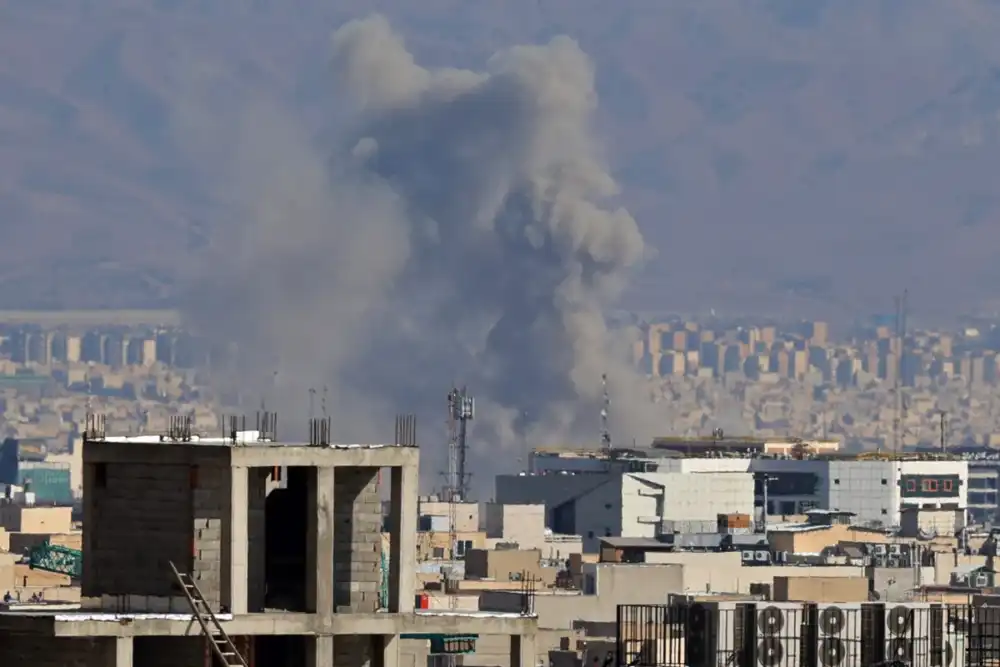
For much of the past decade, the prevailing narrative in global equity markets centered on the perceived "over-concentration" of the S&P 500. Investors and analysts frequently warned that the performance of the broader American market was overly dependent on a handful of mega-cap technology firms, often referred to as the "Magnificent Seven." In response, a massive wave of capital migrated toward emerging markets (EMs), as fund managers sought the sanctuary of diversification and the allure of superior growth prospects in developing economies. However, the recent escalation of military conflict between the United States and Iran has shattered the illusion of safety in the EM space, revealing a different but equally potent concentration risk that many investors overlooked.
The current crisis has forced a fundamental re-evaluation of what it means to be "diversified" in an era of heightened geopolitical friction. While investors fled the U.S. to avoid being tethered to a few Silicon Valley giants, they inadvertently concentrated their holdings in a different region: East Asia. The iShares MSCI Emerging Markets ETF (EEM), a primary vehicle for international exposure, has enjoyed a stellar run, posting a 29% gain in 2025. Yet, a forensic look at its underlying components shows that the index is not a broad representation of the "developing world" but rather a heavy bet on a specific technological corridor. Approximately 80% of the index is weighted toward Asia, with China, South Korea, India, and Taiwan accounting for more than three-quarters of the total allocation.
This geographical imbalance has created a systemic vulnerability that the U.S.-Iran conflict has brought to the fore. The conflict has not only threatened regional stability in the Middle East but has also triggered a seismic shift in global energy markets. Because the industrial powerhouses of East Asia are among the world’s largest net importers of crude oil and liquefied natural gas, any disruption in the Persian Gulf translates directly into a localized economic shock for the very stocks that dominate the emerging market indices.
The vulnerability is particularly acute within the technology sector, which now commands more than 30% of the total emerging market index weight. Unlike the software-heavy concentration seen in the United States, the Asian tech boom is rooted in hardware and high-end manufacturing. Companies like Taiwan Semiconductor Manufacturing Company (TSMC), Samsung Electronics, and SK Hynix are the backbone of the global artificial intelligence (AI) revolution. However, the fabrication of semiconductors and high-bandwidth memory (HBM) chips is an incredibly energy-intensive process. When energy costs spike, the margins for these industrial giants are squeezed, and the "AI premium" that investors paid for begins to evaporate.
South Korea’s financial markets have served as the "canary in the coal mine" during this period of heightened tension. This week, the KOSPI experienced unprecedented volatility, recording its worst single-day percentage drop in history on Wednesday as news of the escalating hostilities broke. The panic was driven by fears that an extended conflict would choke off energy supplies to Seoul’s industrial hubs. While the market staged a dramatic technical rebound on Thursday—its best performance since the 2008 financial crisis—the underlying scars remain. The iShares MSCI South Korea ETF (EWY) remains down nearly 13% for the week, illustrating how quickly gains can be erased when a concentrated portfolio meets a geopolitical black swan event.
The volatility in South Korea is also a byproduct of "overcrowding" in the retail sector. Last year, speculative fervor surrounding the AI supply chain drove SK Hynix up by a staggering 274%, while Samsung saw a 125% increase. As prices surged, retail investors piled into these names, creating a feedback loop of rising valuations. When the geopolitical outlook soured, the rush for the exits was equally synchronized, leading to the "flash crash" dynamics observed in recent trading sessions.
The energy dimension of this crisis cannot be overstated. As the conflict intensified, global oil benchmarks surged to levels not seen in years. Brent crude futures breached the $90 per barrel mark on Friday, while West Texas Intermediate (WTI) followed suit, closing the week with a gain of more than 30%. This energy squeeze has forced sovereign actors in Asia to take defensive measures. China, for instance, reportedly instructed its top refining companies to suspend all exports of diesel and gasoline this week, prioritizing domestic stockpiles over international trade. This move signaled to the global market that the era of cheap, reliable energy flow into the Asian manufacturing belt may be entering a period of significant disruption.

For investors, the lesson is clear: true diversification requires more than just moving money out of the United States; it requires a strategic "barbell approach." Market strategists are now arguing that the traditional emerging market portfolio is "top-heavy" and needs to be balanced with assets that benefit from, rather than suffer from, rising commodity prices. This has put a fresh spotlight on Latin America.
While Asian markets are struggling with the inflationary pressure of $90 oil, Latin American economies—specifically Brazil, Colombia, and Argentina—are positioned as major beneficiaries. These nations are significant exporters of energy and raw materials. In a scenario where the Middle East remains volatile, the "commodity tailwind" for Latin America becomes a powerful engine for economic growth. Analysts suggest that a resilient emerging market strategy should allocate between 25% and 33% of its weight to these commodity-rich regions to act as a hedge against the energy-importing risks of East Asia.
Furthermore, the "Latin American pivot" is supported by more than just oil prices. Several nations in the region are undergoing significant political and fiscal transformations. In Argentina and Brazil, reform-minded policies aimed at fiscal consolidation and market liberalization are beginning to take root. These reforms are expected to provide a long-term boost to the financial services and infrastructure sectors, which are currently trading at deep discounts.
From a valuation perspective, the argument for rebalancing toward Latin America is compelling. The price-to-earnings (P/E) ratios for many Latin American equities are roughly half those of the S&P 500. For context, while the Vanguard S&P 500 ETF (VOO) trades at a P/E of approximately 28, the Vanguard FTSE Emerging Markets ETF (VWO) trades at around 18. Within that EM bucket, the Latin American components often trade at even lower multiples, offering a significant "margin of safety" for value-oriented investors.
The current geopolitical climate suggests that the world is moving away from the era of hyper-globalization toward a more fragmented, "multipolar" economic reality. In such an environment, the risks of geographical concentration are magnified. An investor who is 80% exposed to Asia is essentially making a singular bet on the stability of the South China Sea, the Strait of Malacca, and the energy corridors of the Middle East. The U.S.-Iran conflict has demonstrated that this is a precarious position.
To navigate the remainder of 2026, the sophisticated investor must look beyond the simple "US vs. International" binary. The goal is to build a portfolio that can withstand a variety of macro shocks. This means maintaining exposure to the high-growth AI and tech sectors of Asia while simultaneously holding "inflation-positive" assets in Latin America. This balanced approach acknowledges that while Asia may own the future of technology, the path to that future is paved with commodities that are increasingly difficult to secure.
In conclusion, the volatility sparked by the U.S.-Iran war has provided a necessary wake-up call. It has exposed the fact that many "diversified" international funds were, in reality, highly concentrated tech portfolios with a heavy reliance on stable energy prices. As the geopolitical map continues to be redrawn, the "barbell strategy"—balancing Asian tech dominance with Latin American resource wealth—is no longer just an alternative theory; it is becoming a fundamental necessity for survival in the modern global economy. The search for returns continues, but the search for true diversification has never been more urgent.