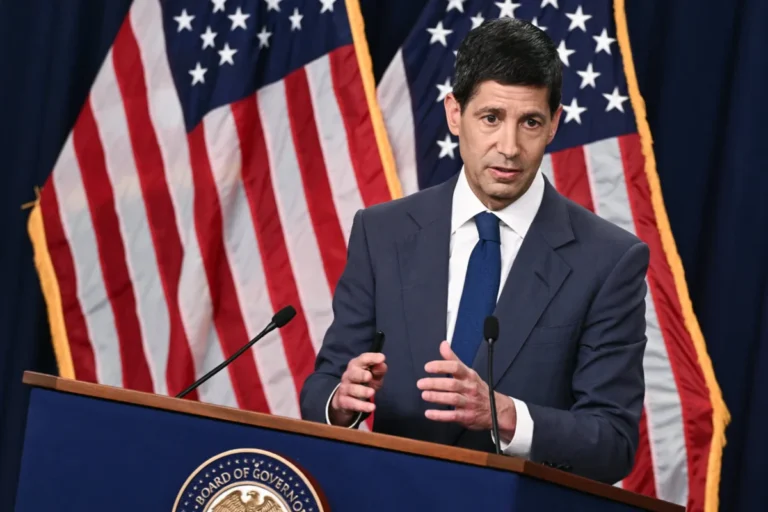
The United States labor market, long considered the bedrock of the post-pandemic economic recovery, has flashed a significant warning sign that is now reshaping the internal debate at the Federal Reserve. Following the release of a startling February jobs report, which revealed a contraction of 92,000 nonfarm payrolls, Federal Reserve Governor Stephen Miran has intensified his call for a decisive pivot in monetary policy. The decline, reported by the Bureau of Labor Statistics, represents a stark departure from the robust hiring patterns of previous years and suggests that the central bank’s prolonged stance of "higher for longer" interest rates may finally be exerting excessive pressure on the real economy.
In a series of public remarks addressing the data, Miran argued that the Federal Open Market Committee (FOMC) must now prioritize its mandate of maximum employment over its lingering concerns regarding inflation. For much of the past two years, the Fed has been locked in a battle against surging consumer prices, but Miran’s assessment suggests that the "inflation problem" has largely been resolved, or at least superseded by the risk of a systemic labor market downturn. He posits that the current monetary stance is no longer merely restrictive but potentially punitive to American workers and businesses.
The current federal funds rate, sitting in a target range of 3.5% to 3.75%, follows a series of three quarter-percentage-point reductions implemented in late 2025. While these cuts were intended to ease the transition toward a "soft landing," Miran contends they have been insufficient. From his perspective, the policy rate remains significantly above the "neutral" level—the theoretical interest rate at which the economy is neither being stimulated nor restrained. While the broader consensus among Fed officials at the December meeting pegged this neutral rate at approximately 3.1%, Miran’s calculations suggest a much lower threshold, arguing that the rate should be reduced by at least another full percentage point to reach a truly neutral posture.
The divergence between Miran and his colleagues highlights a growing rift within the central bank. Since his nomination by President Donald Trump to fill the unexpired term of former Governor Adriana Kugler, Miran has established himself as a prominent "dove" on the board. He has consistently dissented at FOMC meetings, frequently advocating for more aggressive 50-basis-point cuts when the majority opted for 25, and pushing for a cut in January when the committee chose to pause. This internal friction reflects a broader debate in economic circles: is the Federal Reserve moving too slowly to prevent a recession, or is it right to remain cautious to ensure inflation does not stage a resurgence?
Miran’s dismissal of current inflation concerns is rooted in a nuanced analysis of how price indices are calculated. He has argued that the stubbornly high inflation readings seen in recent months are less a reflection of actual price pressures in the economy and more an artifact of statistical "noise" and measurement methodologies used by the Commerce and Labor departments. A primary example cited by Miran involves portfolio management fees. Because these fees are often structured as a percentage of assets under management, a rising stock market naturally increases the dollar value of the fees charged to investors. In the consumer price index (CPI) and personal consumption expenditures (PCE) frameworks, this increase is often recorded as an inflationary spike in financial services, even if the underlying service rate remains unchanged. Miran views such data points as distortions that mask the reality of a cooling economy.
Furthermore, the geopolitical landscape has introduced new variables into the Fed’s calculus. The recent surge in global oil prices, driven by escalating conflict involving Iran, has pushed costs higher at the pump for American consumers. Traditionally, such supply-side shocks create a dilemma for central bankers: they raise headline inflation while simultaneously acting as a "tax" on consumers that can slow economic growth. Miran, however, maintains that the Fed should "look through" these fluctuations. Historically, energy-driven price spikes are viewed as one-off shocks rather than sustained inflationary trends. By focusing on "core" inflation—which strips out volatile food and energy costs—Miran argues the Fed can get a clearer picture of medium-term economic health, which currently points toward a need for more accommodation rather than restraint.

The labor market’s sudden turn in February has added a sense of urgency to this perspective. A loss of 92,000 jobs in a single month is rarely a contained event; it often signals a shift in corporate sentiment, where businesses transition from "labor hoarding" to active cost-cutting. If this trend persists, it could trigger a negative feedback loop: reduced employment leads to lower consumer spending, which in turn leads to further business contraction. The Fed’s dual mandate requires it to balance price stability with maximum employment, and Miran’s stance is that the scales have now tipped decisively toward the latter.
This policy debate is unfolding against a backdrop of significant institutional transition at the Federal Reserve. Miran’s own tenure is in a state of flux; though his official term expired in January, he continues to serve until a successor is confirmed. Meanwhile, the nomination of Kevin Warsh to a position that will eventually lead to the chairmanship—succeeding Jerome Powell, whose term concludes in May—suggests a potential overhaul of the Fed’s leadership philosophy. The incoming administration has made no secret of its desire for a more growth-oriented monetary policy, and Miran’s vocal advocacy for rate cuts aligns with that broader political and economic agenda.
Economists are now closely watching the upcoming FOMC meetings to see if the February jobs data will force a consensus shift toward Miran’s position. If the central bank remains hesitant, it risks being "behind the curve," a situation where interest rates remain high even as the economy enters a contraction. Conversely, if the Fed pivots too sharply and the labor market weakness proves to be a temporary blip, it could reignite the very inflation it has spent years trying to tame.
The global implications of the Fed’s next moves are equally profound. As the world’s reserve currency issuer, the U.S. central bank sets the tone for global liquidity. A more aggressive cutting cycle in Washington would likely weaken the dollar, providing relief to emerging markets burdened by dollar-denominated debt, but it could also export inflationary pressures to trading partners. In Europe and Asia, where growth has been sluggish, central banks are watching the Fed’s struggle with the labor-inflation trade-off as a harbinger of their own potential challenges.
For now, the focus remains on the domestic American worker. The 92,000 jobs lost in February are more than just a statistic; they represent a cooling of the American dream and a potential stall in the country’s economic engine. For Governor Miran, the path forward is clear: the restrictive era of monetary policy must end to prevent a cyclical downturn from becoming a structural crisis. Whether he can convince his colleagues to abandon their cautious approach in favor of a neutral—or even stimulative—posture remains the most critical question facing the U.S. economy this spring.
As the next FOMC meeting approaches, the "divided Fed" narrative is likely to dominate financial headlines. With Miran signaling a continued willingness to dissent if the committee does not act, the pressure on Chair Jerome Powell to find a middle ground has never been higher. The central bank finds itself at a crossroads, where the data of the past (inflation) is clashing violently with the data of the present (employment). In this high-stakes environment, Miran’s call for accommodation serves as a reminder that in the world of central banking, the only constant is the necessity of adaptation. "I hope that we vote to cut," Miran stated, reflecting a sentiment shared by many in the markets who fear that the window for a soft landing is rapidly closing. The coming weeks will determine if the Fed’s majority shares his sense of urgency or if they will hold their ground, betting that the February report was an anomaly rather than a new, darker reality.