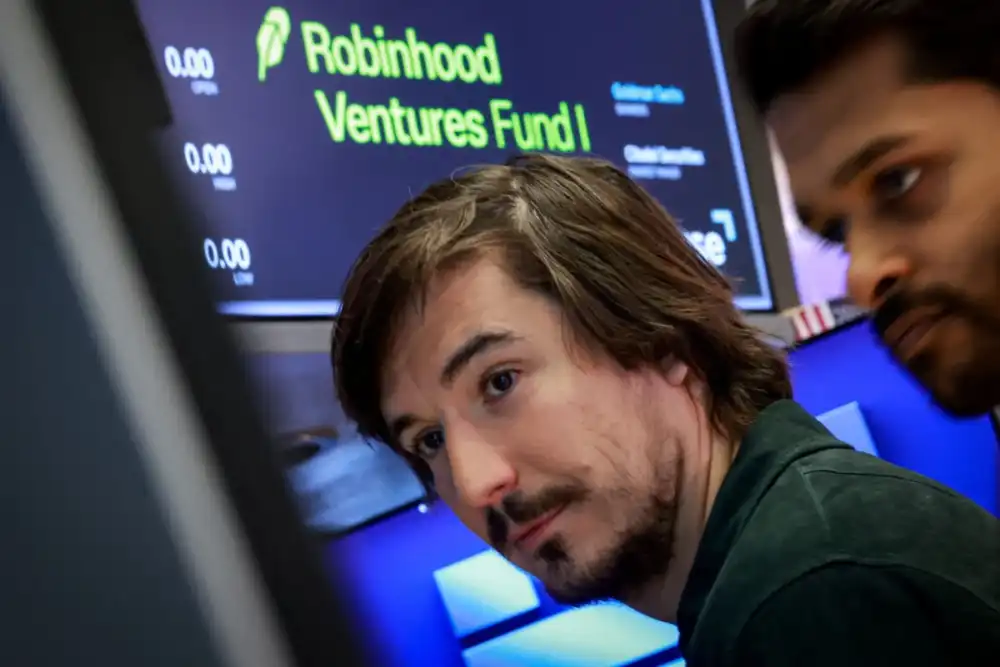
The ambitious attempt by Robinhood Markets to bridge the gap between Main Street and the exclusive world of private equity faced a sobering reality check on the New York Stock Exchange this week. Robinhood Ventures Fund I, trading under the ticker RVI, saw its shares plummet by 11% during its initial day of trading, signaling a cautious, if not skeptical, reception from an investment community currently grappling with heightened geopolitical instability and shifting macroeconomic priorities. While the fund’s launch was intended to be a landmark moment in the democratization of high-growth venture capital, the immediate price action suggests that the path to making private markets accessible to the masses may be fraught with more volatility than its architects anticipated.
The debut of RVI is the latest chapter in CEO Vlad Tenev’s broader strategy to evolve Robinhood from a mere brokerage app into a comprehensive financial services ecosystem. By offering retail investors a vehicle to own stakes in "unicorns"—private companies valued at over $1 billion—Robinhood is targeting a structural shift in how wealth is generated in the modern economy. For decades, the most significant value appreciation of tech giants and fintech innovators has occurred behind closed doors, accessible only to institutional players, sovereign wealth funds, and accredited investors. By the time many of these companies reach a traditional initial public offering (IPO), much of the exponential growth has already been harvested.
Tenev, speaking from the floor of the New York Stock Exchange, framed the fund’s mission in revolutionary terms, suggesting that the current system effectively locks out the average person from the most lucrative segments of the capital markets. He noted that as companies stay private longer, often reaching valuations in the hundreds of billions or even trillions before considering a public listing, the retail investor is left with the "scraps" of the growth cycle. The Robinhood Ventures Fund was designed to "blow the hinges off" these doors, providing a liquid, publicly traded wrapper for assets that are inherently illiquid.
The fund’s initial portfolio includes some of the most watched names in the global private sector. Among its holdings are Revolut, the London-based fintech titan that has disrupted traditional banking across Europe, and Databricks, the data and artificial intelligence powerhouse that remains one of the most highly anticipated IPO candidates in the software space. By pooling these assets into a closed-end fund structure, Robinhood allows investors to buy and sell shares on an exchange just as they would a stock, providing a daily exit ramp that is nonexistent in traditional venture capital.
However, the timing of the launch proved to be a significant headwind. Global markets have been on edge as tensions in the Middle East, specifically the escalating conflict between the United States and Iran, have triggered a flight to safety. In times of geopolitical uncertainty, the "risk-on" appetite required for venture-style investments typically evaporates. Investors often rotate out of speculative growth assets and into defensive postures, such as gold, Treasuries, or consumer staples. The 11% drop in RVI’s share price—falling from an IPO price of $25 to a close of $21—reflects this broader atmospheric anxiety.
Beyond the immediate geopolitical noise, the fund’s debut highlights a persistent challenge in the "democratization" of finance: the valuation gap. In the private markets, valuations are often determined by the most recent funding round, which may have occurred months or even years prior. These valuations do not fluctuate daily. In contrast, once a fund like RVI is listed on a public exchange, it is subject to the real-time sentiment of the market. This creates a potential disconnect where the "net asset value" (NAV) of the underlying private holdings may not align with the market price of the fund shares. On Friday, the market clearly signaled that it believed the entry price for these private exposures was too high given the current economic climate.
The struggle of RVI also invites comparisons to other attempts to bring private equity to the public. Closed-end funds and Business Development Companies (BDCs) have long existed, but they often trade at significant discounts to their net asset values. This "closed-end fund discount" is a well-documented phenomenon where investors demand a lower price to compensate for the lack of transparency in the underlying assets and the management fees associated with the vehicle. Robinhood’s challenge will be to prove that its brand and the quality of its "unicorn" portfolio can overcome these traditional structural hurdles.
From a broader economic perspective, the launch of the Robinhood Ventures Fund comes at a time when the IPO market itself has been relatively sluggish. High interest rates have increased the cost of capital, making investors more discerning about profitability over pure growth. For companies like Revolut and Databricks, staying private has been a strategic choice to avoid the quarterly scrutiny and volatility of the public markets. By creating a secondary market for these shares via RVI, Robinhood is essentially creating a "shadow public market," where the companies remain private in their governance but their value is continuously appraised by public traders.
Critics of the move argue that venture capital is inherently unsuited for retail investors due to its "long-tail" nature—where a few massive winners compensate for a high number of failures. They worry that retail traders, who may lack the long-term horizon of institutional venture capitalists, could be caught in downward spirals during market corrections. Furthermore, the fees associated with managed funds can eat into returns, a point of contention for a platform that built its reputation on "commission-free" trading.
Despite the rocky start, Robinhood’s foray into asset management represents a significant maturation of the company’s business model. Following the "meme stock" frenzy of 2021, the company has worked aggressively to diversify its revenue streams, moving into retirement accounts, credit cards, and now, institutional-grade investment products. The success or failure of RVI will likely serve as a bellwether for other fintech firms looking to provide "alternative" asset classes—such as real estate, fine art, or private debt—to a wider audience.
As the first day of trading concluded, the message from the floor was one of resilience mixed with caution. While the price drop was a clear setback, the volume of trading suggested that there is indeed an appetite for this type of product, even if the initial pricing was off the mark. For the retail investors who bought in at the open, the 11% loss is a stark reminder that the "democratization" of finance involves the democratization of risk just as much as the democratization of opportunity.
Looking ahead, the performance of the Robinhood Ventures Fund will be closely tied to the broader recovery of the tech sector and the eventual reopening of the IPO window. If companies like Databricks eventually go public at valuations higher than those held within the fund, the RVI shares could see a significant upward correction. Conversely, if the private market "bubble" continues to deflate under the pressure of sustained high interest rates, the fund could face further downward pressure.
In the final analysis, Robinhood’s venture fund is a bold experiment in market structure. It challenges the traditional gatekeeping of the financial elite and tests whether the public market can effectively price assets that were never meant to be liquid. While the first day on the NYSE was a bruising encounter with reality, the long-term viability of the fund will depend on whether Robinhood can convince its millions of users that the volatility of the private markets is a price worth paying for a seat at the table of the next generation of global industry leaders. For now, the "hinges" may be off the doors, but the investors walking through them are finding a room that is much more turbulent than they were promised.