

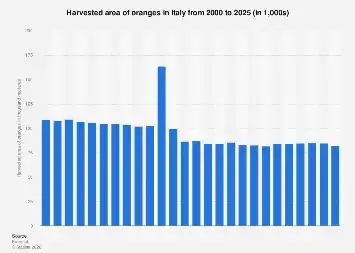
The Italian citrus sector, a cornerstone of the nation’s agricultural output and a significant contributor to its culinary identity, is undergoing a discernible transformation in its cultivated land dedicated to oranges. While specific, granular data on the exact harvested area for oranges in Italy requires specialized market intelligence access, broader agricultural trends and historical patterns offer insights into the dynamics affecting this vital crop. The cultivation of oranges in Italy is not a static entity; it is a responsive sector influenced by a complex interplay of market demands, climate variability, disease pressures, and evolving agricultural policies. Understanding these forces is crucial for grasping the current and future trajectory of Italian orange production.
Italy’s orange-growing regions, primarily concentrated in the southern parts of the country, including Sicily and Calabria, have long been celebrated for the quality and diversity of their citrus varieties. These areas benefit from a Mediterranean climate conducive to citrus cultivation, with warm summers and mild winters. However, the Mediterranean basin itself is experiencing the impacts of climate change, with rising temperatures, altered rainfall patterns, and increased frequency of extreme weather events. These climatic shifts can directly affect orange yields, fruit quality, and the optimal timing for planting and harvesting, potentially leading to adjustments in the land allocated to the crop.
Beyond environmental factors, economic considerations play a paramount role in determining the acreage dedicated to any agricultural product. The global demand for oranges, both for fresh consumption and for juice production, fluctuates. Italy, as a major European producer, must remain competitive in a global market that includes large-scale producers from Spain, Turkey, Egypt, and North Africa. The profitability of orange cultivation, influenced by input costs (fertilizers, labor, water), global commodity prices, and trade agreements, directly impacts farmers’ decisions regarding crop allocation. If returns are perceived to be lower for oranges compared to other potential crops like olives, grapes, or vegetables, farmers may opt to diversify or switch their land use.
Furthermore, the persistent threat of citrus greening disease (Huanglongbing), though more prevalent in other parts of the world, remains a background concern for citrus growers globally. While Italy has maintained stringent phytosanitary controls to prevent its introduction, the economic and horticultural impact of such diseases in other major producing nations can create market uncertainties and influence planting decisions. Farmers might be inclined to reduce their exposure to potentially vulnerable crops, opting for more resilient alternatives or diversifying their citrus varieties to include those with perceived lower disease susceptibility.
The European Union’s Common Agricultural Policy (CAP) also exerts a significant influence on agricultural land use across member states, including Italy. CAP reforms, subsidy structures, and environmental regulations can incentivize or disincentivize the cultivation of certain crops. Support for sustainable farming practices, organic production, or specific regional specialties can steer farmers towards particular choices. For instance, incentives for organic orange cultivation could lead to an increase in dedicated acreage if market demand and profitability align. Conversely, stringent environmental regulations or reduced subsidies for traditional farming methods might prompt a reevaluation of land use.
Looking at broader European agricultural statistics, it’s evident that many Mediterranean countries face similar challenges and opportunities in their citrus sectors. Spain, a dominant force in European citrus, often sets benchmarks for production levels and market trends. Any significant shifts in Spanish production – whether due to weather, disease, or policy – can have ripple effects across the continent, influencing import and export dynamics and, consequently, affecting Italian producers’ strategic decisions. Similarly, understanding the import volumes of oranges into Italy from non-EU countries provides context for domestic production levels and the competitive landscape.
The statistical data, when accessible, would likely reveal nuanced shifts rather than a dramatic collapse or surge in orange acreage. It might show a gradual decline in areas dedicated to less profitable or more disease-prone varieties, coupled with potential growth in regions focusing on high-quality, niche varieties or organic production. The consolidation of smaller farms into larger, more efficient operations could also play a role, as these larger entities may have greater resources to invest in modern cultivation techniques, pest management, and market access, potentially influencing their planting strategies.
The economic impact of even minor fluctuations in orange acreage can be substantial. Oranges are not merely a crop; they are integral to regional economies, supporting a complex value chain from cultivation and harvesting to processing, packaging, distribution, and retail. Jobs in rural areas are directly linked to citrus farming. A decline in harvested area can translate to reduced employment opportunities, a decrease in the demand for agricultural inputs, and a ripple effect on related industries. Conversely, an expansion, driven by innovation or strong market demand, can stimulate economic growth and create new employment.
The perception of the Italian orange sector is also shaped by its contribution to the country’s agrifood heritage and its role in export markets. Italian oranges are valued for their distinct flavor profiles and are often associated with premium quality. Maintaining and potentially expanding the acreage of high-quality oranges is crucial for preserving this international reputation and for capturing value in export markets that often pay a premium for such characteristics. This necessitates continuous investment in research and development, focusing on disease-resistant varieties, improved cultivation techniques, and sustainable practices that resonate with increasingly conscious global consumers.
In conclusion, while precise figures on Italy’s current orange harvested area require specialized data, the underlying economic, environmental, and policy drivers point towards a dynamic and evolving landscape. The sector is likely navigating a path of adaptation, balancing market demands, climate challenges, and the need for sustained competitiveness. The decisions made by Italian farmers regarding orange cultivation will continue to be shaped by a complex web of factors, influencing not only the availability of this beloved fruit but also the economic vitality of the regions where it is grown. The future of Italian orange acreage will depend on the sector’s ability to innovate, adapt to changing conditions, and effectively leverage its reputation for quality in an increasingly globalized and environmentally conscious market.